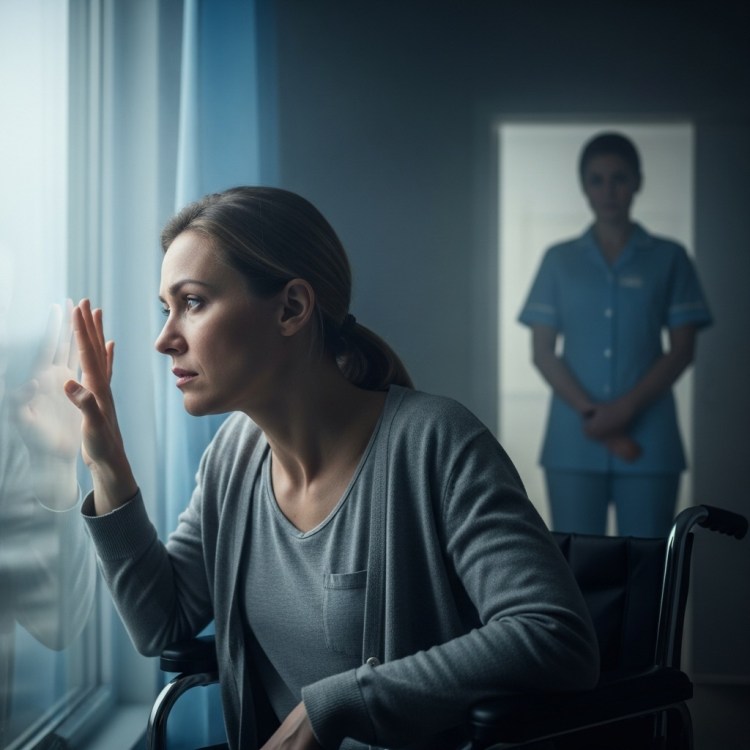
Lucinda Ritchie previously lived in her own adapted bungalow in Billingshurst, West Sussex. She was admitted to hospital with pneumonia last April, but 10 months later, she was not allowed to return home.
Instead, this February, she was taken to a nursing home in Uckfield – an hour from her home and family. Within two days of being there, her condition worsened, and she was returned to the hospital.
NHS Sussex said it was “committed to working with Lucinda and her family to make sure she receives high-quality and safe care to meet her needs”.
Neil Allen, an independent barrister, told the BBC it was “very unusual” for an adult with full mental capacity to be moved to a residential home against their will, as it was “totally unlawful”.
The NHS has denied that funding considerations played any role in the decision-making around Ritchie’s care, saying it was based on her clinical safety.
But Allen said disputes over the funding of people’s healthcare packages were happening up and down the country all the time.
“That is a national issue at the moment,” he explained.
Ritchie has Ehlers-Danlos syndrome, a condition that affects the joints; functional neurological disorder, which affects her mobility; Addison’s disease, a hormonal disorder; and epilepsy.
She has a tracheostomy and sometimes uses a ventilator. Able to speak when she was younger, she has mostly used eye-gaze technology to communicate since 2017.
Before her hospital admission, Ritchie had 24‑hour one‑to‑one nursing funded in her own home by NHS Continuing Healthcare (CHC).
She was studying for a master’s in sustainability at Southampton University, as well as acting as a charity ambassador and keynote speaker.
In 2023 and 2024, Ritchie was recognised as one of the most influential disabled people in the UK for her pioneering work supporting communication using eye movement.
She was admitted to East Surrey Hospital last April with pneumonia and suffered further complications, which prolonged her stay.
She wanted to be discharged back to her own home, but this did not happen.
Instead, her mother Christine Ritchie says care commissioners at NHS Sussex All Age Continuing Care (AACC) told them Ritchie would be going to a nursing home.
Ritchie refused.
On the day she was transferred, Ritchie told the BBC she was “devastated” and wanted to get back to her own home.
More recently, she explained: “In my own home, with my nurses, I feel safe and can see my friends and family easily.
When she was taken from East Surrey Hospital to Temple Grove Nursing Home, Ritchie’s mother said her powered wheelchair was “switched off and pushed”.
“She didn’t consent to go,” she told the BBC. “It’s absolutely horrific.”
If a person has the capacity and can communicate what they want, then these people should not be able to control their lives.
Due to her disability, this woman shouldn’t have been denied the opportunity to live in her own home. Her human rights are being violated, and a nursing home is not the proper setting for her.
By refusing to pay for any other option—in this example, nursing care in her own home—they can coerce you into entering a nursing home. They can claim that it’s her own decision, but in practice, there isn’t a choice. They then contend that they have provided a suitable and secure care placement, and that the individual has the option to reject it, absolving them of all accountability.
 THE MONTHLY MOSQUITO