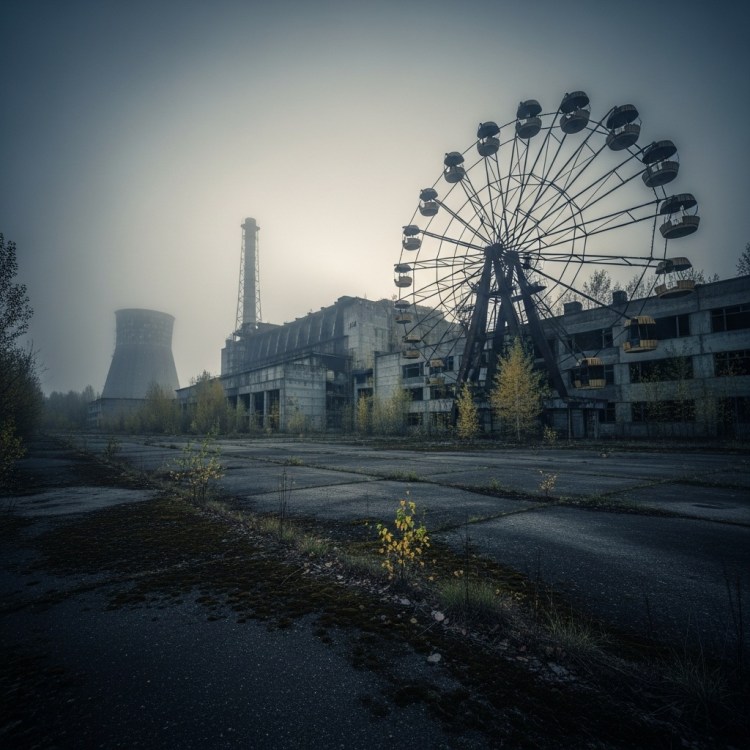
A frozen world, sealed in time. Earth, as it was known, changed on April 26, 1986, at 1.23 am, when the night split open.
Inside Reactor No. 4 at the Chernobyl Nuclear Power Plant, a routine safety test spiralled into disaster.
What ensued was the worst nuclear catastrophe in history. Almost 50,000 inhabitants of nearby Pripyat were evacuated within hours, many told they would return in a few days. Most never did.
Today, four decades on, the Chernobyl Exclusion Zone (CEZ) – a vast, restricted area spanning approximately 2,600sq km – remains one of the most haunting places on Earth.
Nature has returned. Tower blocks that are disintegrating are swallowed by forests. With schoolbooks still open, tables still arranged, and chalk on the blackboards, classrooms are precisely as they were when they were left.
Only the wind and the far-off crackling of Geiger counters break the complete quiet, and yet, despite the creepy silence, the zone is not completely empty.
The people who refuse to vacate the radioactive site, known as the ‘samosely’, are self-settlers who returned illegally to their homes following the disaster.
Among the most polluted structures is the Pripyat hospital, where the first firefighters were treated. Amidst the turmoil, medical equipment and protective clothes were left behind.
Deep inside the power plant complex itself, corridors once bustling with engineers are now dark and heavily controlled, with peeling paint, exposed wiring and lingering radiation hotspots.
Preserved as stark memories of the moment everything went wrong, the control rooms, which were previously full of bright lights and anxious voices, are now hauntingly quiet.
They have refused to leave the land they had lived on for decades.
The majority are old. Many rely on small-scale farming and imported goods to survive without access to modern services.
As of recent calculations, fewer than 200 remain, their numbers decreasing with time.
About 80 per cent of the re-settlers are women, now aged in their 70s and 80s.
Authorities once attempted to remove them. Now, they are tolerated – ghosts living among ghosts.
In nearby villages, deserted hospitals and schools loom over the empty streets. They remain untouched since the chaos of the nuclear meltdown.
Inside the abandoned city of Pripyat, the Ferris wheel in the amusement park stands stationary, its yellow carriages deteriorating in silence, never having carried a single rider after it was due to open just days after the disaster.
Apartment blocks loom like hollow shells, their windows blown out or dimmed with dirt, while curtains still hang in places, gently moving with the drafts that move through broken glass.
In kindergartens, rows of tiny metal beds remain neatly arranged, and gas masks are spread across the floor – haunting relics of preparations that came too late.
Schoolrooms are littered with rotting textbooks, Soviet propaganda posters peeling from the walls, and exercise books still marked with children’s handwriting frozen in time.
The railway station in the neighbouring town of Yaniv is a mute testimony to the enormous exodus that took place in a matter of hours, with its lines overgrown and its platforms abandoned.
Villages such as Zalissya and Opachychi stand half-reclaimed by woodland, where houses collapse inward, and fruit trees still bloom each spring with no one left to harvest them.
As nature gradually reclaims the ground, roads that formerly connected villages are bent and fractured, and trees are pushing their way through the asphalt.
Street signs remain in place, pointing towards towns that no longer function, their names faded but still readable underneath layers of rust and moss.
Inside abandoned shops, shelves lay empty save for the occasional fragment of packaging, a reminder of lives interrupted mid-routine.
Personal belongings – shoes, toys, photographs – are spread across floors, often precisely where they were left in the rush to evacuate.
The swimming pool in Pripyat, once an epicentre of activity, remained in use for years after the tragedy for cleanup workers, but now sits empty, its tiles broken and its roof partly collapsed.
Soviet-era paintings that depict an idealised future that never materialised nevertheless adhere to the walls of certain structures.
Many buildings are severely unstable, with lifts stuck mid-shaft, stairwells blocked with debris, and whole floors fallen in some locations.
Chernobyl’s unfinished colossi – two cooling towers – are also observable from miles around.
The enormous concrete cylinders protrude from the dead ground, strewn with pieces of metal of variable shapes and sizes.
At the very top, four levels of scaffolding cling to the rim. The intricate structure has somehow managed to survive despite the years of harsh weather it has endured.
Yet, far from being totally deserted, life enters the Exclusion Zone on a daily basis.
Around 3,000 workers rotate in and out – engineers, scientists and technicians overseeing the slow dismantling of the ruined reactor and maintaining the vast steel confinement structure that now cages it.
The concrete sarcophagus that entombed Reactor No. 4 is surrounded by the New Safe Confinement (NSC), which houses the containment operations and nuclear waste management conducted by the Ukrainian government.
During the cleanup after the explosion, teams of men called liquidators tested and washed everything inside the Exclusion Zone.
Anything considered too contaminated to be washed – such as the entire Red Forest, so named because the pine trees absorbed so much radiation that they turned red, and all the houses in the town of Kopachi – was demolished and buried underground instead.
Nobody lives there permanently – except those who chose to return.
When Russian troops invaded Ukraine on February 24, 2022, they did so through the Exclusion Zone surrounding the ruins of Chernobyl.
The Russian army occupied the immediate area surrounding the defunct plant for over five weeks, causing an estimated $54million in damage to the Exclusion Zone and the New Safe Confinement.
The Russian army occupied the immediate area surrounding the defunct plant for over five weeks, generating an estimated $54 million in damage to the Exclusion Zone and the New Safe Confinement.
The site of the disaster was a logical base for over 1,000 Russian troops, as the NSC houses electrical operations that connect to Kyiv’s main power grid, and aerial attacks from Ukraine would be unlikely.
Regular troop and vehicle movements inside the CEZ disrupted the site’s nuclear radiation by agitating dirt and dust, which released more radioactive particles into the atmosphere.
In addition to looting and destroying much of the lab and computer equipment located inside the NSC, the Russian army also cut electrical power to the plant, making the cooling of the deteriorating nuclear material unreliable.
But perhaps the most disturbing legacy of Chernobyl is not the reactor, nor the ruins, but the animals left behind.
When residents fled in 1986, they were forced to abandon their pets. Many were subsequently culled to stop the spread of contamination.
But some survived, and their descendants still roam the zone today.
There are now hundreds of semi-feral dogs living among the ruins, clustered around the power plant, checkpoints and deserted towns.
Images of luminous eyes, contorted bodies, and radiation-warped creatures have become part of Chernobyl legend, along with stories of mutant canines.
The truth is more complicated and, in many respects, more disturbing.
According to studies, isolation, inbreeding, and environmental pressure have formed these canines’ genetic differences from populations beyond the zone.
Some show signs of evolutionary change – genes linked to DNA repair and survival in harsh conditions – but scientists are cautious.
Contrary to common belief, there is no concrete proof of severe radiation-induced mutations.
Instead, what is occurring is slower and quieter – natural selection at work in one of the most contaminated environments on Earth.
Even the viral pictures of blue dogs seen in recent years were not the result of radiation, but probably caused by chemicals they had rolled in.
Still, the idea lingers as Chernobyl feels like the type of place where such things should exist.
The exclusion zone is now an unintentional test. Ecosystems have recovered since people left. However, radiation is still present in the water, the soil, and the landscape itself.
The area behind the power plant, called the ‘Red Forest’ is one of the most radioactive areas on Earth.
Some estimates suggest part of the Exclusion Zone may stay unsafe for hundreds to thousands of years, but animals live, reproduce and die here nonetheless.
The dogs – descendants of abandoned pets – are possibly the most poignant symbol of that contradiction. Life continues in a place defined by disaster.
Chernobyl is no longer just a disaster site. It is a warning, a wilderness, a graveyard – and strangely, a refuge.
A place where humans vanished, but life did not.
It was said that in 2018, 34 dogs were adopted into the US and Canada. There is publicly no proof that the 34 Chernobyl dogs adopted into the US and Canada in 2018 suffered radiation-related illness or failed to thrive because there were no follow-up studies or news reports.
What we do know is that in 2018, there was an adoption program. It was called the Clean Futures Fund (CFF), and it ran a program to vaccinate, sterilise, and rehome a small number of puppies from the Cernobyl Exclusion Zone. These puppies were allowed to be adopted abroad because the puppies had lower radiation exposure than adult dogs. They underwent radiation screening, veterinary checks, and decontamination before travel, and only dogs that met stringent safety thresholds were cleared for export.
Nevertheless, no scientific or journalistic follow‑up has tracked the health of those specific 34 dogs after adoption. This is a genuine information gap — not something concealed, just something never studied or reported.
However, what we do know about Chernobyl dogs in general is that in recent scientific studies, there has been an insight into the health of dogs still living in the Exclusion Zone, and dogs in the zone reveal genetic differences from normal dog populations, likely due to long-term radiation exposure.
Researchers have discovered distinct populations of dogs living near the reactor vs. in Chernobyl City, with limited interbreeding.
Studies suggest chronic radiation exposure may increase risks of cancer, immune system changes, and decreased lifespan, though research is ongoing. Despite this, numerous dogs in the zone are surviving and even thriving behaviourally, forming stable populations and adapting to extreme conditions.
These findings apply to dogs still living in the zone, not the exported puppies, who had far lower exposure.
Can You Visit Chernobyl Today?
All credible, up‑to‑date sources agree that Chernobyl is presently closed to tourists due to the ongoing Russia–Ukraine conflict, and has been since early 2025. Authorised tourism will only resume once the security situation stabilises.
Tours have been suspended since early 2025 because of military activity in the region.
According to the most recent information, only state and military delegations are permitted entry to the Exclusion Zone, which is still prohibited to ordinary tourists.
Due to the conflict and potential building damage from the occupation, travel guides affirm that Chernobyl is off-limits.
When tours were operating, the radiation exposure on approved routes was low — approximately equivalent to a short flight (5–7 μSv/day).
If tourism continues in the future, expect stringent supervision and compulsory guided tours, passport control and restricted entry zones. Protective clothing (long sleeves, long trousers, closed shoes), and avoiding dangerous structures — numerous buildings are collapsing and are hazardous.
Will Chernobyl reopen to tourists? Well, tour operators are optimistic, but there is no timeline, and safety inspections of the zone and infrastructure will have to be satisfied first.

