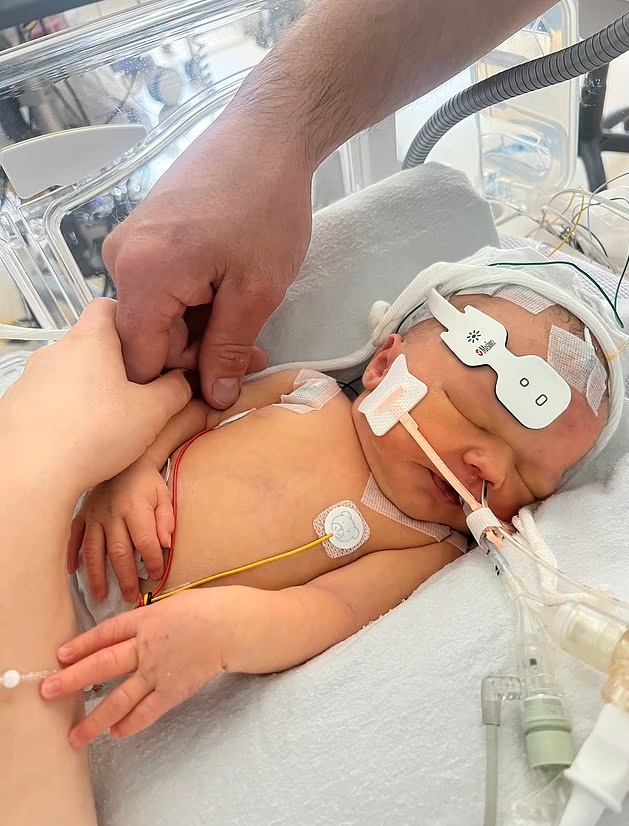
A midwife positioned a ‘blue and floppy’ newborn on her mother’s chest and said ‘there’s your baby’, an inquest has heard.
Following problems during a scheduled home delivery with the Edgware Midwives home birth team, Poppy Hope Lomas was taken to the hospital and died at the age of seven days.
Barnet Coroner’s Court heard Gemma Lomas was not properly consulted about the risks surrounding the natural delivery of her second child, having delivered her first daughter, Willow, via caesarean section.
Ms Lomas described how midwives were slow to react when Poppy was born ‘blue and floppy’. Doctors from University College Hospital in London later discovered the baby girl had been ‘starved of oxygen’ for ‘around seven to eight minutes’.
In a witness statement read out by her lawyer, Teresa Hargreaves, Ms Lomas said: ‘The midwife placed Poppy on my chest and said, “There’s your baby”.
‘Poppy was blue and floppy. There was blood coming out of her mouth, and her head fell back. That’s a horrific memory that sticks in my mind, being handed my dead baby.
‘I said “there’s something wrong”, but the midwives moved very slowly, there was no sense of urgency.’
The inquest heard Alice Boardman, who was head midwife at Edgware Midwives, had encouraged a vaginal birth after caesarean (VBAC) at home but failed to explain the potential risks.
In her statement, Ms Lomas said: ‘I immediately trusted Alice. She was young, and I felt like she was really advocating for me. She was very upbeat and said, “Let’s go for this.”
‘VBACs were something they did every day. She said they’d just delivered a lady with a VBAC with twins.
‘She said that, because of my previous C-section, I’d have to “jump through a few hoops” and speak to their consultant.
‘I was very much led to believe that the conversation I’d be having with their consultant was just a tick box exercise and there was no good reason I could not have a VBAC at home.’
VBAC deliveries should take place in a ‘suitably staffed and equipped delivery suite’ and ‘with resources available for immediate caesarean delivery’, according to guidance from the Royal College of Obstetricians and Gynaecologists (RCOG).
Poppy was rushed to the hospital after the midwives, who are the designated home birth team at Barnet Hospital, told Mr Lomas to ring 999.
After Poppy’s brain was scanned, Dr Giles Kendall, a consultant neonatologist, described the scan as ‘one of the worst that he’d seen in his career’, according to Ms Lomas’s statement.
Dr Kendall believed Poppy had been ‘starved of oxygen for a long time’, Ms Lomas said, while Ms Boardman estimated it to be around seven to eight minutes.
Ms Lomas said: ‘I still don’t understand how she was without oxygen for so long when the midwives were supposedly monitoring her heart rate.’
Poppy, who had been a healthy baby throughout the pregnancy, died aged seven days old when her breathing tube was removed. Ms Lomas said: ‘That was the worst week of our lives. We knew she wasn’t going to make it.’
The inquest, conducted by senior coroner Andrew Walker, heard midwives also dismissed Ms Lomas’s complaints of pain from her previous C-section scar, including Ms Boardman.
Ms Lomas said: ‘I complained my scar was hurting. It was tight and was starting to really hurt. It felt like it was stretching rather than ripping.
‘I remember saying that it really hurt when she was pushing the Doppler (a handheld ultrasound device used to monitor a baby’s heart rate) hard against my stomach and asking her to stop.
‘She said: “I need to do this, it’s important.’
RCOG guidance states practitioners should be cautious when managing deliveries involving uterine scars, as there is a one in 200 risk of uterine rupture.
Ms Lomas said losing Poppy was even harder to deal with as the baby had been healthy during pregnancy.
She said: ‘She was perfectly fine inside me. She had no defects or problems. It was just those final moments of her birth.
‘That makes her loss even harder to deal with. The fact that it all happened in our home, a place where we should feel safe, has also made the trauma so much worse.’
Edgware Midwives is the designated home birth team at Barnet Hospital, which is part of the Royal Free London NHS Foundation Trust.
A Royal Free London spokesperson said: ‘Our heartfelt condolences remain with Poppy Lomas’s family at this incredibly difficult time.
‘An investigation into the care provided to Ms Lomas and to Poppy has been carried out, and the findings shared with the Lomas family.
‘We await the outcome of the inquest and will carefully review any matters which are raised.’
All births should be conducted in a hospital, regardless of choice, because if anything goes wrong in a hospital, there is always a team of professionals immediately available for mother and baby.
Home births are not safe because there is no life-saving equipment and medical professionals to help.
Numerous deliveries result in post-partum haemorrhages, and if not conducted in a hospital setting, would likely have resulted in the mother or baby not surviving.
There is a reason women started having babies in hospitals, and I can’t believe that some women still prefer this route, unless there simply is not enough time to get the mother to the hospital. However, the hospital is the more suitable option because there are things you can never plan for during birth.
It is appalling what happened here. I understand that they were from the NHS Midwifery Team, but it is disgusting how casual these caregivers were, especially given the years of experience they must have evidently had. I just hope this case is not buried in reams of paperwork because this needs to be spotlighted. After all, a baby died in their care, and these parents will have to relive this trauma for the rest of their lives.
 THE MONTHLY MOSQUITO