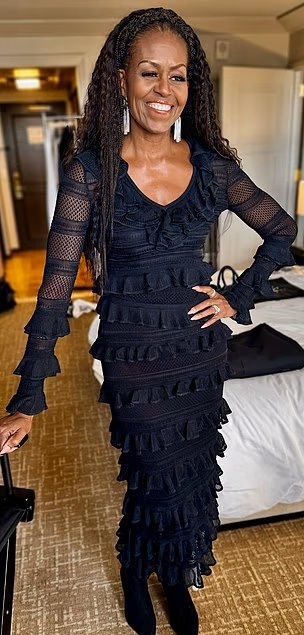
Michelle Obama was photographed looking noticeably slimmer during a Beverly Hills dinner with daughters Malia and Sasha, and Barack Obama’s absence at the outing has certainly fueled renewed online speculation about their marriage — but the available reporting reveals no documented evidence of a split, only public chatter and commentary.
Michelle Obama, 62, dined with Malia (27) and Sasha (24) at Funke, a celebrity‑frequented Beverly Hills restaurant. She appeared visibly thinner than in prior months, sporting an everyday trucker jacket, fitted Henley top, and light‑wash jeans. Barack Obama, 64, was not attending because he was in Austin, Texas, speaking at an event or campaigning, depending on the outlet.
Her slimmer appearance reignited speculation about Ozempic/GLP‑1, though no evidence supports those assertions.
The couple’s different schedules, combined with Barack’s recent remarks about “tension” at home, have heightened public speculation, not verified facts.
Recent reporting highlighted several factors: that Barack Obama told The New Yorker that Michelle wanted him to slow down and spend more time with her, acknowledging ‘genuine tension’ in their household.
Michelle has openly discussed difficult periods in their marriage before, saying that there were ten years when she couldn’t stand her husband, and Michelle missed two high-profile events Barack attended alone in January 2025, which the tabloids seized on. Of course, none of this constitutes proof of a separation; it only reflects public interpretation, not oK’d information.
No outlet reports a breakup, separation, or divorce. There is no medical or personal explanation for Michelle’s weight change that has been confirmed. There is no credible source that supports the Ozempic rumours, and there is no insider confirmation of any marital trouble beyond what the Obamas themselves have publicly admitted about normal long-term relationship strain.
The predictable, well-established language and narrative patterns used in tabloid coverage of celebrity weight fluctuations sexualise women, perpetuate weight stigma, and portray bodies as public property. This then shapes public perspectives and reinforces toxic norms.
Media coverage portrays weight as a personal failure or moral flaw, which it is not.
Weight framing is wrong. It’s socially constructed, politically convenient and scientifically illiterate.
Weight is not a personal virtue test. It’s influenced by dozens of factors outside individual control, including genetics, medication, disability and chronic illness, stress, trauma, and cortisol, and numerous other factors.
None of these is ‘willpower,’ but media narratives pretend it’s all about discipline because that story is simple, blame-heavy, and it sells.
Moral framing obscures the real structural problem – if weight is ‘your fault’, then governments don’t have to address food deserts. Employers don’t have to fix low wages or long hours. Councils don’t have to build safe parks or pavements. Healthcare doesn’t have to face bias, and the media doesn’t have to stop profiting from shame, so they blame the individual to protect the system.
And the cruel irony is that the people doing the shaming know better, but they still shame and judge ordinary people for simply existing in public.

