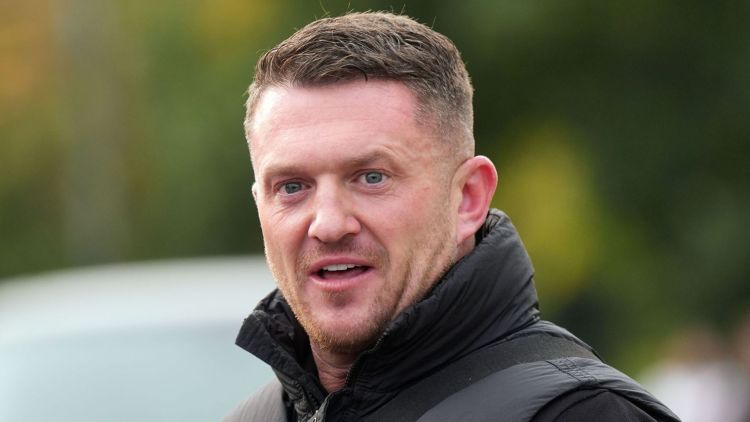
Far-right activist Tommy Robinson has said he would ‘stop Islam’ if he ever became prime minister.
Speaking at Saturday’s far-right anti-Islam march, the organiser, whose actual name is Stephen Yaxley-Lennon, said it was time for ‘Muslims to leave this country’ and vowed to stop Islam if he ever came to power.
Of course, Tommy Robinson is never going to become prime minister because in the UK, you have to be an MP (elected to the House of Commons) and be the leader of a party that can control a majority in the Commons.
However, in the abstract, he could stand for election, win a seat, lead a party, and control a majority, but that’s where the visionary possibility concludes.
For Tommy Robinson to become prime minister, all of the following would need to happen. He would have to win a parliamentary seat. He would need to become a leader of a major party or build a new one. That party would need to win a general election, and he would need to command the confidence of the House of Commons.
Each of those steps is exceedingly far-fetched, and all four together are virtually unattainable.
Some figures with extreme or fringe politics achieve traction in public debate, but not in electoral politics, and in the UK, the gap between online influence and actual political power is immense.
Tommy Robinson might be effective in particular online spaces, but that doesn’t translate into institutional power.
Tommy Robinson’s comments at the weekend were clearly incendiary, but he’s only voicing what many people are feeling; he’s got the guts to say it.
For many years now, Tommy Robinson has framed Islam as a civilisational threat.
Islam as a religion is not a ‘civilisational threat’ to the UK, but this needs to be unloaded appropriately, and Islam, the religion, is not deemed a threat by MI5, the Home Office or any major security body. However, Islamist extremism, which is a political ideology, is deemed a threat, and of course, there are concerns about immigration, identity, and cohesion.
Of course, not all Muslims are terrorists, but unfortunately, the whole area gets obscured by rhetoric.
The majority of Muslims in the UK and globally are just regular people living regular lives, with no connection to violence or extremism.
Violent extremist groups like ISIS, Al-Qaeda, Boko Haram, et cetera, are the ones that are responsible for this enormous harm and human rights violations. Still, they represent only a tiny fraction of the world’s 1.9 billion Muslims.
Of course, like in every country, the UK has a small number of individuals who hold extremist views, but they’re a tiny minority. However, minority or not, they are still very dangerous, and they are indoctrinated, but not in a way the internet often frames it, but they do indeed target people for indoctrination, recruitment, and radicalisation, and they target whoever they believe they can exploit.
The indoctrination doesn’t depend on race; it depends on susceptibility, and the recruiters look for people who feel alienated or angry. People who feel humiliated or vulnerable. People who want to belong or have uniqueness. People who are socially secluded, and people who are already consuming polarising content, and colleges and universities are a good hunting ground for this.
Then there is online radicalisation, making targets even easier. White teenagers in the UK, US, and Europe become primary targets for far-right propaganda, because they’re heavily online and often politically naive.
Sadly, politicians often frame extremism as something ‘done by’ one group or another, but in reality, extremism is a method, not an ethnicity, and any group that uses violence for political ends will recruit whoever they can.

