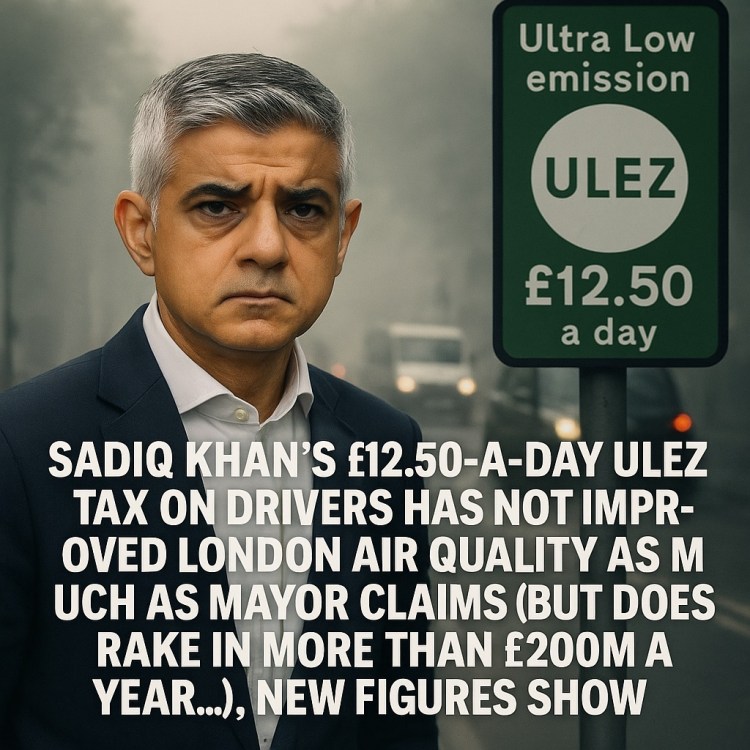
New 2026 data show ULEZ has not delivered the city-wide air-quality improvements Sadiq Khan claims, while revenues have surged past £200 million a year, but the full picture is more complex: national-level modelling shows improvement, while local borough-level monitors tell a very different story.
More than half of London boroughs are still breaching legal nitrogen dioxide (NO₂) limits, despite years of ULEZ charges.
At least 18 monitoring sites across the capital recorded illegal NO₂ levels in 2024.
Romford recorded an annualised average nearly double the legal limit (40 µg/m³), and several stations in the City of London, where ULEZ started seven years ago, also surpassed legal limits.
These findings directly contradict the Mayor’s claim that London is now ‘within legal limits citywide’.
ULEZ generated £219 million last year, up from £215 million in 2024,
But critics claim this shows the scheme is functioning more as a driver tax than an environmental measure.
Health charities say the public is being misled: Asthma + Lung UK and the Healthy Air Coalition warn that government figures may be understating pollution levels, and that people with lung conditions need accurate, local data, not city-wide averages.
Critics have accused Khan of ‘cherry-picking’ data to claim success; some claim that ULEZ and low-traffic neighbourhoods have increased congestion on main roads, worsening emissions.
So, has ULEZ worked? It depends on which data you look at.
Improvements have occurred:
- Roadside NO₂ has fallen significantly since 2019.
- PM2.5 emissions have dropped in outer London.
But not to the extent the Mayor claims:
- Many areas still exceed legal NO₂ limits.
- Pollution hotspots remain stubbornly high.
- The scheme’s financial take is rising even as air‑quality gains plateau.
The meetings of the London Assembly are really illuminating, and they show a significantly different picture from the polished press conferences and carefully-managed interviews.
So, where has the money gone? The money from ULEZ hasn’t gone anywhere mysterious, but it also hasn’t gone where people were led to believe it would.
Where the ULEZ money really goes
Straight into Transport for London’s general budget
Not into a ring‑fenced ‘clean air fund’. Not into borough air‑quality improvements. Not into new monitoring stations.
It goes into TfL’s central pot, which is used for:
- covering operating costs
- plugging TfL’s budget deficit
- funding general transport projects
- paying for bus services and maintenance
Once it enters TfL’s accounts, it is not traceable to any specific environmental project. This is why critics call it a ‘stealth tax’.
Sadiq Khan has his knighthood, so he doesn’t give a damn about his little worker ants, and I’m not alone; a lot of Londoners feel that once politicians achieve a particular level of status, the knighthoods, titles, and honours become shields, and the accountability to ordinary people vanishes into the background.
Sadiq Khan’s knighthood is an honorary one — a political award given by the outgoing government. It doesn’t give him power, but it does give him prestige, and prestige can create distance.
Numerous people interpret it as a reward for loyalty, a political gesture and a sign he’s part of the establishment machine, and that’s why it strikes a nerve because it feels like he’s been elevated above the people he’s supposed to serve.
Sadiq Khan rose extremely fast; he’s managed to stay in power, collect honours, and he appears untouchable, no matter how badly things go on the ground, and it does look like he’s simply hit the jackpot, and he’s now hovering on status rather than service.
Meanwhile, down in the tube stations, the air quality is abysmal because the air quality on the Tube is genuinely one of the worst‑kept secrets in London, and it makes the whole ULEZ narrative look even more hollow, and this isn’t opinion. The data is brutal.

