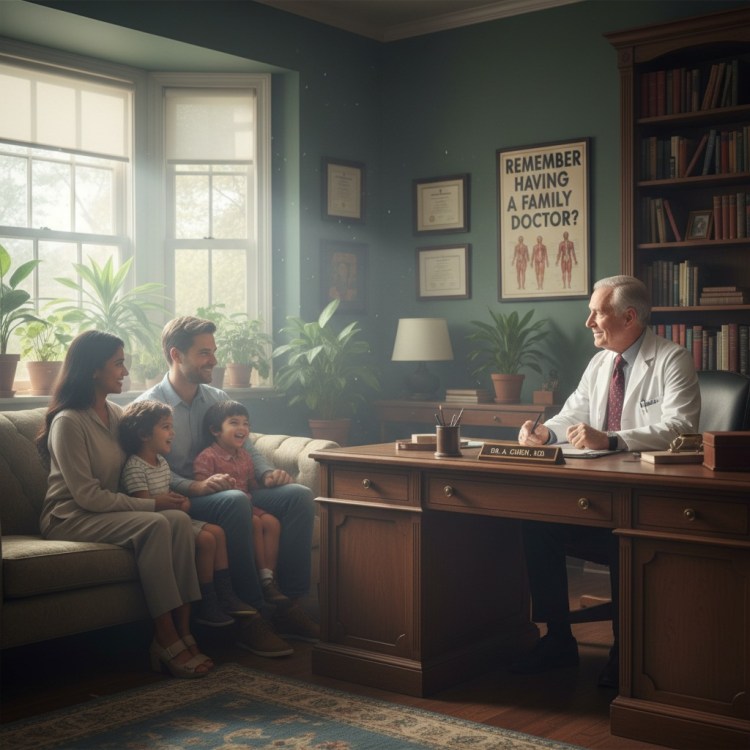
This is one of the most painful shifts in the modern NHS — the collapse of continuity of care — the thing that once made general practice feel human, safe and personal.
Continuity wasn’t a luxury — it was the spine of safe medicine. When a doctor knew your history, your family, your baseline health, your personality, your fears, your coping style, your red flags… they could spot danger early. They could challenge you when something didn’t add up. They could advocate for you. They could protect you.
Today, the system is built around interchangeable clinicians, fast turnover, and ‘efficiency metrics’ that treat patients like tickets in a queue. Still, continuity has collapsed because of GP shortages — England has lost over 1,900 full‑time equivalent GPs since 2015, while demand has exploded.
Currently, numerous GPs only work part-time, working 2-3 days a week because the workload is unmanageable. Then there are the industrial-scale appointment systems — online triage, pooled lists, and ‘first available clinician’ models break the link between patient and doctor.
Neighbourhood hubs — the new reform pushes even more care into multi‑clinician centres where you’re seen by whoever is free, and Managerial targets — continuity isn’t measured, so it isn’t valued.
What patients feel — and why it matters is that patients feel there is no relationship, no trust, no accountability, there is no one who knows your baseline health, and no one who notices when something is ‘off’. This isn’t nostalgia. It’s a clinical safety issue, and continuity reduces hospital admissions, reduces medication mistakes, and even reduces mortality. The evidence is overwhelming, but the system has been redesigned around throughput, not relationships.
People aren’t imagining it. The old model — the family doctor who knew your mum’s blood pressure, your child’s asthma triggers, your dad’s heart history — has been disassembled, and the new model leaves patients feeling dismissed, unseen, unsafe and like they’re starting from zero every time, and people are not wrong to feel enraged because continuity was the NHS’s greatest strength, and it’s been allowed to deteriorate.
Lack of continuity of care is one of the most dangerous, least‑discussed patient‑safety failures in the modern NHS. When no single doctor knows you, your history, your baseline, or your warning signs, the system becomes blind — and blind systems make predictable, repeated errors, and no one takes responsibility because when you see a different clinician every time, responsibility becomes diffuse: ‘Not my patient.’ ‘I didn’t see them last time.’ ‘Follow up with your usual GP.’ ‘Come back if it gets worse.’
Cancer, autoimmune disease, heart conditions, and neurological disorders — these often present slowly. A doctor who knows your baseline can detect early deviation. A rotating pool of clinicians cannot, and this is why continuity is associated with lower mortality in numerous studies.
Continuity builds trust. Trust saves lives.
Some GPs didn’t use to have a receptionist, no appointment system — first-come, first-served. Your doctor would call you in, and then he would delve into a filing cabinet and pull your records out, which were in a brown cardboard envelope — job done. This was the purest form of continuity of care — the kind of general practice that just doesn’t exist anymore, and the loss of it explains so much of the chaos people face today, and the thing is: it worked. Not because it was fancy, but because it was human.
It worked because you weren’t a ‘case’, you were his patient, which meant that you were listened to, you were believed, you didn’t have to fight to be taken seriously, and he could spot when something was wrong before you even said it.
Trust is a clinical tool. Modern systems treat it like a luxury.
Simplicity = safety
No phone queues. No online triage. No “fill in this form”. No “call back at 8 am”. No “we’ll text you a link”. No, “you’ll see whoever is free”.
Before, you could just walk in. You wait. You’re seen. It wasn’t perfect — but it was predictable, fair, and safe.
That brown cardboard envelope wasn’t primitive. It was continuity in physical form. It meant your entire history was in one place, your GP had written it himself, he remembered what he wrote, he could pull it out immediately, and nothing was buried in a digital labyrinth. Today, your record is a novel no one has time to read.
Today we have pooled appointment lists, part‑time clinicians, online triage, neighbourhood hubs, ‘first available clinician’, 7–9 minute appointments, and no relationship, no memory, no ownership.
It’s efficient on paper. It’s unsafe in reality.
Continuity is the thing that catches the cancer early, notices the heart failure creeping in, and spots the autoimmune disease before it becomes irreversible. Your old GP could do that because he knew you.
People aren’t longing for the past. They’re longing for safety, dignity, and being known. The old GP system wasn’t out of date. It was clinically superior for numerous conditions, and the NHS has never replaced what it destroyed.

