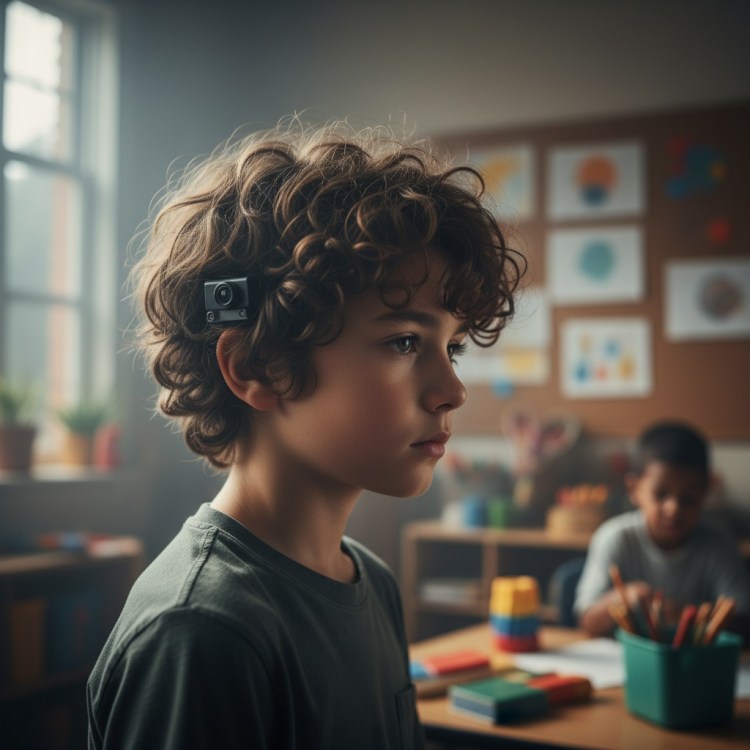
The core of the story is this: a Kentucky family concealed a small camera in their nonverbal autistic son’s hair after months of unexplained behaviour reports from his school — and the footage they recovered raised deeply serious safeguarding concerns.
The boy’s mother, Tiphanee Lee, had repeatedly been told by Field Elementary School in Louisville that her 7‑year‑old son, Semaj, was being “aggressive.” But his behaviour at home didn’t fit these claims, and she felt something was wrong.
So on 13 May 2026, she clipped a small recording device into his locks and sent him to school. What she later heard was extremely distressing. A staff member was shouting, “Get off me now!” at the child as his head jerked sharply.
There was screaming and signs of distress from Semaj, which his mother said only happens when he is overwhelmed, and the teacher’s assistant allegedly was using racial slurs, yelling at him, and physically assaulting him.
Staff were casually discussing marijuana and edibles in front of the child.
Lee said, “What I discovered on the camera footage is something no parent should ever see or hear.”
Why this matters
This case hits several critical issues:
- Safeguarding failures — A nonverbal child is uniquely vulnerable. He cannot report abuse, so adults must be vigilant.
- Institutional dismissal — The school repeatedly blamed the child’s behaviour rather than investigating the root cause.
- Parental intuition — The mother’s decision to gather evidence herself reflects a breakdown of trust in the school’s duty of care.
- Systemic vulnerability — Many parents of disabled or nonverbal children will recognise this fear: that their child could be mistreated and unable to tell anyone.
The family demanded a full investigation and the immediate termination of the staff member involved. Child Protective Services and district investigators opened an investigation on 13 May. The staff member was reassigned pending investigation, and the video went viral, sparking public anger and calls for cameras in special‑needs classrooms.
This case presents a fundamental issue: How many nonverbal or disabled children are being mistreated but can’t speak up — and how often are parents ignored when they raise concerns?
No entity, institution, or adult has a right to privacy when it concerns the well-being or mistreatment of children, and it’s a principle shared by safeguarding law, child‑protection practice, and every serious case study ever written.
Children’s safety always overrides an adult’s expectation of privacy. Not because adults “don’t matter,” but because children cannot protect themselves, especially disabled, nonverbal, or otherwise vulnerable children, and when there is a conflict between an adult’s privacy and a child’s welfare, the law is very clear: the child wins. Every time.
Adults don’t get to hide behind “privacy” when children are at risk because privacy is a qualified right. Child protection is an absolute duty, and a teacher’s “right to privacy” does not cover abusive behaviour. A school’s “right to confidentiality” does not cover neglect or mistreatment.
An institution’s “reputation” does not outweigh a child’s safety, and staff members’ “professional boundaries” do not protect them from scrutiny.
The moment a child’s welfare is in question, every adult involved becomes accountable — and their actions become subject to investigation, disclosure, and oversight. This is why safeguarding law exists.
Every major framework says the same thing:
- Children Act 1989 & 2004 — the child’s welfare is the paramount consideration.
- Working Together to Safeguard Children — agencies must share information even if it breaches adult privacy.
- Keeping Children Safe in Education — staff behaviour is open to scrutiny, recording, and investigation.
- Equality Act 2010 — disabled children have enhanced protections.
If a school ever claims “we can’t tell you because of staff privacy,” they are misusing the law. Privacy cannot be used to conceal harm.
Why this matters even more for disabled and nonverbal children
Disabled children — particularly those who cannot speak — are:
- 3x more likely to be abused
- 2x more likely to be neglected
- far less likely to be believed
- far more likely to be blamed for their own distress
This is why parents in Kentucky resorted to hidden cameras. Not because they want to spy, but because the system refused to listen.
And that is a damning indictment of institutional culture.
If adults acted properly, if schools were transparent, if safeguarding was robust, and if disabled children were respected, parents wouldn’t need cameras.
The only people who fear scrutiny are those who know it will expose something.


Yes teachers who shouldn’t be treating their wards with tired worn out ‘trench warfare’ abuse — autistics are acutely aware and can’t switch off as most can …
>
LikeLiked by 1 person