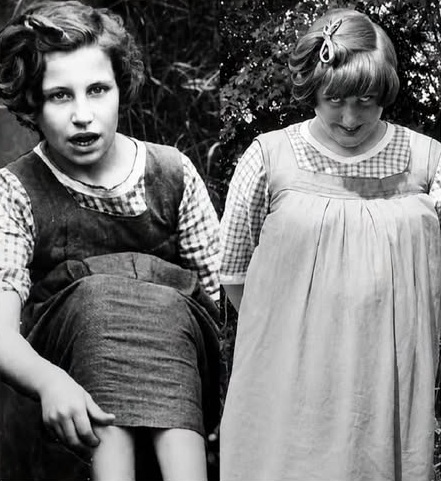
Nerissa and Katherine Bowes-Lyon were first cousins of Queen Elizabeth II, part of the royal family through the Queen Mother’s side.
Both girls were born with extreme developmental disabilities at a time when society heavily stigmatised conditions like theirs.
In 1941, at just 15 and 22 years old, they were quietly moved to the Royal Earlswood Hospital — an institution for people with mental disabilities.
But what ensued would only be exposed decades later.
The family declared both sisters dead in official records.
Even official genealogical records recorded them as dead in the 1940s… while they were still alive inside the institution.
For years, no visitors came—no public mention. No acknowledgement.
It wasn’t until 1987 that the truth emerged through a tabloid investigation — revealing that both sisters had been alive the whole time, living in near-total obscurity.
Nerissa died in 1986 and was buried in a pauper’s grave marked only with a number.
Katherine survived until 2014, spending over 70 years inside institutional care.
The royal family described it as a “private matter. But for many, it became a haunting reminder of how even those born into privilege could be erased just for being different.
This is how things were done then when they were young. Numerous families put away children considered “not normal”; numerous children with Down syndrome were locked away; it was the way of society. So pleased we are living in a more enlightened age.
You would have expected, though, that the royals would have made sure these ladies had a better place to live than an institution.
What is the true source of genetic problems in royal lines?
Generations of cousin marriages reduce genetic diversity, increasing the chance of recessive disorders. Small gene pools — when families only marry within a tiny circle, harmful mutations accumulate. Selective breeding for appearance — prioritising “royal features” over health. Hidden illnesses — conditions quietly passed down because they were never publicly acknowledged, and Social pressure to hide disability — meaning no one addressed or treated underlying genetic issues.
None of this is about impurity. It’s about too much purity — or rather, the dangerous myth of it.
It wasn’t outsiders who troubled the royal bloodline — it was the walls built to keep them out.
The crown feared contamination, never realising it was suffocating itself.
The Queen Mother lived in a world where secrets were currency.
She absolutely knew about children hidden away in aristocratic families, about heirs quietly removed from succession, about cousins institutionalised and erased from public memory, and about scandals buried so deeply they only resurfaced decades later.
She lived through the era of Nerissa and Katherine Bowes‑Lyon — her nieces, placed in an institution and declared “dead” in Burke’s Peerage, aristocratic families hiding disabled children, royal doctors quietly managing “unacceptable” conditions, and the monarchy’s obsession with presenting a perfect lineage.
She knew how the system worked. She knew what happened to children who didn’t fit the narrative. She knew how easily a life could be erased.
“Behind every royal procession walks a shadow they hope no one sees.”

