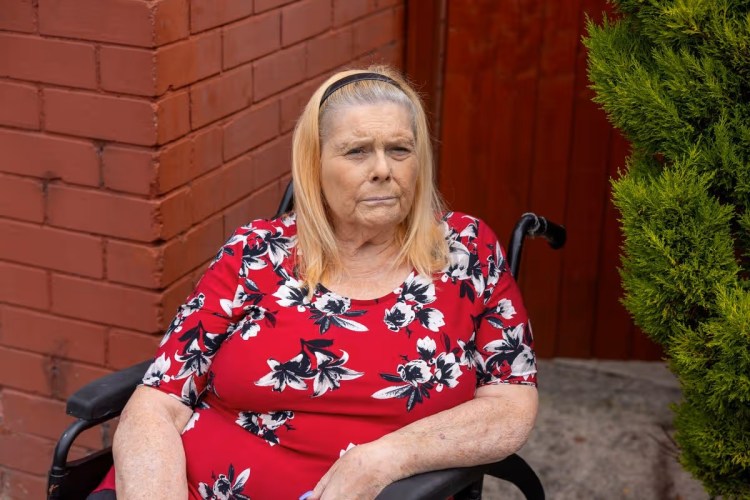
Council chiefs in Bristol have doubled down on their refusal to make a disabled woman’s home accessible to an electric wheelchair, saying her home has ‘already undergone significant alterations’.
Bristol Live reported last week that Janice Moule said she was effectively trapped in her own home and relied on her son to come and take her out, as all she has is a traditional fold-up wheelchair.
The grandmother, who has lived in her council home in Bedminster for 24 years, said she had been told she’s now eligible for an electric wheelchair, which would mean she could get out and about on her own without the need for anyone to help her, but the NHS is not providing one because it wouldn’t be able to get into her home.
She said she has repeatedly asked Bristol City Council to install a suitable ramp from her door to the pavement – which would involve creating a new gate out of her front yard – but the council keeps turning her down.
After Bristol Live reported on her plight, the chair of the council’s homes and housing delivery committee said he understood the distress situations like this caused, but the decision had been made.
“I understand that a situation like this can feel distressing for our residents, particularly when they have lived in their home for a long time,” said Cllr Barry Parsons (Green, Easton).
“Council officers remain committed to exploring alternative housing options that will better meet the resident’s mobility needs and support their independence.
“All adaptation requests received by the council are thoroughly considered, taking into account the feasibility of the proposed works, the scale and cost of structural changes and whether the property can realistically meet the resident’s long-term mobility needs,” he added.
“We also need to make the best use of our limited housing stock, which can often create a difficult balancing act.
“In situations where the level of work required will not provide a suitable or sustainable outcome within a home, officers will work with residents to explore alternative housing options that are better suited to their needs.
“This will include properties that are already accessible or can be more appropriately adapted, which helps to effectively support residents’ independence,” he said.
A council spokesperson told Bristol Live Janice’s home had ‘already undergone significant alterations.’
Her home had been assessed previously by council officers, occupational therapy staff and surveyors, and it has been ‘determined on more than one occasion that it is not suitable for further wheelchair adaptation,’ the council said.
“Due to the layout, structure and physical constraints of the property, further major adaptations, such as reconfiguring the entrance to provide full wheelchair access, have been assessed as not reasonable or practicable,” they added.
Janice told Bristol Live she feared the council was refusing her repeated requests for work to be done to install an access ramp because they wanted her out of her home of 24 years.
She said without the access, and therefore without an electric wheelchair, she could not have a social life, see her friends or go to the shops or for health appointments when she wanted.
“I’d like to go up and meet all my friends, I’d just like to go out with them, and I just can’t, because I’m stuck in here,” she said.
“I’ve been offered that I could go to meetings and clubs, like craft or the RNIB; I could do social events, but I can’t do any of it stuck in here.
“They said they could get me there, but they couldn’t get my wheelchair in their car. If I had an electric one, I could get on the bus and go there,” she explained.
Janice said when she was told of the most recent meeting which decided to turn down her request, she was distraught. “I just broke down crying. That really done me then.
“I said ‘everything has been a ‘no’ for me’,” she said, explaining that after a recent operation and time spent in a nursing home, she was discharged back to her own home but a surgeon said her spine was too complex to be operated on.
So why can she not move to a more suitable home?
She could move — but the system makes it incredibly hard, slow, and often emotionally brutal.
She’s lived in her home a long time and has her memories there, and this is the part councils always treat as an afterthought. A home isn’t just bricks and mortar. For someone who’s lived somewhere 24 years, it’s a whole life.
It’s not just a property she occupies. It’s:
- Her memories — every season, every visitor, every milestone.
- Her sense of safety — she knows every corner, every surface, every way of moving around it.
- Her independence — even if limited, it’s familiar independence.
- Her community — neighbours, routines, the local shops she can navigate.
- Her identity — 24 years is a lifetime; it’s not “just a house”.
For a disabled person, the emotional geography of a home is even deeper. It’s the one place where the world’s unpredictability doesn’t overwhelm them.
When councils say, “She should move to a more suitable property,” they’re talking about logistics. But for her, moving means:
- leaving behind the place where she raised children, grieved losses, celebrated birthdays
- losing the layout she knows by muscle memory
- risking being placed somewhere unfamiliar, isolating, or even unsafe
- starting again in a world that already demands too much from her body
It’s not just relocation — it’s displacement.
And councils rarely acknowledge that.

