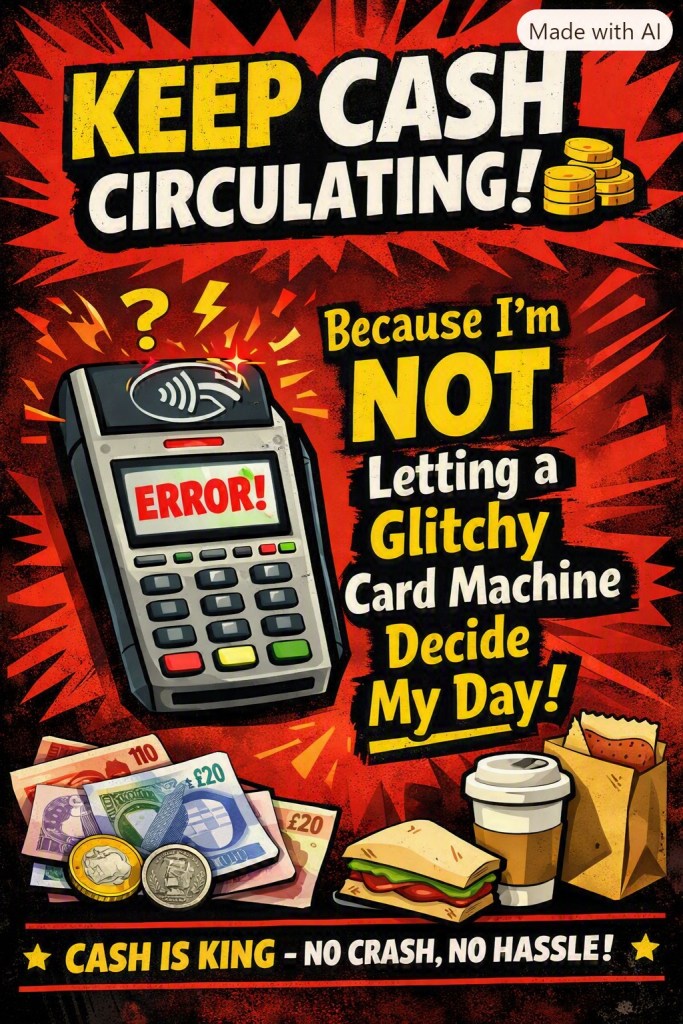
Cash has worked perfectly well for two hundred years without passwords, signals or monthly fees, so the rush to get rid of it feels like someone trying to replace a perfectly good kettle with a “smart” one that needs Wi‑Fi, updates, and your bank details just to boil water.
Cash is best — it’s the only payment method that never needs charging, never freezes, never asks you to “try again later”, and never decides it’s not in the mood because the Wi‑Fi’s having a funny turn.
It’s the original contactless: you just hand it over.
And honestly, nothing beats the feeling of slapping a crisp fiver on a counter like you’re in a BBC drama making a point.
It is all about control — that’s the bit no one likes to say out loud.
Cash gives you control. Digital systems give someone else control.
Once money lives entirely on screens, it can be tracked, limited, paused, or charged for. Cash can’t be switched off, censored, or declined because “the system is busy”.
That’s why the push feels so fast — not because cash stopped working, but because digital money is easier for institutions to manage, monitor and monetise.
And you know what? People sense it. That’s why there’s such a stubborn loyalty to coins and notes. They’re the last bit of everyday life where you don’t need permission.
A cashless society mainly benefits banks, payment companies, tech firms and governments because digital money is easier to track, charge fees on, analyse and control.
Politicians and bankers have long made decisions that devalue our money, and many people feel this erodes the real worth of their savings and earnings.
The Bank of England adjusts the money supply to stabilise the economy, and when the UK moved fully away from gold backing, the pound became a fiat currency — giving policymakers more power to influence inflation, interest rates and the real value of people’s savings.
When governments expand the money supply faster than the economy grows, inflation reduces the pound’s buying power, and many people feel this steady erosion of savings is policy that harms ordinary workers.
Between 1999 and 2002, Gordon Brown sold a large portion of the UK’s gold reserves at low prices, and many people feel this decision reduced the country’s long‑term financial resilience and increased reliance on a fiat currency system where policymakers have greater influence over inflation and borrowing.
Many people feel the current system erodes the value of ordinary people’s savings because governments rely on expanding the money supply instead of making difficult fiscal decisions, while financial institutions profit from inflation and debt.
When inflation rises faster than wages, people feel their savings evaporate, trust in leaders collapses, and financial anxiety pushes them toward assets like gold, silver or property as confidence in the system weakens.
Many people believe the solution is stronger fiscal discipline, clearer accountability for policymakers, and economic policies that protect the real value of the pound rather than allowing inflation to erode people’s savings.
KEEP CASH CIRCULATING — it protects privacy, preserves independence, and stops every transaction from being controlled, tracked or charged by someone else.
KEEP CASH CIRCULATING — because I’m not asking permission from a card machine that’s having a meltdown.

