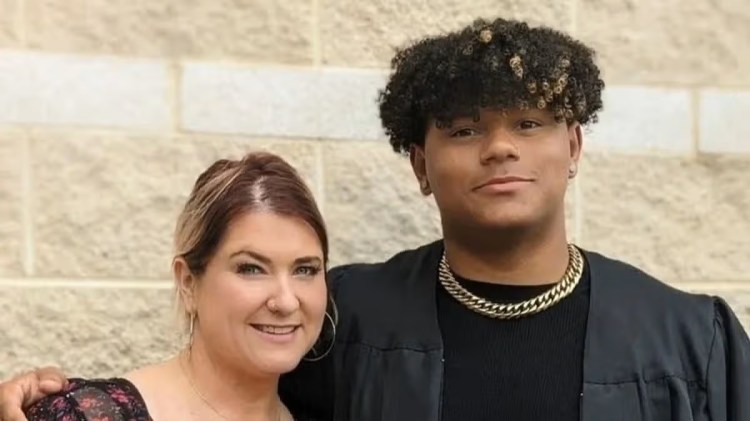
A mother’s grief sharpened into fury when she learned her dead son’s body had been stripped for parts without her consent, leaving her to bury a boy who’d been altered without her knowledge.
Andrea Mauk’s world shattered thousands of miles from home as she learned her son had died — and that his body had been stripped for parts without her consent.
Andrea Mauk was notified that her son, Damon, had died at age 18 — a clinical fact delivered across continents with no space for grief.
Damon Mauk, aged 18, was pronounced dead on 24 June 2023 in Lucas, Ohio, following a single‑vehicle collision in which he lost control of his car and struck a tree. He had recently completed high school and was undertaking study toward a real‑estate license. No evidence of third‑party involvement was identified, and death was attributed to injuries sustained in the impact.
Andrea Mauk, located abroad in Costa Rica, was formally notified of her son’s death via a telephone call initiated by her parents due to the immediacy of the incident.
She stated that sedation was administered after notification of her son’s death due to the severity of her physiological stress response.
The 42‑year‑old returned home immediately, and upon arrival identified an additional distressing development that further impeded the process of viewing and taking final leave of her son.
Parts of Damon’s body were removed and designated as anatomical gifts without any recorded authorisation from his next of kin.
Speaking to the New York Post, the 42‑year‑old stated that she experienced complete devastation upon receiving the information.
She reported that upon attending the funeral home, she was unable to view her son due to the removal of multiple anatomical components.
She stated that her son’s eyes had been removed without her consent, and that she did not wish to retain a final memory of him in that condition.
The Ohio mother reported that the hospital failed to initiate contact, despite records identifying her as her son’s primary emergency contact, and confirmed that Damon was not enrolled as an organ donor.
Consent for the removal of Damon’s organs was authorised by his biological father, whom Andrea reports had minimal involvement in the child’s life.
Consent had been formally secured, placing the Organ Procurement Organisation’s actions within the applicable legal framework.
Andrea stated that, despite being listed as Damon’s primary emergency contact, no outreach was initiated. Her information was fully available in the hospital records, yet no communication occurred.
Damon was raised without participation from his biological father. It was only after Damon’s death that the biological parent chose to assert parental authority and make decisions on his behalf.
Public commentary reflected significant concern, with multiple individuals questioning the decision‑making process and the absence of communication with the primary emergency contact.
The sequence of events was permitted because a legally recognised consent was on file, and the Organ Procurement Organisation acted within the statutory boundaries that govern organ retrieval. Once that consent was validated, the system did not require additional verification from the primary emergency contact, even though her details were clearly documented.
The deeper issue — the absence of contact, the reliance on a parent who had not been present in Damon’s life, and the failure to cross‑check relational context — sits in the gap between what the law allows and what most people would consider reasonable practice.
From a strictly legal standpoint, the process was permitted because a valid consent was documented, and the Organ Procurement Organisation acted within the statutory framework governing organ retrieval. Under that framework, the presence or absence of prior parental involvement is not a determining factor; the system recognises the individual who holds legal authority at the time consent is sought.
The current framework prioritises legal authority over relational proximity, meaning that once a parent with recognised legal standing provides consent, the Organ Procurement Organisation is permitted to proceed. The law is designed to create a clear, unambiguous chain of authority so that organ retrieval decisions can be made quickly, particularly in time‑sensitive clinical contexts.

However, cases like this expose a structural weakness: the system does not require verification of actual caregiving involvement, nor does it mandate contact with the primary emergency contact, even when that person is the one who has been responsible for the patient’s welfare. As a result, the law can produce outcomes that are legally compliant but operationally and ethically misaligned with the realities of family dynamics.
Without a donor card, there was no documented expression of Damon’s wishes. In the absence of such documentation, the system defaults to legal authority, not personal intent. The Organ Procurement Organisation is required to obtain consent from whoever holds recognised parental or next‑of‑kin authority, and once that consent is validated, the process is permitted to proceed.
The circumstances bear an uncomfortable resemblance to the Burke and Hare dynamic, where control over a body was exercised by those with authority rather than those with proximity.

