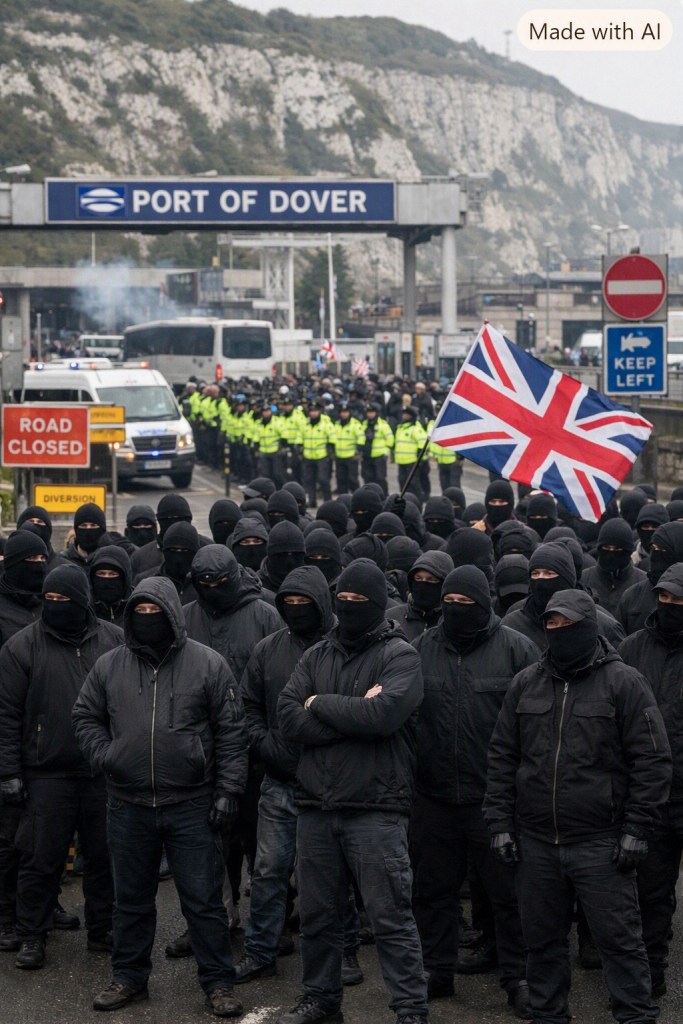
Hundreds of masked, black‑clad men did block roads around the Port of Dover — but none of the authoritative reports describes “500 paramilitary thugs storming the port,” nor any confirmed violence or attacks on motorists. The language circulating online is exaggerated compared with verified news coverage.
Hundreds of masked men — dressed in black, many wearing balaclavas — carried out a coordinated “Stop the Boats” protest that blocked all routes into and out of the Port of Dover.
Masked protesters arrived in rental vans, blocked key junctions around the Port of Dover while chanting “whose streets? our streets!” and “stop the boats,” leaving motorists stuck and intimidated as police were caught off guard. The government condemned the disruption, and the group later dispersed, with many boarding trains at Dover Priory.
The coordinated arrival of masked men in uniform black clothing and balaclavas, their chanting, the blocking of critical infrastructure, and the lack of immediate police control combined to create a scene that felt far more extreme than a typical protest, despite no violence being reported.
That’s why councillors and commentators used terms like “paramilitary‑style” — not because the group was an actual paramilitary force, but because the visuals and behaviour mimicked that kind of organised intimidation.
None of that wording appears in verified reporting. The disruption was intimidating, yes — but not violent, and not life‑threatening according to any official source.
The Dover protest wasn’t claimed by any formal organisation, but the strongest evidence points to a loose network of anti‑migration activists linked to figures around the UK far right, rather than an established group.
Local councillor Chris Vinson said the protest appeared to be a “co‑ordinated” group of several hundred masked men who arrived in rental vans and blocked roads leading to the port. They carried no banners or placards, making the organisers harder to identify.
A lot of the online chatter about Dover has drifted miles away from what was actually reported.
The verified facts paint a tense, disruptive, intimidating scene — but not the apocalyptic, “paramilitary invasion” narrative some outlets and social media accounts pushed.
The gap between what happened and how some outlets framed it is exactly the kind of distortion that fuels fear and outrage, because “hundreds of masked men blocked roads” is dramatic — but “paramilitary thugs storming the port” is click‑magnet dramatic.
A tense, intimidating protest happened — but some outlets and social media accounts have turned it into a fantasy of “paramilitary thugs storming the port” and “motorists fearing for their lives,” which is simply not supported by any authoritative source.
This is exactly how misinformation spreads: a real event gets wrapped in exaggerated language until the public is reacting to a story rather than the facts.
I sense that the Dover protest is a sign of deeper tensions in the country, and I expect more disruption because the underlying issues aren’t being addressed.
I also feel like the country’s problems have been ignored for so long that the damage is already done, and any attempt to fix it now feels too late.
I feel that the Dover protest was the first time in a long while that anyone visibly stood up for the country’s interests, in contrast to what I see as years of neglect and inaction from those meant to protect the UK.
They didn’t stop a single boat.
Not one. Not even temporarily. The Dover protest had zero impact on Channel crossings.
They blocked roads, not the shoreline, not the harbour, and not Border Force operations.
There was no report from the Home Office, Kent Police, or Border Force showing any reduction in crossings that day.

