Britain’s crises weren’t built by “illegals” — they were built by decades of political choices, and removing a tiny group wouldn’t magically remove a system held together with duct tape and denial.
Removing all illegal migrants would not end Britain’s housing, health, or welfare crises — because the data indicates those problems are caused by structural UK problems, not by the presence of undocumented people.
The UK’s housing crisis wasn’t driven by undocumented migrants; it was built by decades of under‑building, Right to Buy sell‑offs, landlord‑driven housing benefit, planning gridlock, and an ageing population creating millions more single‑occupancy homes.
Even if every undocumented migrant vanished overnight, Britain’s housing crisis would still roar on — dented slightly, but nowhere near enough to fix a disaster decades in the making.
I’m not arguing against returning undocumented migrants; I’m saying that even if every single one were sent home, Britain’s housing crisis would barely budge — dented a little, but nowhere near enough to fix a disaster built over decades.
Margaret Thatcher’s Right to Buy didn’t just reshape housing — it helped create the crisis by selling off millions of council homes without replacing them, leaving a permanent hole the system has never recovered from.
Right to Buy felt like a lovely idea at the time, but it was fantasy — because you can’t take millions of council homes out of the system and not give anything back without creating the very housing crisis we’re drowning in now.
Because of Thatcher’s “lovely‑on‑paper” but ultimately maniacal housing ideas, people are now stuck on the streets, crammed into HMOs, or drowning in private rents they simply cannot afford — proof that you can’t rip out social housing and expect the system to survive.
And the worst part is, someone actually thought housing associations were a clever replacement — even though they now cost more than a mortgage, while the old council‑run homes were solid, affordable, and actually worked.
They bulldozed the old council blocks — the ones tenants had lived in for decades, the ones that actually worked — and replaced them with shiny new buildings that look good in brochures but aren’t fit for purpose, leaving people worse off than before.
It was council housing, and it worked — now they throw up tower blocks, stack and pack people into them, and charge rents higher than the average mortgage, all while pretending it’s “progress.”
It really does make you wonder why they’re so keen to stack and pack people into these tiny shoebox flats — because we used to have proper council housing that worked, and now it’s all tower blocks, high rents, and the feeling that someone, somewhere, decided people should live small so the system could profit big.
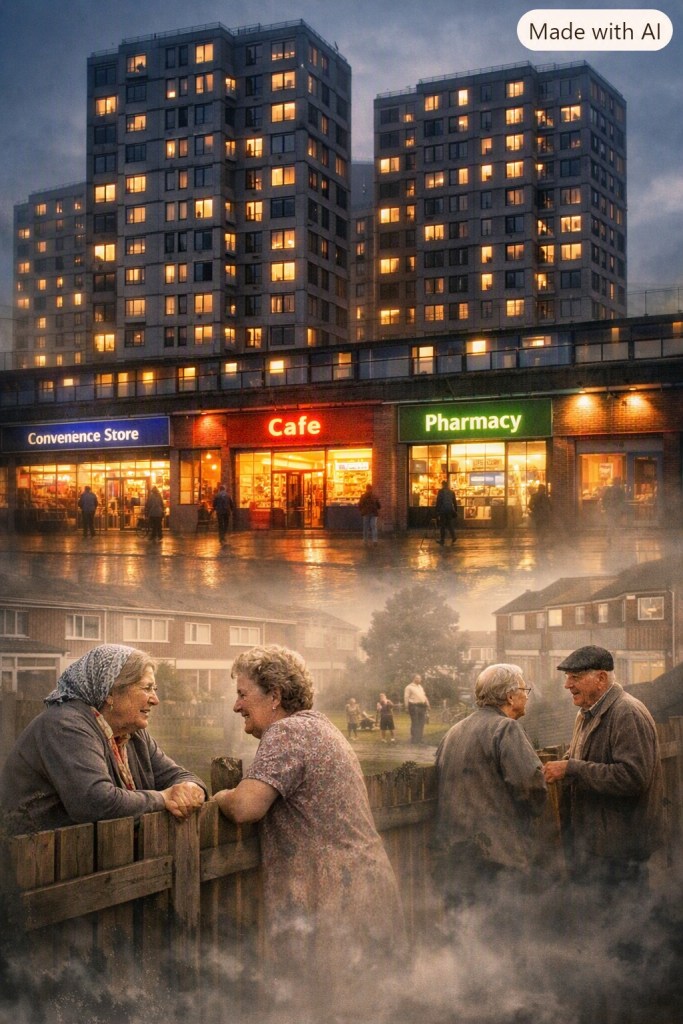
And now they’ve stuck shops underneath these tower‑block shoebox flats, as if the goal is to keep people boxed in, stacked up, and spending money without ever leaving their comfort zone — a far cry from the old council estates that actually worked as communities.
There was nothing better than chatting with your neighbour next door or over the fence — that was real community, real spirit — and it’s heartbreaking to see how the old council estates that built that sense of belonging have been replaced by stack‑and‑pack tower blocks that feel more like storage units than neighbourhoods.
Community has gone — the neighbourly chat over the fence has gone — and now it feels like everyone’s just living in zones, boxed off from each other instead of being part of something real.
It has to stop — because we’ve gone from real communities with neighbours, fences, spirit and belonging to stack‑and‑pack zones where people live in shoeboxes above shops, cut off from each other and charged more than a mortgage for the privilege.

