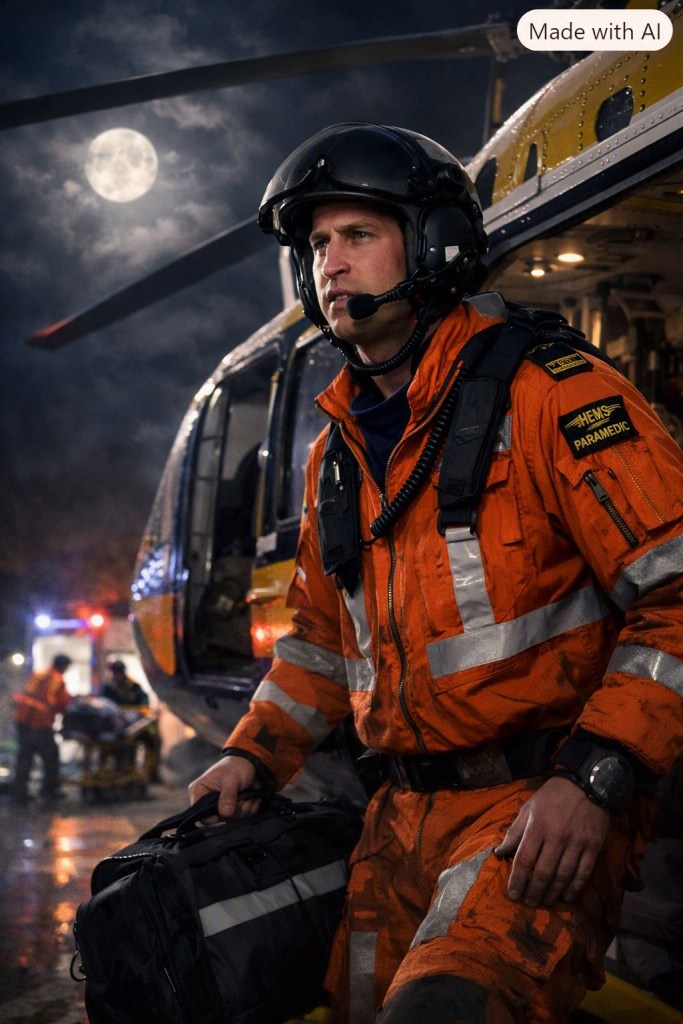
Prince William worked night shifts flying air ambulances — and gave the entire salary away.
Prince William didn’t just do the job — he leaned into the grind, flying night shifts for the East Anglian Air Ambulance, then quietly donated every penny of his £40k‑a‑year salary back into the service.
Prince William swapped palace corridors for cockpit controls — and paid for the privilege.
A prince in a flight suit, running night rescues as Pilot Wales and giving the whole salary back.
A future king on a rota, making the tea, taking the banter, flying the night shifts — and donating the entire £40k salary back to the service.
The work left a mark he only discussed later. He has described callouts involving children that stayed with him, and has said the accumulated weight of what he saw affected him more than he expected — which he has linked directly to why he began taking mental wellbeing seriously in his public work, through the Heads Together campaign launched in 2016.
He stepped away in 2017, trading the cockpit for the Crown just as the older generation began easing back — and in doing so became the first heir in British history to have worked a civilian emergency‑response job, answering real calls on real nights with a real crew.
And he didn’t cash it in, dramatise it, or turn it into a memoir — he just did the job, carried the weight, and walked away quietly.
A prince who never wrote a book — though if he ever did, he’d probably give the royalties away too.
It’s a job that scars quietly — because the things air‑ambulance crews see and hear never really leave them.
You don’t need a crown to be a hero — sometimes it’s just a flight suit, a rota, and a pair of steady hands keeping someone alive.
Paramedics and Air Ambulance: they’re the hands in the mud, the voices in the panic, the calm in the screaming. Police secure. Firefighters extract. But paramedics? They treat. They stabilise. They keep someone alive long enough for everyone else to matter.
Paramedics and ambulance techs are the heroes people forget — special souls who show up first, stay longest, and carry the weight quietly.
Paramedics are a special kind of special — the kind of people who run towards the pain when everyone else freezes.
They’re the ones who kneel in the gravel, steady the bleeding, calm the terrified, and carry the stories home in silence. They don’t get the headlines, the documentaries, or the glossy PR — but they’re the heartbeat of emergency care.
Paramedics don’t just help. They interrupt death. They buy time. They create chances. They pull people back from the edge with skill, instinct, and sheer human courage.
They’re the ones who kneel beside a stranger on a pavement and decide, in seconds, what happens next. They’re the ones who keep a heart beating long enough for a surgeon to have something to work with. They’re the ones who hold a hand, steady a voice, and make the unbearable survivable.
Paramedics don’t just save lives — they give them back.
Princess Diana raised William to be a person in a world of performance — because she knew the royal life wasn’t real.
Plenty of people are born into privilege and never lift a finger. Plenty are born into struggle and become extraordinary. Position doesn’t make the person — the choices do.
What I’m describing is the kind of goodness that isn’t performative: showing up, serving, learning, growing, doing the hard things because they’re right, not because they’re noticed.

