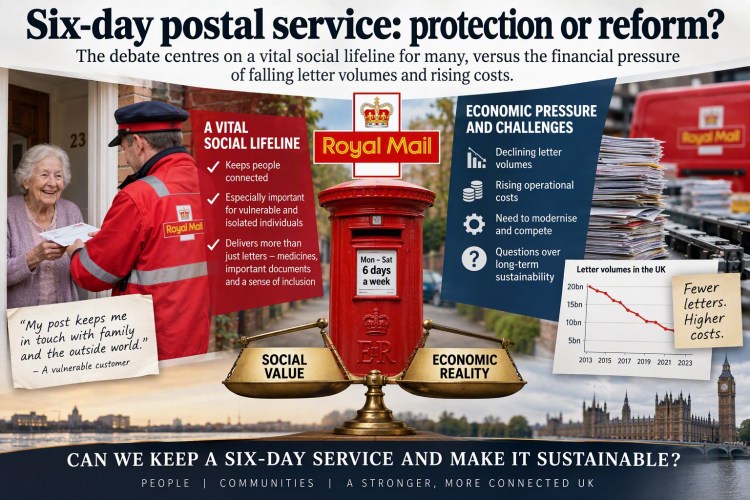
The debate over legally protecting a six-day postal service involves balancing its role as a vital social lifeline for vulnerable people against the economic pressure of declining letter volumes and rising operational costs.
Critics argue that Royal Mail must first fix its unreliable service and meet its legal delivery targets before using cost-cutting measures to permanently scale back delivery days.
Junk mail arrives reliably because it is handled under strict commercial contracts, whereas personal letters are frequently delayed by backlogs and staffing shortages within the standard sorting network.
The proposal to renationalise Royal Mail and tax foreign-owned couriers involves balancing the potential to restore a dedicated public service against the significant taxpayer funding required and existing legal safeguards used to regulate international firms.
The historic second daily postal delivery was permanently abolished in 2004 because afternoon letter volumes dropped significantly, making the extra round financially unsustainable as digital communications began to grow.
The decline of traditional letter delivery suggests a future where standard postal services may eventually disappear, leaving carriers to operate almost entirely as parcel delivery networks driven by the widespread shift to digital communication.
To adapt to falling letter volumes, countries like Denmark and Norway have transitioned to mandatory national digital mailboxes for official communications, while using automated print hubs to maintain a physical delivery safety net for vulnerable citizens.
Exemptions from mandatory digital mail systems are granted based on practical barriers like physical or cognitive disabilities, lack of internet access, and language difficulties rather than chronological age alone, ensuring vulnerable citizens automatically receive printed letters instead.
The NHS and UK government services use automated fallback systems that automatically detect when a citizen lacks a digital account or fails to read an electronic alert, instantly routing the message to a commercial printing hub to be sent as a physical Royal Mail letter.
Under the mandatory Accessible Information Standard and the Equality Act 2010, all UK health and social care services are legally required to provide alternative physical formats—such as Large Print, Braille, and Audio CDs—to ensure patients with sensory or cognitive impairments can access their physical mail.
UK GP practices use standardised clinical software to attach permanent digital codes and high-priority alert flags directly to a patient’s master electronic health record, automatically forcing all generated mail into their required accessible format across the entire healthcare network.
To establish an accessibility flag, a patient or carer can simply contact their GP surgery by phone, in person, or online to state their preferred format—such as Braille or Large Print—and then verify that the correct digital code appears under their profile in the NHS App.
The network keeps the “Royal Mail” name because it functions as a private commercial brand, but the UK government holds a legal “golden share” that forces its Czech owners to maintain the historic identity, UK headquarters, and tax residency.

