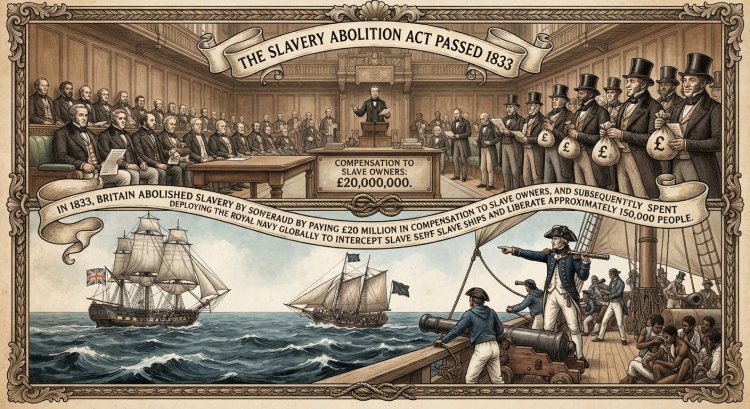
In 1833, Britain abolished slavery by paying £20 million in compensation to slave owners, and subsequently spent decades deploying the Royal Navy globally to intercept slave ships and liberate approximately 150,000 people.
The massive £20 million debt used to compensate slave owners was consolidated into permanent government bonds and serviced by generations of British taxpayers for 180 years until HM Treasury finally redeemed the bonds on 1 February 2015.
The £20 million in compensation was rapidly injected into the Industrial Revolution by former slave owners, who ultimately funded 487 distinct railway investments and critical transportation lines across Britain between 1835 and 1850.
Major financial institutions like Barclays, NatWest, HSBC, and the Bank of England heavily profited from the 1833 abolition by functioning as corporate administrators, payout agents, and capital repositories for the £20 million bailout given to slave owners.
During the 18th and early 19th centuries, Lloyd’s of London served as a primary financial pillar of the transatlantic slave trade by treating captive Africans as insurable cargo, with slave-economy policies making up 41% of the entire marine insurance industry’s business at its peak.
The infamous 1781 Zong massacre occurred when a crew threw over 130 living Africans into the ocean to exploit a maritime insurance loophole covering jettisoned cargo, leading to a landmark legal battle (Gregson v. Gilbert) that was fought entirely as a commercial property dispute rather than a mass murder trial.
In March 1783, Olaudah Equiano discovered the Zong killings through shipping industry contacts and strategically exposed the atrocity to the British public by partnering with lawyer Granville Sharp to launch a searing newspaper campaign that forced the horrific reality of the slave trade into the national spotlight.
Founded in London in 1787 by formerly enslaved men like Olaudah Equiano and Quobna Ottobah Cugoano, the Sons of Africa became Britain’s first Black political organisation by directly lobbying Parliament, publishing best-selling memoirs, and exposing the horrors of the slave trade to turn abolition into a mass public movement.
Published in 1787, Quobna Ottobah Cugoano’s groundbreaking treatise demanded the immediate, unconditional abolition of slavery, radically arguing that enslaved people had a moral duty to violently rebel against their oppressors and that Britain should deploy a naval fleet to forcefully suppress the slave trade.
While the £20 million payout—equivalent to roughly 40% of the government’s annual budget—successfully secured the passage of the 1833 Abolition Act, historical records show it was a tactical political bailout explicitly paid to compensate white slave owners for the loss of their “property” rather than a moral investment to rectify the wrongs of slavery.
During the 1833 parliamentary debates, British legislators fiercely prioritised corporate property rights by ruling that the legal precedent of owning human beings as private property superseded the moral right to immediate freedom, resulting in a £20 million bailout for enslavers and a system of forced unpaid labour for the emancipated.
The direct conflict of interest of British politicians who were also slave owners allowed them to negotiate their own massive £20 million bailout in 1833, saddling generations of ordinary citizens with servicing the resulting national debt for 180 years until it was finally cleared on 1 February 2015.

