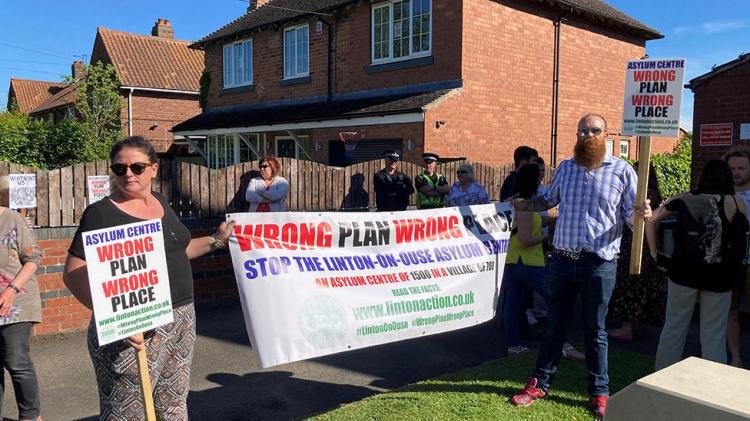
Dozens of Linton-on-Ouse residents are threatening to sell their homes over fears that a proposed Home Office facility at a nearby former RAF base could house up to 1,200 asylum seekers, effectively doubling the small North Yorkshire village’s population and overwhelming its local infrastructure.
Homeowners in Linton-on-Ouse fear they face devastating property value drops of up to 20 per cent if the Home Office goes ahead with controversial plans to house 1,200 single male asylum seekers at the village’s former RAF base.
Driven by these anxieties, several Linton-on-Ouse homeowners have already put their properties on the market, prepared to absorb severe financial losses of up to 20 per cent just to leave the village before the proposed asylum centre opens.
Furthermore, residents report that newly built houses in the village are currently standing empty because prospective tenants are being actively deterred by the looming prospect of a nearby asylum centre.
With a population of only 700 and no local GP or police station, residents fear the proposed facility will completely overwhelm the village’s non-existent infrastructure, leaving them outnumbered by asylum seekers by nearly two to one.
The government maintains that no final decision has been made as it continues to assess the suitability of the former RAF Linton-on-Ouse site, noting that any formal proposal would still require necessary planning permissions and approvals.
Despite the lack of a final decision, local villagers and campaigners report that the ongoing uncertainty alone is already having a severe negative impact on the community.
Data gathered by the Linton-on-Ouse Action Group from 404 residents revealed that 60 per cent of surveyed renters said they were “very likely” to leave the village if the plans were approved.
Furthermore, residents report that around 35 newly renovated former Ministry of Defence homes across two new-build estates are currently sitting vacant due to the ongoing uncertainty.
Homeowners have described two other estates owned by property developer Annington as a ‘revolving door’, with people constantly moving in and out of the area following the announcement.
Campaigners fear that if more residents leave, the once-populated RAF community could become a “ghost town” again.
The looming prospect of the asylum centre has already prompted several families to consider taking substantial financial hits just to get out of the village.
The ongoing debate over housing asylum seekers in local communities remains deeply polarising, as residents and campaigners express intense frustration over severe infrastructure strains while the government faces immense pressure to manage border control and rising accommodation costs.
This intense debate exposes a core conflict between critics who view modern immigration as a sign of national decline compared to the stability of the 1980s, and those who see it as a complex challenge that governments must manage within a global economy.
Deep anxieties reflect a prominent viewpoint in the national debate, where many citizens feel that rapid demographic changes and pressure on public services are leaving local populations marginalised in their own communities.

