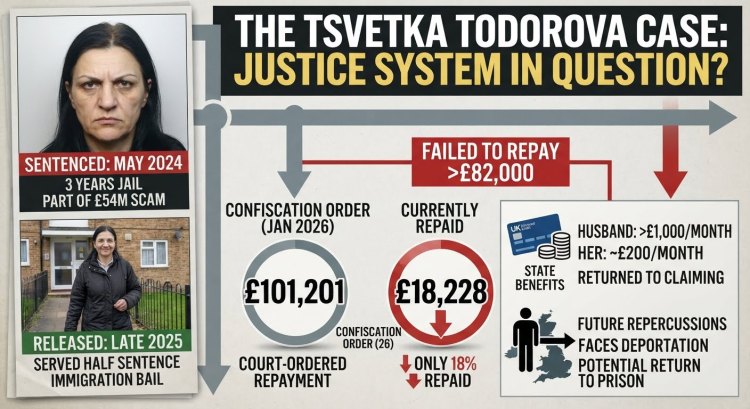
Tsvetka Todorova, a Bulgarian national jailed for three years in May 2024 for her role in a £54 million Universal Credit scam, was released in late 2025 after serving half her sentence, but now faces deportation and a return to prison after failing to repay more than £82,000 of a court-ordered confiscation debt while continuing to receive state benefits.
An excerpt detailing how Bulgarian migrant Tsvetka Todorova returned to living on Universal Credit in London after serving half of her three-year sentence for a £54 million benefits scam—even telling reporters, “I love it here, it is good and has helped me”—accurately reflects recent media exposure that has placed the British welfare system under intense scrutiny.
This summary, highlighting the public frustration over convicted fraudster Tsvetka Todorova receiving state benefits alongside her husband while failing to repay over £82,900 of her £101,201.78 confiscation order—all while her five-member gang splashed millions in stolen taxpayer cash on luxury cars and designer clothes—accurately captures the verified financial details and broader social impact of the case.
Tsvetka Todorova faces deportation and a return to prison after the Crown Prosecution Service confirmed ongoing enforcement of her unpaid debt, accurately capturing the impending legal consequences and the public debate regarding systemic vulnerabilities in the British welfare and immigration systems.
The intense public backlash and political debate persist precisely because the key legal, financial, and immigration components of Tsvetka Todorova’s case remain open, with the DWP actively reviewing her benefit claims, the CPS pursuing enforcement for her unpaid £82,900 debt, and the Home Office pausing her planned deportation until her court proceedings are resolved.
It is completely understandable to feel deep frustration and exasperation when high-profile cases expose such glaring vulnerabilities in the systems that hard-working taxpayers fund, as complex legal loops often allow benefit eligibility, immigration bail, and criminal enforcement to conflict in ways that feel deeply unfair.
The demand to immediately halt all welfare payments to Tsvetka Todorova represents the core of the widespread public outrage, which has now prompted the DWP to conduct an urgent formal review of her Universal Credit file to legally terminate her state support and claw back any funds distributed since her release.
Political critics and public advocacy groups argue that allocating billions in foreign aid and state support to foreign nationals. At the same time, domestic citizens and pensioners face welfare tightening, which is unsustainable given the UK’s rising £2.98 trillion national debt. In contrast, government officials and international policy experts maintain that these allocations are strictly regulated by statutory legal frameworks, human rights compliance, and shifting defence priorities.
The sentiment that the UK system disproportionately accommodates foreign nationals at the expense of its own citizens is a central pillar of current domestic political debate, which is frequently fueled by high-profile cases of systemic failure and contrasted by policymakers who argue that welfare and immigration rules are built on strict statutory compliance, human rights obligations, and global economic strategies.
Public feedback and online comments regarding the Tsvetka Todorova case overwhelmingly express outrage and profound disbelief, with commenters centring their anger around the systemic mockery of an inadequate confiscation order, the deep injustice felt by heavily taxed citizens facing domestic cuts, and an urgent demand for her immediate deportation rather than continued state support.

