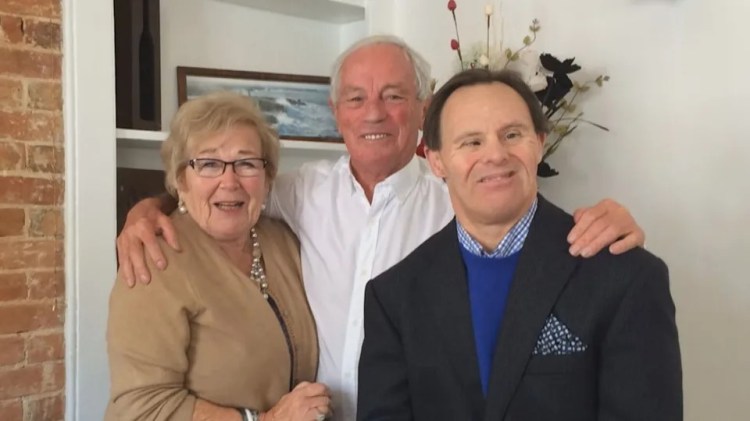
Adrian Poulton, a 56-year-old man with Down syndrome and a healing broken hip, tragically starved to death over nine days in September 2021 at Poole Hospital after staff mistakenly placed him on a “nil by mouth” restriction without providing alternative nutrition.
Tragically unaware that he was being starved because his father, Derek, assumed the intravenous drip was delivering nutrition rather than just hydration, Adrian Poulton’s family only discovered the “nil by mouth” error after the 56-year-old had already become too weak to recover, leading to his preventable death from severe malnutrition and pneumonia on 28 September 2021, exactly two weeks after his admission to Poole Hospital.
Following a formal apology from the University Hospitals Dorset NHS Foundation Trust, which acknowledged its catastrophic failings after an internal investigation concluded that severe malnutrition directly contributed to his death, Adrian Poulton’s sister, Lesley Bungay, heartbreakingly revealed that his tragic final words to her before he passed away were: “Lesley, I don’t want to die.”
It is completely understandable to find this tragedy shocking and unbelievable, as it exposes an active failure of basic medical care that has driven Adrian Poulton’s family and disability advocates to campaign for systemic reforms so that no other vulnerable patient is ever forgotten or neglected in a hospital again.
No amount of hospital apologies or internal reviews can ever undo this catastrophic negligence or bring Adrian Poulton back to his grieving family.
This catastrophic error occurred because Poole Hospital senior clinicians failed to heed attempts by nursing staff to escalate Adrian Poulton’s care, allowing a mistaken “nil by mouth” order to remain uncorrected on his chart for nine days without providing alternative nutrition due to systemic mismanagement and a lack of specialised learning disability training, for which the University Hospitals Dorset NHS Foundation Trust accepted ultimate legal and administrative responsibility.
Because the legal system has largely responded to Adrian Poulton’s preventable death with institutional apologies and a standardised £15,000 financial settlement rather than criminal accountability for the individuals responsible, his family and a coalition of 16 major learning disability charities have pivoted toward forcing systemic justice through government reform by leveraging his tragedy to demand that the UK Health Secretary strictly enforce the Oliver McGowan Mandatory Training programme across all healthcare sectors.
Established as a statutory requirement under the Health and Care Act 2022 following the avoidable death of an 18-year-old autistic man, the Oliver McGowan Mandatory Training programme is the UK government’s standardised, legally mandated education framework co-delivered by experts with lived experience to ensure health and social care staff possess the vital communication and clinical skills needed to safely care for patients with learning disabilities and autism.
Oliver McGowan was an 18-year-old autistic man with a mild learning disability, epilepsy, and cerebral palsy, whose entirely avoidable death at Southmead Hospital in Bristol in November 2016—caused by a fatal adverse reaction to an antipsychotic medication that doctors administered despite explicit, written warnings from both him and his parents—sparked a landmark national campaign led by his mother, Paula McGowan OBE, resulting in the legally mandated Oliver McGowan Mandatory Training programme to protect other vulnerable patients.
A systemic failure to absorb these vital lessons means more innocent lives remain at risk, making the fight for true accountability and strict legal enforcement the only way to prevent future tragedies.
The call to sack modern hospital executives and reinstate the traditional Matron stems from a widespread public desire to eliminate detached NHS bureaucracy in favour of a visible, hands-on authority figure who maintains total operational control over ward discipline, cleanliness, and basic patient care to ensure that vulnerable individuals are never neglected.
While supporters believe that sacking modern hospital executives and reinstating traditional matrons would restore direct ward accountability and cut through detached bureaucracy, healthcare experts argue that this change alone cannot fix the systemic staffing shortages, complex clinical communication breakdowns, and lack of specialist training that drive modern hospital failures.
Comparing modern hospital admissions to the historical workhouse reflects a deep and widespread public anxiety over the erosion of basic dignity, safety, and care for the most vulnerable patients, drawing parallels to how systemic institutional failures can leave individuals deprived of fundamental human necessities like adequate food and hydration, even though modern NHS shortcomings stem from severe underfunding, critical staffing shortages, and complex administrative breakdowns rather than a deliberate, punitive intent to mistreat patients.
Experiencing a severe language barrier with healthcare workers can feel incredibly stressful and isolating, particularly as the NHS relies heavily on international recruits to combat chronic domestic nursing shortages, though all overseas professionals are legally required to pass rigorous statutory English language proficiency exams before being allowed to register and practice in the UK.
Which is nonsense, because when I was in hospital. Not one nurse was British, and not one spoke a modicum of English fluently. They almost messed my medication up, but because I don’t suffer from Alzheimer’s or dementia, I was able to make it known that they were in the wrong and I was right, but not without a battle. The nurse was insistent that I was to have the medication, which I had in the morning, so inevitably I would have been given a double dose.
I’m not saying that all wards are like this, but this particular one was so flawed that I ended up discharging myself.
Of course, I am not at liberty to name the hospital for legal reasons, but let me say, I was far from impressed.
While being actively vigilant about checking every medication and treatment administered is an important way to safeguard personal health, the tragic reality remains that many isolated elderly individuals lack visiting family members to monitor their care, highlighting a critical reliance on independent medical advocates, hospital liaison services, and dedicated charities to protect vulnerable patients from systemic oversight.
While healthcare workers possess the absolute freedom to resign and pursue other careers, they are already doing so in unprecedented numbers due to chronic burnout, leaving behind an increasingly depleted workforce to manage an uncontained system crisis that directly compromises the safety of vulnerable patients who do not have the choice to seek care elsewhere.

