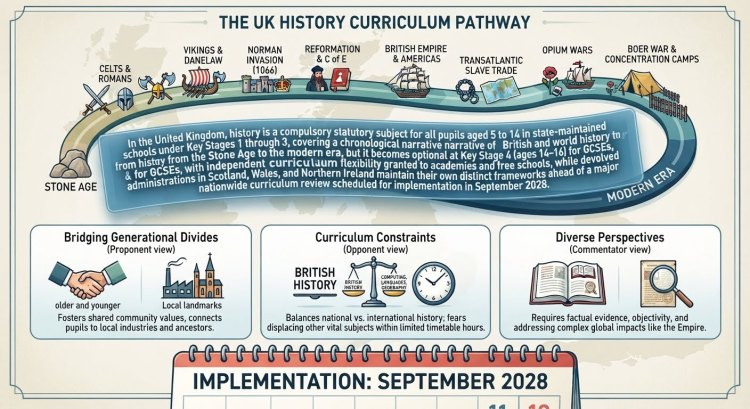
In the United Kingdom, history is a compulsory statutory subject for all pupils aged 5 to 14 in state-maintained schools under Key Stages 1 through 3, covering a chronological narrative of British and world history from the Stone Age to the modern era, but it becomes optional at Key Stage 4 (ages 14–16) for GCSEs, with independent curriculum flexibility granted to academies and free schools, while devolved administrations in Scotland, Wales, and Northern Ireland maintain their own distinct frameworks ahead of a major nationwide curriculum review scheduled for implementation in September 2028.
Proponents argue that a dedicated study of British history bridges generational divides and fosters shared community values by linking pupils to their local geography through the study of regional industries and national legal milestones, while critics counter that an over-emphasis on a singular national narrative risks being exclusionary and that the curriculum must instead honestly confront the complexities of the British Empire, colonialism, and migration to truly unite a diverse, multicultural society.
Opponents argue that the current framework already strikes an effective balance between local, national, and international history, warning that expanding domestic history would create a zero-sum conflict within strictly limited timetable hours and displace other vital disciplines like world geography, computer science, and foreign languages.
Commentators highlight that teaching history requires presenting diverse perspectives and factual evidence, emphasising that ensuring curricula remain balanced, comprehensive, and objective is essential for academic integrity across all schools.
Proponents argue that a truly complete history curriculum must honour the working-class ancestors whose manufacturing, factory, and manual labour built modern Britain’s infrastructure, emphasising that acknowledging those who performed the demanding jobs that laid the foundation for society’s survival is essential for a true understanding of the nation’s identity.
While acknowledging that all historical events possess inherent value and ideally should be taught, educators face the stark logistical reality that there is simply not enough time in the school calendar to cover everything, forcing difficult choices about which events to prioritise.
The ultimate art of history education lies in teaching the core values of the past to unite rather than divide students, fostering a shared understanding through balanced narratives that bring people together instead of driving them apart.
Given that British history is not a single narrative but a complex, multi-layered epic of migration, conquest, religious upheaval, and global empire, curriculum designers face the immense challenge of mapping out this vast timeline—spanning from the linguistic impacts of Celtic, Roman, Anglo-Saxon, and Viking invasions to the birth of the Church of England, the exploitative trade policies of the East India Company during the Opium Wars, and the brutal realities of British concentration camps during the Boer War—by strategically pacing these eras across different age groups to ensure students grasp both the foundational origins and the deeply uncomfortable chapters of the nation’s past.
Proponents of global education argue that expanding history curricula must focus on interconnected international history rather than isolated national narratives, contending that it is impossible to truly understand the past by studying a single country or aspect in isolation, as the forces that shaped modern Britain are fundamentally intertwined with global movements, conflicts, and cross-cultural exchanges.

