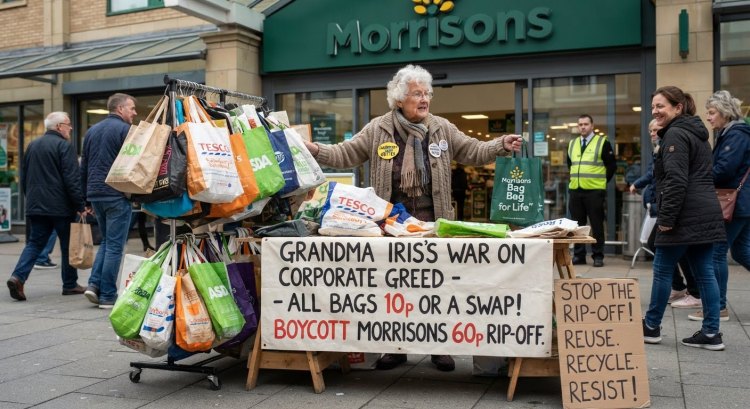
An 82-year-old grandma from Leeds has not actually declared war on corporate greed by selling second-hand carrier bags outside Morrisons; this viral story is entirely fake, based on an AI-generated image that has spread across social media platforms like Facebook and X despite clear visual flaws, such as distorted shopping trolleys.
While the story itself is fictional, the concept of a secondhand carrier bag stall actually makes a lot of practical sense because major UK supermarkets have faced growing criticism for raising the price of their “bags for life” to as much as 60p, prompting many eco-conscious community groups and “Buy Nothing” networks to set up informal, real-world “bag banks” to help shoppers bypass these high costs entirely without violating private property or street trading laws.
While major UK supermarkets like Morrisons, Tesco, and Sainsbury’s charge up to 40p or 60p for their reusable bags, real-world community initiatives actively fight these rising costs through volunteer-run “bag banks” in local hubs and grassroots groups like Morsbags, which sew unwanted household textiles into free fabric totes so shoppers can completely bypass supermarket charges while reducing plastic waste.
Shoppers are charged for carrier bags because a mandatory UK government law—originally introduced at 5p in 2015 and raised to 10p in 2021—was designed to slash plastic pollution by creating a psychological financial deterrent. This initiative successfully cut single-use bag consumption by over 95% across major supermarkets. However, the even higher 40p to 60p prices seen today are entirely down to retailers choosing to phase out those thin bags in favour of pricing their own heavy-duty “Bags for Life” at corporate discretion.
UK supermarkets generally avoid paper bags because their production and transport generate a significantly higher carbon footprint than plastic, requiring them to be reused at least three times to be more eco-friendly, which is highly impractical in the wet British climate where fragile paper easily tears when exposed to rain or heavy items.
Using collapsible plastic crates permanently stored in a car boot is widely considered one of the smartest and most cost-effective alternatives to supermarket carrier bags because they eliminate the ongoing cost of buying 60p “bags for life” while providing a rigid, stackable structure that streamlines unpacking and prevents loose groceries from rolling around during the drive home.
For non-drivers who walk or take public transport, rigid folding plastic crates are highly impractical, so they rely instead on mobile, ergonomic alternatives like personal shopping trolleys, heavy-duty backpacks, and thick canvas shoulder totes to comfortably carry large grocery loads over long distances without paying for supermarket plastic bags.
Even with alternative gear available, many shoppers still end up buying plastic carrier bags due to human forgetfulness during spontaneous, unplanned trips, as well as the convenience of repurposing those cheap supermarket bags as household bin liners or protective wrapping for messy items like raw meat and leaky packaging.
According to official data published by the Department for Environment, Food & Rural Affairs (DEFRA), the average person in England now buys just two single-use plastic bags per year from the main national supermarkets, marking a staggering 98% drop from the 140 bags per person consumed annually before the government mandate was introduced.
Supermarkets charge 40p to 60p for bags because they have completely phased out thin single-use plastic carrier bags in favour of pricing heavier, multi-use “Bags for Life” at their own corporate discretion, utilising a high price point to aggressively incentivise customers to reuse their bags rather than treating thick plastic as disposable.

