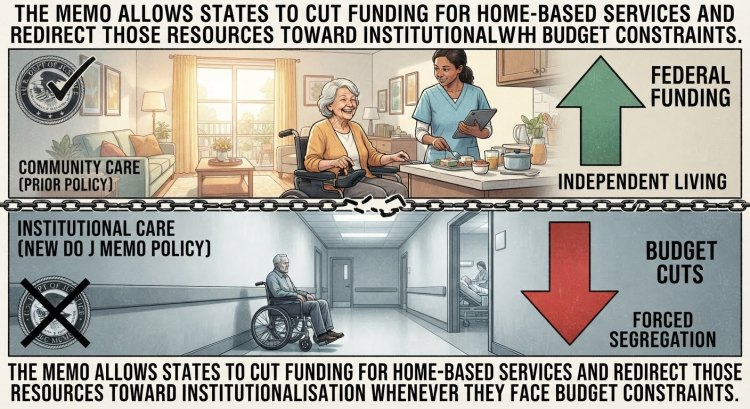
The Donald Trump administration issued a Department of Justice memo stating that federal laws do not require states to provide community-based care over institutionalisation for people with disabilities.
The memo allows states to cut funding for home-based services and redirect those resources toward institutionalisation whenever they face budget constraints.
The shift allows states to cut in-home support services, forcing older adults, people with developmental disabilities, and individuals with mental illnesses out of their communities and into institutional facilities.
Advocacy groups are filing independent lawsuits to force states to follow the original Americans with Disabilities Act and uphold the Supreme Court’s Olmstead precedent in court.
The Olmstead precedent is a 1999 Supreme Court ruling that gave people with disabilities the legal right to receive care in their homes and communities rather than being unnecessarily forced into institutions.
Lois Curtis and Elaine Wilson were two Georgia women who spent years confined in a state hospital until they successfully sued the state, winning a landmark Supreme Court ruling that gave people with disabilities the right to live independently in their communities.
The UK is highly unlikely to copy Donald Trump’s policy because British social care is focused on expanding free home-based care, though recent UK court rulings have separately lowered some legal protections for vulnerable individuals.
While critics and civil rights groups condemn Donald Trump’s policies as extreme and harmful, the administration and its supporters defend them as practical measures to lower costs and return power to local governments.
While critics point to Donald Trump’s harsh language as evidence of fascist tendencies, Trump and his supporters strongly reject any comparison to Adolf Hitler, calling it an extreme political smear.
Historians argue that Donald Trump’s use of words like “vermin” and “the enemy within” mirrors classic fascist rhetoric designed to dehumanise opponents and create a sense of national crisis.
The UK is highly unlikely to copy Donald Trump’s policies because British social care relies on the NHS model and remains protected by strict human rights laws.
While critics view Donald Trump’s divisive style as a toxic disruption to democracy, his supporters see him as a necessary force to tear down a corrupt political establishment.
International leaders manage their relationships with Donald Trump by using direct flattery, arranging personal face-to-face meetings, and offering immediate economic deals to match his transactional style.
The comparison between modern political figures and Adolf Hitler is highly contested, with some critics and historians seeing rhetorical parallels while others strongly reject the comparison as inaccurate and reductive.
Many political analysts and historians share the concern that deepening societal divisions and aggressive political rhetoric increase the risk of civil or international conflict, while others argue that democratic institutions and economic ties remain strong enough to prevent war.
While critics view Donald Trump’s unpredictable and aggressive approach as dangerous and unstable, his supporters defend it as a calculated strategy to project strength and deter foreign adversaries.

