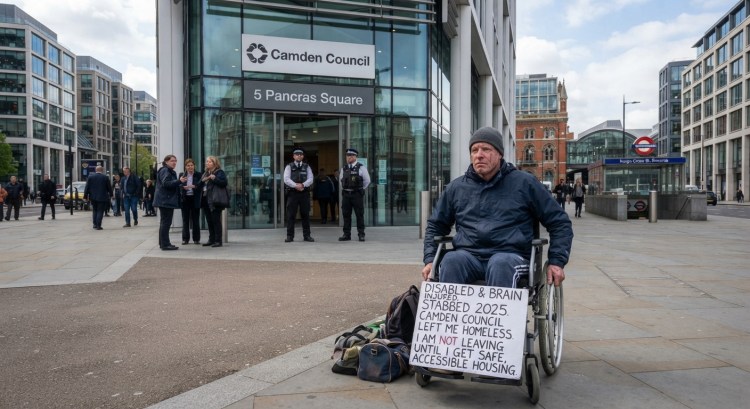
Bruce Lawrence Herry, a 52-year-old former martial arts teacher who sustained life-changing injuries and brain damage after being stabbed in the head in May 2025, staged a protest outside Camden Council’s headquarters by refusing to leave in his wheelchair until he was provided with safe, accessible housing, following months of being placed in unsuitable temporary accommodations across London, where he remains confined to a bed for 20 hours a day.
Bruce Lawrence Herry, a father of four who grew up locally attending the Rosary Primary School and St Aloysius’ College, expressed his deep despair by stating he “can’t take it any more,” explaining that while he is “no angel”, he does not deserve to be left disabled and without a carer while council officials treat his desperate housing situation like a joke.
Although Mr Herry’s severe, life-altering injuries and lack of a dedicated carer should place him at the highest priority tier under Camden Council’s Housing Allocation Scheme, he remains trapped in a bottleneck because the borough faces a massive deficit with over 8,000 households on the waitlist for only 600 annual lets, a crisis further worsened by the extreme scarcity of specialised wheelchair-accessible homes and rigid 28-day medical review processes that legally freeze an applicant’s ability to bid for any available properties while their case is being re-evaluated.
The fundamental breakdown in the system stems from a critical bottleneck where overall social housing is highly restricted—with over 8,000 households on Camden’s waitlist competing for just 600 annual lets—but the crisis is exponentially worse for disabled individuals because fully wheelchair-accessible properties are practically non-existent, forcing vulnerable applicants into an extremely rare, separate queue that averages a two-year waiting time.
Advocates for reform argue that systemic estate-wide audits are desperately needed to eliminate widespread tenancy fraud and reclaim unlawfully sublet social housing properties, which they believe would help free up vital ground-floor space for residents who are locked out of Camden Council’s points-based allocation system despite their deep local ties and critical medical requirements.
Managing this housing crisis operates exactly like a Rubik’s cube, because conducting mass estate-wide audits to evict illegal tenants would simply shift the crisis elsewhere without adding new stock, as the council would immediately become legally obligated to rehouse those newly displaced, evicted families in alternative emergency accommodation, thereby shuffling the same population around a broken system while failing to solve the fundamental problem that specialised, wheelchair-accessible homes are physically non-existent.
While the perception that small-boat asylum seekers receive priority over local residents causes widespread frustration, the hotels and temporary facilities used to house them are managed and funded entirely separately by the national Home Office, meaning they do not consume or impact Camden Council’s local social housing register, which strictly requires a multi-year local connection for permanent placements.
The systemic breakdown in the welfare state means that having complex or extra needs actually lengthens rather than shortens the wait for a permanent home, because the criteria for a safe property become so highly specific that disabled applicants are forced out of the general bidding pool and into a microscopic, stagnant market where specialised, wheelchair-adapted ground-floor units are practically non-existent.
Public commentary on the Bruce Lawrence Herry story reveals deep community divisions, with many residents expressing intense outrage at the council’s treatment of a vulnerable, disabled local stabbing victim, while others direct their frustration toward systemic issues like the nationwide shortage of accessible infrastructure and the perceived mismanagement of local housing lists.

