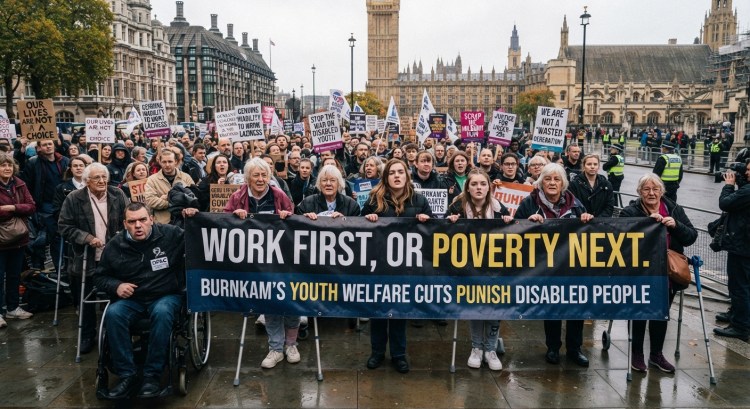
The statement “I don’t want to see anybody in their twenties on benefits in this country,” made by Prime Minister Andy Burnham during PMQs on 21 October 2026, has sparked widespread anger among disability rights advocates who argue that a one-size-fits-all approach pushes young adults with severe disabilities into poverty by ignoring their genuine inability to work.
In response to Prime Minister Andy Burnham’s rhetoric, disability advocacy groups have expressed acute alarm and severe criticism, arguing that cutting benefits for under-25s and limiting free social care to over-65s completely ignores young adults with permanent conditions, risks plunging them into deeper poverty, and fails to provide a fair, comprehensive system for working-age disabled people.
The government’s proposed welfare reforms for under-25s involve completely abolishing the Universal Credit health element and replacing cash benefits with intensive back-to-work schemes, alongside overhauling Personal Independence Payment (PIP) with a separate, tighter regime for youth, though exemptions are planned to protect young people with the most severe and profound disabilities.
While the government’s proposed plan focuses on swapping under-25 cash benefits for intensive back-to-work schemes and overhauling youth PIP, the Conservatives advocate a “tough love” approach that strips Universal Credit from young people without a work history, whereas Reform UK proposes a drastic £50 billion overhaul that restricts disability cash support strictly to the “gravely ill” while moving lower-level conditions entirely to local authority in-kind aid.
Following the publication of the Milburn and Timms reviews in late autumn 2026, the government’s under-25 welfare overhaul is expected to see tighter youth PIP rules apply to new claimants from November 2026, with legislation to replace the Universal Credit health element unveiled after the late 2026 Budget ahead of a full phase-in through 2027 and 2028.
While under current transitional protections, existing under-25 claimants have their Universal Credit health payments temporarily frozen at historical rates rather than immediately cut, ministers are explicitly reviewing whether to retroactively apply the upcoming autumn 2026 Milburn and Timms overhauls to existing recipients rather than limiting the changes to new applicants.
The upcoming Autumn Budget on 28 October 2026 is expected to formalise these decisions by locking in targeted welfare savings to force the Department for Work and Pensions to implement the under-25 Universal Credit cuts and PIP restrictions, thereby directly funding the multi-billion-pound employment and training packages proposed by the Milburn Review.
Chancellor John Healey plans to balance these welfare savings by introducing a “steady as she goes” budget that avoids main tax increases, instead driving revenues through a new tax allowance scheme alongside targeted levies.
Public comments and social media feedback on Prime Minister Andy Burnham’s remarks reveal a deeply polarised response, with critics and disability advocates aggressively condemning the rhetoric as a cruel, out-of-touch threat to vulnerable youth, while some supportive commenters argue that the focus should shift toward fixing an education and mental health system that leaves a “wasted generation” dependent on welfare.
Major UK disability charities have aggressively condemned the youth welfare proposals, with Scope UK warning that cutting Universal Credit will push more young disabled people into poverty rather than jobs, while Contact highlighted that the plans are deeply alarming for families and Sense labelled the cuts as unjust and cruel.

