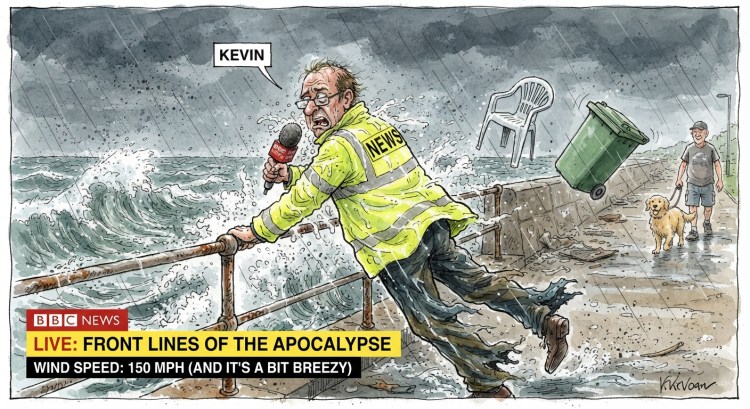
Television news companies send reporters to stand on beaches during hurricanes because nothing says “Trust our meteorology” quite like a wet bloke in a high-vis jacket getting absolutely battered by a flying patio chair.
While it looks like a bizarre form of corporate hazing, networks keep doing it for a few hilariously flawed reasons.
A studio meteorologist can look at a satellite map and say, “Winds have reached 90 miles per hour.” The viewer thinks, “Right, okay. Sounds breezy.”
But if the network sends ‘Weather-Reporter Dave’ outside, and Dave is currently leaning forward at a 45-degree angle, screaming into a foam-covered microphone while an entire wheelie bin ricochets off his shins, the viewer goes, “Ah! Ninety miles per hour. Understood.” It turns abstract weather data into physical comedy.
News executives are terrified of looking soft. If the BBC keeps its reporter safely inside a Premier Inn sipping a warm brew, but ITV sends their guy out to stand on a jetty while gripping a rusty handrail for dear life, the audience will change channels immediately. No one tunes in to watch a bloke be sensible. We want to see a man fight a wave and lose.
There is a grand journalistic tradition that says, “If I am not physically suffering, it isn’t real news.” Placing a reporter on the shoreline is the network’s way of shouting, “Look at our commitment to truth! We are risking Dave’s life so you can see exactly how wet a beach gets during a deluge!” Meanwhile, the actual camera crew is usually sheltered inside a heavily reinforced broadcast van five yards away, eating biscuits.
The best part of this tradition is how often the illusion completely shatters on live television.
The reporter is screaming about “unprecedented, life-threatening gales,” completely out of breath, only for some bloke in shorts and a raincoat to casually stroll past in the background, walking his Labrador.
Multiple reporters over the years have stood proudly on stormy shorelines to deliver a serious monologue, only to be entirely swallowed whole by a sudden, massive wave of toxic, brown sea foam.
Ultimately, until drones can mimic the specific look of a man regretting every career choice that led him to this exact moment, the “bloke on a beach” remains the pinnacle of severe weather broadcasting.
They don’t report from a sheltered spot because a sheltered reporter is a boring reporter.
If the news director sends Kevin to report from the architectural safety of a subterranean concrete multi-storey car park, the broadcast just looks like a man doing an incredibly stressful Microsoft Teams call from a basement. There is no drama. There is no texture. Crucially, there are no clicks.
The strategy for choosing the absolute worst location rests on a few beautifully unhinged principles.
News crews don’t just happen upon a bad spot; they use rigorous scientific principles to find the geographical epicentre of misery. They actively look for what structural engineers call “the wind-tunnel effect.”
If you stand in a nice, flat open field, a 100 mph wind just passes smoothly over you like a gentle caress. But if you stand on a concrete promenade right where the sea wall forces the Atlantic Ocean to explode upwards, or between two high-rise coastal hotels, the wind compresses and accelerates. The producers choose these spots specifically because it turns a standard gale into a localised particle accelerator. They want Kevin to look like he is attempting to skydive horizontally while remaining attached to a handrail.
Here is the industry’s dirty little secret: Kevin is usually standing exactly four feet away from a perfectly warm Costa Coffee.
The camera operator frames the shot with absolute precision to show nothing but Kevin, a rusty chain-link fence, and the roaring mouth of hell. But if the camera panned two inches to the left, the viewer would see a heavily reinforced, structurally sound five-star hotel, or a six-tonne satellite broadcast van parked right there acting as a massive steel windbreak.
Kevin isn’t out in the wilderness; he has just been instructed to step out from behind the broadcast van into the exact slipstream of the tempest for his ninety-second segment, before immediately retreating back inside to wrap himself in a foil space-blanket and eat a packet of salt and vinegar crisps.

