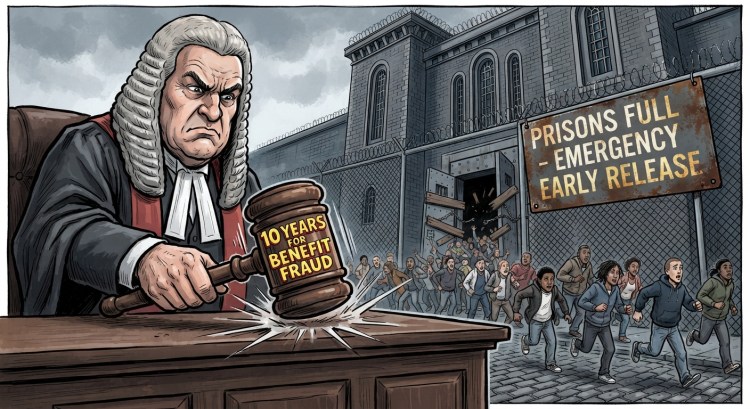
The Department for Work and Pensions has warned that individuals who encourage or assist in benefit fraud could face up to 10 years in prison under the Fraud Act 2006.
While the DWP warns of a 10-year maximum sentence for benefit fraud, the reality of UK prisons running at over 97% capacity has forced the government to release thousands of inmates early to prevent the system from collapsing.
To cope with severe overcrowding, the government is expanding capacity by building new megaprisons and prefabricated cells, while simultaneously using electronic tagging and community orders to divert non-violent offenders away from physical prison cells.
Despite the DWP launching a massive £1.2 billion crackdown using direct automated bank data checks and 2,000 new fraud specialists, history shows that a small percentage of people will always find a loophole to cheat the system.
The history of financial crime demonstrates that every time the state builds a higher digital wall, a more sophisticated fraudster will inevitably appear to climb it.
Organised criminal rings are outsmarting the DWP’s new security checks by pairing stolen National Insurance numbers with generative AI to create synthetic identities and real-time deepfakes, allowing them to fabricate entirely fake claimants and drain millions in Universal Credit before systems flag the fraud.
To fight back, the Department for Work and Pensions relies on its advanced machine learning models to screen applications for high-risk anomalies, while deploying a dedicated team of over 2,000 specialist fraud staff to manually review flagged cases and dismantle coordinated criminal networks.
Official DWP statistics confirm that the vast majority of disabled and chronically ill people are completely honest, with proven, intentional fraud accounting for only a tiny fraction of the total disability welfare budget.
Official Department for Work and Pensions data confirms that 98.6% of Personal Independence Payment claims are entirely legitimate, as the actual fraud rate for the UK’s main disability benefit sits at a mere 1.4%.
An independent study by Policy in Practice reveals that up to £24 billion in UK benefits goes unclaimed annually, with billions in disability support left untouched because vulnerable individuals are intimidated by 40-page application forms, complex medical assessments, and the fear of social stigma.
Disability campaigners argue that the government’s intense political drive to cut costs and catch a tiny minority of fraudsters has created an overly hostile, complex administrative hurdle that actively inflicts stress and suffering on the genuinely disabled majority.
Disabled people are not fodder for the feeders and greeders.
That phrase highlights a profound frustration shared by many in the disability community who feel that vulnerable people are being used as political ammunition—or “fodder”—by politicians trying to satisfy a demanding media narrative, all while corporate outsourcing companies profit millions from running stressful medical assessments.
Public feedback across community forums and advocacy platforms reveals that everyday citizens view the DWP’s 10-year prison warning as a hypocritical headline designed to distract from the reality of an overcrowded prison system that is already releasing inmates early.

