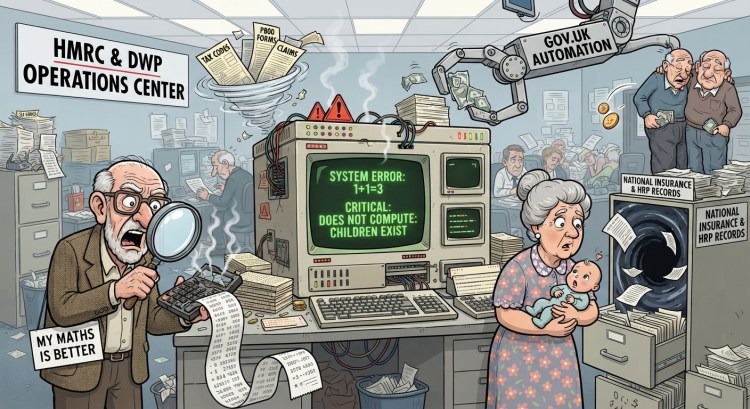
In an impressive display of institutional multitasking, HMRC and the DWP managed to accidentally rob millions of British pensioners by hilariously overtaxing 3.2 million retirees who couldn’t escape their broken math, while simultaneously shortchanging 200,000 mums and widows out of £1 billion because their ancient IT systems forgot that people who have children also exist.
HMRC’s decade-long math meltdown means they are finally coughing up the cash, trying to balance the books for 3.2 million retirees who were accidentally treated like high-rolling corporate conglomerates.
In a heroic effort to prove that simple addition is, in fact, quite difficult, the tax machinery spent over ten years treating the state pension crossover week like a luxury bonus, artificially inflating granny’s income and accidentally siphoning off an estimated £19.3 million.
The sheer scale of the mathematical chaos breaks down into three distinct brackets of bewildered taxpayers.
The PAYE Club. 1.4 million workers and retirees who thought their tax codes looked a bit creative.
The Self Assessment Survivors. 955,000 independent souls who did all their own paperwork, only for HMRC to mess up the final boss battle.
The Simple Assessment Squad. 760,000 people who trusted a system literally named “Simple,” only to find out it was anything but.
The Great “Please Don’t Sue Us” Refund Scheme
Instead of sending a massive fleet of apology cakes, the government is scrambling to fix the mess using various forms of bureaucratic wizardry.
The Stealth Edit. For PAYE folks, they are quietly tweaking current tax codes behind the scenes, hoping nobody notices the numbers shifting.
The Digital High-Five. Self Assessment accounts are getting arbitrary credits dropped into them like an accidental casino payout.
The Retrotech Remedy. For everyone else, the state is deploying the ultimate tool of 20th-century technology—the physical paper cheque—which should arrive in the post sometime before the turn of the next century.
Consumer advocates have gently pointed out that while the computer is doing some of the heavy lifting, anyone hoping for a totally seamless, roadblock-free windfall across all ten historical years might still need to get on the blower and manually argue with an automated phone menu.
The DWP’s official business model seems to be “If our computers don’t know it, it didn’t happen,” resulting in a system where you need a PhD in bureaucracy just to unlock money that was already yours.
To put their efficiency into perspective, Parliament’s Public Accounts Committee has effectively looked at the DWP’s financial ledger and stamped it with a giant “Highly Suspect” warning for 37 consecutive years due to a spectacular mix of fraud and good old-fashioned administrative chaos.
Public opinion on the HMRC and DWP pension blunder ranges from bitter amusement to total disbelief. The general consensus across UK forums and newspaper comment sections is that if a citizen made a mathematical error this large, they would be heavily fined, but when the state does it, it’s just called “Tuesday.”

