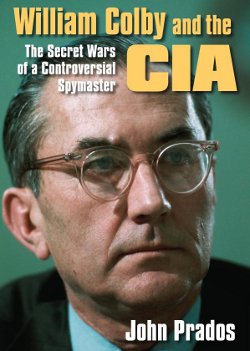
William Colby didn’t just work for the CIA. He ran it—which is wild, because he looked less like a master spy and more like a mid-level accountant who gets stressed about Excel formulas.
Colby was the ultimate “good grey man.” If you walked past him in 1974, you’d assume he managed a regional paper supply branch. In reality, he spent his youth dropping out of aeroplanes behind Nazi lines and covertly rigging European elections.
Colby’s time as Director of Central Intelligence (1973–1976) was basically the CIA’s corporate trust-fall exercise gone completely wrong.
Just as Colby took the wheel, investigative journalists and Congress started digging into the agency’s sketchy past.
Instead of shredding the evidence or practising the classic “I do not recall,” Colby went full Marie Kondo on the CIA’s secrets. He compiled a massive list of every illegal, insane thing the agency had done over the last 25 years—from domestic wiretapping to assassination plots involving exploding cigars—and handed it right over to Congress.
The rest of the intelligence community looked at him like a roommate who just told the landlord where the illegal subletter was hiding.
While old-school spies thought Colby was a total narc, his strategic over-sharing actually saved the agency. By being transparent (or as transparent as a spy chief can be), he stopped Congress from completely nuking the CIA. Instead, they just gave the agency a permanent chaperone in the form of congressional oversight committees.
President Gerald Ford wasn’t a fan of this “confession is good for the soul” strategy, though, and promptly fired Colby in 1976, replacing him with George H.W. Bush.
The “Family Jewels” is basically a 700-page burn book the CIA wrote about itself.
In 1973, William Colby ordered everyone in the agency to write down every illegal, insane, or highly questionable thing they had ever done, resulting in a literal catalogue of madness. Henry Kissinger took one look at it and told President Gerald Ford that if this stuff leaked, “blood would run.”
When the CIA finally aired its dirty laundry, the public realised the world’s most elite spy agency had spent the 1960s operating like a cross between a sci-fi villain and an episode of Looney Tunes.
The CIA desperately wanted to assassinate Fidel Castro, but instead of using elite commandos, they thought, “Hey, you know who hates communists? The Mafia.”
The CIA approached Las Vegas mobster Johnny Roselli, who put them in touch with Chicago godfather Sam Giancana.
The CIA handed the mobsters a handful of highly toxic poison pills to slip into Castro’s food. The mob tried for months, but they kept chickening out or losing their inside contacts. The world’s most powerful intelligence agency literally outsourced a hit to the mob, and it failed because of bad restaurant logistics.
This was the CIA’s highly illegal, completely unhinged attempt at mind control. For years, the agency spent millions of dollars dosing unwitting US and Canadian citizens, prisoners, and mental health patients with massive amounts of LSD just to see what would happen. They even set up fake brothels in San Francisco where CIA agents watched through two-way mirrors while unsuspecting clients were secretly slipped acid in their drinks. The takeaway? The CIA learned a lot about how to make people hallucinate, but absolutely zero about mind control.
The CIA’s charter explicitly states they are not allowed to spy on Americans on American soil. But when reporters started publishing government leaks, the CIA decided the rules were more like “strongly worded suggestions.” Under Project Mockingbird, they wiretapped the home phones of prominent Washington journalists and literally followed them around town to see who they were having lunch with.
For two decades, if you were an American citizen mailing a letter to a relative in the Soviet Union or China, there was a high chance a guy in a trench coat intercepted it. The CIA ran a massive mail-opening operation where they steamed open letters, photographed them, resealed them, and filed them away. They read over 200,000 letters, including mail sent by John Steinbeck and Martin Luther King Jr.
Because the Nixon administration was convinced the anti-war movement was being funded by foreign communists, the CIA started Project MHCHAOS. They compiled massive, illegal intelligence dossiers on nearly 10,000 American citizens whose only “crime” was protesting the Vietnam War or participating in civil rights rallies. They found absolutely no foreign communist connection, meaning they broke the law just to find out Americans really hated the war.
The CIA got so paranoid about a Soviet KGB defector named Yuriy Nosenko—convinced he was a double agent—that they threw him into a specially built, windowless jail cell on a secure military base for over two years. He had nothing but a steel cot and was subjected to intense interrogation. It turned out he wasn’t a double agent; the head of CIA counterintelligence was just completely paranoid.
When investigative reporter Seymour Hersh finally blew the lid off this dossier in late 1974, it caused a massive panic. Congress realised the CIA had been running around like a rogue black-ops fraternity, which is why we now have congressional oversight committees keeping tabs on them.
When The New York Times dropped this bombshell on 22 December 1974, the American public didn’t just spit out their morning coffee—they collectively checked their drywall for hidden microphones.
The timing could not have been worse. America was already suffering from the ultimate political hangover: Richard Nixon had just resigned over Watergate a few months earlier, the Vietnam War was a certified disaster, and trust in the government was already sitting in the basement.
Then the public found out the CIA was basically operating like a rogue fraternity with an unlimited budget. The vibe across the nation instantly shifted from “patriotic pride” to “extreme, twitchy paranoia.”
Before December 1974, if you told your neighbour that the government was steaming open your mail, tapping your phone, and trying to invent mind-control potions, they would have told you to put down the tinfoil hat. After the article dropped, those exact “crazy” people were suddenly looking at everyone else like, “I told you so.”
Everyday Americans suddenly had to accept that their local anti-war book club or civil rights march wasn’t just a community gathering—it was a file in a shadowy Langley dossier.
The public’s cynicism was so intense that Hollywood immediately turned it into a business model. The mid-1970s became the golden era of movies where the government is the bad guy.
Films like Three Days of the Condor (where Robert Redford discovers his CIA coworkers have all been assassinated by the CIA) perfectly captured the public mood. Americans went from watching James Bond save the world to watching movies where the guy in the trench coat is tapping your blender.
The public outcry was so loud that politicians in Washington had to pretend to be shocked, too. But the funniest part of the congressional fury was the sudden realisation that the CIA hadn’t just been spying on citizens—they’d been keeping tabs on politicians, too.
Senator Frank Church famously called the CIA a “rogue elephant” that was rampaging out of control. Meanwhile, the public realised the CIA wasn’t actually a rogue elephant at all; it was more like the White House’s personal raccoon, doing the exact illegal garbage disposal jobs that presidents from Eisenhower to Nixon had quietly told it to do.
To stop people from literally rioting, the government had to launch the Church and Pike Committees—televised congressional hearings that became absolute must-watch TV.
The public tuned in by the millions to watch stone-faced spy chiefs get dragged in front of microphones to explain things that sounded like a comic book. In one famous moment, Senator Church held up a CIA-engineered poison dart gun that could shoot a tiny dart, cause a silent heart attack, and completely dissolve. It was the moment America realised its tax dollars hadn’t gone to high-tech Cold War defence—they’d gone to ACME-style supervillain gadgets.
Ultimately, the public reaction permanently broke the spell of post-WWII government trust. It transformed the CIA from a symbol of suave, patriotic espionage into the ultimate pop-culture shorthand for “shadowy government agency trying to steal your thoughts.”

