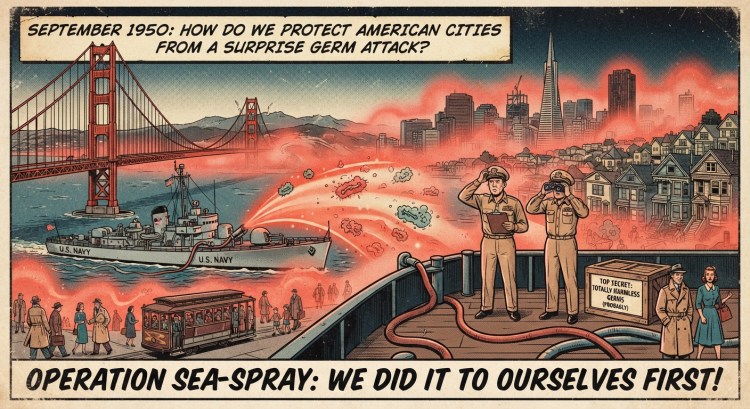
In September 1950, the U.S. military looked at the terrifying threat of Cold War biological warfare and asked a profound question: “How do we protect American cities from a surprise germ attack?”
Their brilliant, totally normal solution? Secretly launch a surprise germ attack on San Francisco themselves.
For six days, a U.S. Navy minesweeper parked itself just off the Golden Gate and casually misted the Bay Area with 50 gallons of bacteria. If anyone noticed, they probably just assumed Karl the Fog was having a really weird week.
The military picked two bacteria—Serratia marcescens and Bacillus globigii—because they glowed bright red and orange under lab lights, making them super easy to track. The Pentagon’s finest minds assumed these germs were 100% harmless to humans, essentially treating 800,000 Californians like a giant, unconsenting petri dish.
Turns out, San Francisco’s famous coastal breeze is fantastic at distributing airborne pathogens. Scientists set up 43 monitoring stations and high-fived each other when they discovered the bacteria had drifted 23 miles inland, ensuring almost every man, woman, and sourdough starter in the city inhaled a few million particles.
Remember how the bacteria were supposed to be harmless? A week later, 11 people checked into Stanford University Hospital with mysterious, glowing-red urinary tract infections. Doctors were baffled—mostly because the Navy forgot to mention they had just crop-dusted the city. (Sadly, one patient didn’t survive, which really killed the mood of the Pentagon’s “Mission Accomplished” party.)
The military liked the results so much they kept it secret for 26 years and went on to run 238 more secret germ tests across the country—including dropping bacteria-filled lightbulbs into the New York City subway.
When Congress finally found out in 1977, the military’s official defence was essentially: “Look, we proved a bioweapon attack would totally work, so you’re welcome.”
The U.S. military really looked at the whole concept of “informed consent” and thought, “Nah, that’ll ruin the vibe of the data.”
The brass figured that if they sent out a friendly neighbourhood flyer saying, “Hey San Francisco, please breathe normally while we mist you with mystery germs,” people might act weird, stay indoors, or—heaven forbid—ask questions. To keep the data “pure,” 800,000 people were drafted into a clinical trial without even getting a free tote bag out of it.
While families were packing lunches and kids were walking to school inhaling millions of invisible microbes, the Navy was quietly taking notes from the sidelines. Meanwhile, local doctors were left playing a high-stakes round of House, M.D. when rare red-tinted infections started popping up in the ER, completely unaware the Pentagon was holding the answer key.
The government held onto this secret longer than most people hold onto a grudge. An entire generation lived their lives in the Bay Area without ever knowing their morning commute was sponsored by the Department of Defence.
When the truth finally leaked in 1977, the government didn’t even send a “Sorry we crop-dusted you” card—they just argued in court that keeping secrets from the citizens they were protecting was totally standard operating procedure.
When Edward Nevin’s family finally dragged Uncle Sam into court in the 1980s, the Justice Department pulled off the ultimate legal version of “New phone, who dis?”
Instead of apologising for crop-dusting an American city, government lawyers rolled into Nevin v. United States with a two-step routine that would make a shady used-car salesman blush.
First, the government invoked a glorious bureaucratic loophole called the “discretionary function exception.”
Under the Federal Tort Claims Act, you can normally sue the government if a federal employee accidentally backs a mail truck into your mailbox. However, if a top general sits down and deliberately decides to fog 800,000 people with mystery microbes as a “national security policy,” that’s high-level strategy!
Justice Department lawyers essentially told the judge, “Your Honour, secretly spraying San Francisco wasn’t a sloppy mistake—it was an official Pentagon brainstorming session. Therefore, we are legally untouchable.”
Just in case the judge wasn’t buying the whole “we have a constitutional right to mist Californians” angle, the government had a backup plan: gaslighting the microbiology.
Lawyers argued that the exact strain of Serratia marcescens sprayed off the Golden Gate was slightly different from the one that showed up in Stanford Hospital days later. Yes, the Navy dumped 50 gallons of a super-rare bacterium onto the city, and yes, 11 people immediately got infected with that exact super-rare bacterium for the first time in the hospital’s history, but surely that was just a quirky, unrelated coincidence!
The defence also pointed out that in 1950, medical books said the bacterium was totally harmless. Basically: “How were we supposed to know spraying germ clouds at recovering surgery patients was bad? It wasn’t in the syllabus!”
The federal judges ate it up. The courts ruled that picking which bacteria to spray on unsuspecting taxpayers was a protected executive privilege, and the Supreme Court declined to even look at the appeal.
The Pentagon walked out of court completely off the hook—proving that if you’re going to run a questionable science experiment, you just need to classify it as “national defence” first.

