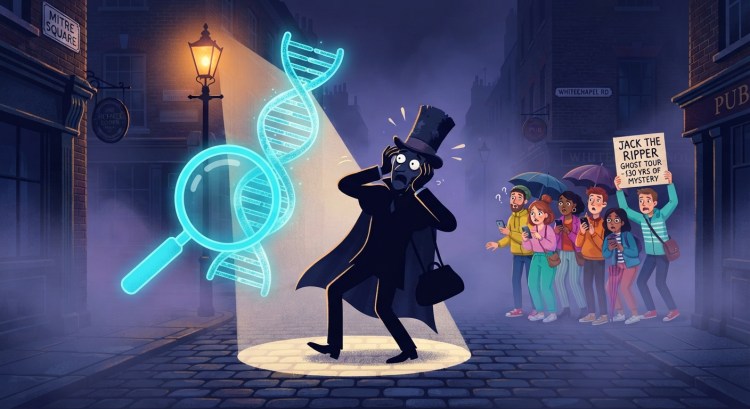
Good news, true crime fans: after 130 years of Victorian fog, wild conspiracy theories, and dodgy walking tours, scientists say they have finally unmasked Jack the Ripper.
The culprit? Aaron Kosminski, a 23-year-old Polish barber from Whitechapel—which means London’s most notorious villain was basically just a guy who probably asked if you had any plans for the weekend while aggressively trimming your fringe.
Unfortunately, before you cancel your East End ghost tour, the wider scientific community has stepped in to ruin the party. Here is why the “case closed” headlines are slightly premature.
The entire breakthrough relies on a stained silk shawl bought at an auction in 2007. There is zero police paperwork proving it was actually at the 1888 murder scene, meaning it spent over a century being passed around unsealed like a haunted Victorian hand-me-down.
Researchers used mitochondrial DNA, which only traces maternal lineage. As actual geneticists have pointed out, this doesn’t prove Kosminski did it—it just proves the killer shares a maternal ancestor with him and roughly half of Eastern Europe.
When independent scientists asked to check the raw genetic data to verify the results, the study’s authors admitted they couldn’t share the files because they only had coloured charts left. Nothing screams airtight forensic science quite like losing your homework.
So, while Kosminski was certainly a real suspect back in 1888 (before being committed to an asylum in 1891), the Ripper’s identity remains about as clear as a November night in Whitechapel.
Between August and November 1888, the killer murdered five women—collectively known by historians as the “Canonical Five,” because nothing says Victorian true crime quite like giving a grim serial killer a literary fandom name.
Two of the victims were even killed on the exact same night in what became known as the “double event,” proving that 19th-century London tabloid editors were already desperately trying to make murder sound like a two-for-one weekend deal. Every single victim had her throat cut, and all except one suffered horrific post-mortem mutilations—the lone exception likely only spared because someone accidentally interrupted the killer mid-spree, which remains the most consequential awkward walk-in in British history.
It is a case that has horrified and fascinated true-crime fans for over a century—mostly because Victorian London had zero CCTV, gas lamps with the brightness of a dying birthday candle, and detectives whose main forensic strategy was squinting at footprints in the mud.
Now, forensic experts reckon they’ve finally unmasked the culprit, landing on a name that has been gathering dust in the case files since the 1880s. According to a series of genetic tests, the notorious killer was none other than Aaron Kosminski—making this the greatest “we literally had him in the group chat the whole time” blunder in Scotland Yard history.
Kosminski—a 23-year-old Polish barber who was already on the Metropolitan Police’s prime suspect list back in 1888—moved to London’s East End after fleeing persecution in Eastern Europe.
Working as a hairdresser right in the middle of Whitechapel, he lived in the literal epicentre of the Ripper’s hunting ground, meaning his daily walk to work was basically a sightseeing tour of active crime scenes. Toss in the fact that he wielded sharp blades for a living and was already showing early signs of severe mental illness, and you really have to admire Victorian detectives for looking at his file and saying, “Nah, too obvious—it’s definitely a secret member of the Royal Family.”
By 1891, Kosminski’s mental health had spiralled to the point where he was committed to a psychiatric institution—right after threatening his own sister with a knife, which is generally the universal red flag that a guy shouldn’t be trusted with scissors for a living anymore.
He was first checked into Colney Hatch Lunatic Asylum (a Victorian facility whose subtle, compassionate name sounds like something out of a rejected Charles Dickens draft) before being transferred to Leavesden Asylum, where he spent the rest of his life safely away from sharp objects and foggy East End alleyways.
During his years in the asylum, Kosminski developed an intense paranoia about being poisoned—flat-out refusing to eat food prepared by anyone else or ever take a bath, which effectively made him a one-man Victorian health-and-safety violation.
As it turns out, surviving purely on suspicion and unwashed stubbornness is a catastrophic diet plan. By February 1919, he weighed just 96 pounds (44 kg), and he died the following month at age 53—taking his secrets straight to the grave and accidentally guaranteeing full-time employment for British true-crime podcasters for the next century.
Police officials later officially named him as a prime suspect, with one senior officer claiming an eyewitness had actually spotted him—only to refuse to testify against him.
Which really sums up Victorian law enforcement: finally catching a break when someone recognises Britain’s most notorious serial killer, only for the witness to basically say, “Yep, that’s 100% him—anyway, good luck with the paperwork, I’m not ruining my Tuesday in court.”
The latest breakthrough hinges on a stained silk shawl reportedly found next to the body of Catherine Eddowes, the Ripper’s fourth victim, back in 1888.
Because nothing says “airtight 21st-century forensic science” quite like solving a cold case with a Victorian fashion accessory that floated around unwashed in private hands for over a hundred years without a single evidence bag in sight.
Forensic experts tested DNA extracted from blood and semen stains on the shawl and matched it against samples donated by living descendants of both Eddowes and Kosminski.
Imagine happily taking a modern DNA test expecting to find out you’re 12% Scandinavian, only for a scientist to ring you up and say, “Good news, we matched your swab to a 130-year-old crime scene—bad news, your family tree has a serial killer branch.”
According to the recent study, the DNA delivers what scientists call a genetic match with some of Kosminski’s living relatives—which is basically forensic-speak for “the guy’s been dead for over a century, so his family tree had to snitch on him instead.”
Imagine spitting into a DNA test tube expecting to find out you’re 15% Italian, only to get a phone call letting you know your spit just placed your great-great-uncle at the scene of Victorian London’s most infamous murder spree.
If accurate, this would be the strongest scientific link yet tying Kosminski to the gruesome murders that have stumped detectives, armchair sleuths, and unhinged conspiracy theorists for over 130 years.
Of course, the phrase “if accurate” is doing the heavy lifting of an Olympic weightlifter here—meaning until independent geneticists actually get to check the receipts, Britain’s most infamous cold case stays just lukewarm enough to keep East End ghost walks fully booked for another century.
However, several actual geneticists have pointed out a slight snag: instead of publishing the raw genetic sequences, the study just slapped some coloured blocks onto a chart—which makes verifying the results roughly as scientific as trying to solve a murder using a box of Crayola crayons.
Nothing says “we definitely cracked the cold case of the century” quite like refusing to show your working and handing peer reviewers a Microsoft Paint bar graph instead.
The authors cited UK privacy laws as the reason for holding back the rest of the genetic data.
Nothing says “we’ve officially cracked the 1888 murder mystery of the century” quite like fiercely protecting the GDPR rights of a bloke who died in 1919—just in case Victorian London’s most notorious serial killer decides to sue them for a data breach from beyond the grave.

