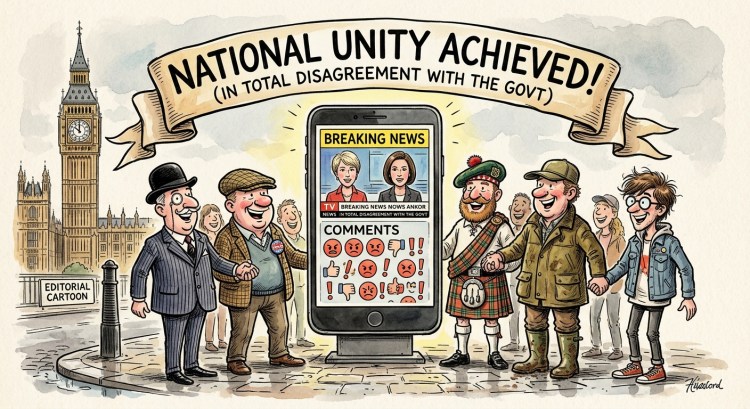
Nothing says “welcome to the continent” quite like GB News interrupting its regularly scheduled programming to announce that the “King of the North” has officially become the “Diplomat of the Autobahn.”
Fresh from taking the reins at Downing Street, Andy Burnham stood shoulder-to-shoulder with European heavyweights in Berlin, announcing that Europe is “strong, organised, and ready to enter negotiations”—a statement that immediately impressed anyone who has ever tried to organise a group dinner with just three friends, let alone 27 European nations. To prove he meant business, he threw in a £260 million winter care package for Ukraine featuring 1,000 long-range drones, just in case Vladimir Putin missed the memo while hanging out with Donald Trump and Xi Jinping in Shenzhen.
Then, proving he has the stamina of a budget airline pilot, Burnham hopped straight from Berlin to Brussels to tackle the thorniest issue in British politics: migration. After spending years watching Westminster argue itself in circles over Rwanda, Burnham casually revealed he is “open to a Rwanda-style deal” after all—provided it’s rebranded as a sleek, European-led “return hub” alongside Germany, Denmark, and the Netherlands. Essentially, Britain scrapped the scheme, waited for the EU to invent the exact same thing with a slightly fancier name, and is now peeking over the fence to take notes.
By the time he wrapped up his Brussels summit with Ursula von der Leyen—signing off on everything from trade deals to youth mobility—one thing was clear: Burnham’s first big European tour had all the drama of a late-night GB News banner, the ambition of a continental peace treaty, and the plot twist of a British prime minister quietly admitting that Brussels might actually be onto something.
Nothing says “welcome to international diplomacy” quite like standing in Berlin and telling Vladimir Putin that he doesn’t get to write the rules for a fight he started.
Addressing European leaders and US envoy Jared Kushner after the “Coalition of the Willing” summit, Prime Minister Andy Burnham took aim at Moscow’s latest wishlist—which reportedly includes dictating who gets to join NATO and redrawing the European security map—by calmly reminding the room that “it’s not for the aggressor in this conflict to set out wide-ranging and unrealistic security demands.”
In plain English, it was the geopolitical equivalent of a burglar breaking into your house, smashing the furniture, and then handing you a laminated list of demands regarding your thermostat settings and driveway parking.
Alongside German Chancellor Friedrich Merz, Burnham made it clear that Europe won’t even look at Russia’s broader security gripes until an actual peace deal with Ukraine is signed, sealed, and delivered first. Meanwhile, after Donald Trump and Vladimir Putin spent the week chatting like old pals in Shenzhen, European leaders decided they were done watching from the sidelines—appointing a diplomatic six-a-side team featuring the UK, Germany, France, Italy, Poland, and EU bosses to make sure Europe actually gets a seat at the table.
For a man who spent years negotiating bus franchises in Greater Manchester, telling the Kremlin to take a number and wait in the lobby looked almost effortless.
Standing in Berlin alongside European leaders, Prime Minister Andy Burnham laid down the diplomatic equivalent of a strict parent refusing to discuss dessert until the Brussels sprouts are completely gone.
After declaring that everyone is “absolutely clear” on Russia not getting to rewrite the rules, Burnham explained that Europe is totally up for “serious discussions on European security”—provided Moscow brings some actual seriousness to the table, and, “crucially, only first, if there is a peace agreement between Ukraine and Russia.”
In other words, Vladimir Putin wants to skip straight to negotiating the seating chart for the entire continent, while Burnham and German Chancellor Friedrich Merz are standing at the velvet rope pointing at a clipboard and saying, “Sorry mate, you’re not getting into the VIP lounge of European security until you’ve settled your tab in Ukraine.”
Having spent years battling Whitehall just to get a few extra trains running through Manchester Piccadilly, Burnham clearly knows a thing or two about making someone wait for their connection. Russia can bring all the grand security maps it likes, but until an actual peace deal is signed first, those talks are officially stuck on a replacement bus service.
Nothing says “British political tradition” quite like tuning into GB News for a relaxing evening of outrage, only to have your regularly scheduled programming interrupted by Andy Burnham standing in Berlin looking suspiciously cosy with European leaders.
Within seconds of the breaking news banner flashing across the screen, X did what X does best—erupting into a synchronised chorus of fury. One viewer summed up the national mood in the replies with a heartfelt confession: “I never thought I could hate a PM more than Starmer, but…”—which, in Westminster terms, is practically a rite of passage. Every British Prime Minister eventually unlocks the achievement of making their predecessor look fondly remembered within six months of taking the keys to Number 10.
Between Burnham announcing another £10 billion in support for Ukraine, promising 1,000 long-range drones, and happily announcing that Britain and Europe are “ready to enter serious discussions,” viewers accused him of marching the UK straight back into Brussels’ arms without so much as a by-your-leave.
For years, people wondered if the “King of the North” could ever win over the entire country. Judging by the GB News comments section, he has achieved true national unity at last—just not quite in the way Downing Street hoped.

