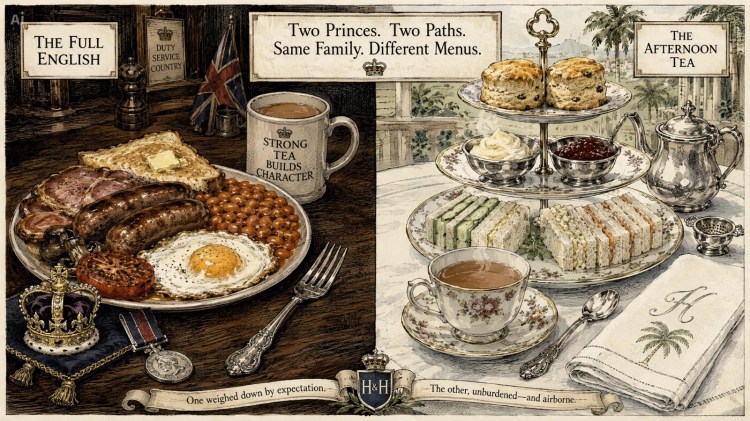
Deciding which royal brother is more patriotic is a bit like arguing over whether a full English breakfast is better than afternoon tea—both are aggressively British, just served in entirely different ways.
During a November 2026 trip to Ukraine, Harry told The Telegraph he would “100 per cent” rejoin the British Army to fight Russia if needed—proving he’s always ready to swap a podcast mic for a helmet.
Supporters point out he spent a decade in the Army, flew Apache helicopters on two tours in Afghanistan, and founded the Invictus Games.
Less impressed commentators, like Adam Boulton on Sky News, have brushed the pledge off as a bit of self-serving PR, noting it is easy to volunteer for the front lines when Palace protocol and security logistics make it roughly as likely as the King opening a TikTok shop.
As heir to the throne, William’s version of patriotism involves cutting ribbons, shaking thousands of hands, and keeping a polite, neutral smile fixed on his face until the end of time.
William also served for over seven years in the military as an RAF Search and Rescue pilot, though Palace officials strictly banned him from combat zones—mostly because losing the future King in a firefight creates a massive paperwork headache.
While traditionalists praise his steady devotion to the Crown, critics sometimes view his cautious, strictly scripted public persona as playing it safe compared to his younger brother’s willingness to speak off the cuff.
In the end, whether you lean toward Harry or William depends entirely on your preferred flavour of Britishness: bold, unscripted, and ready to charge into battle, or stoic, constitutional, and quietly holding down the fort.
Calling Prince Harry a “dangerous fool” over his military offer is definitely one of the spicier takes in the UK press, though commentators are split on whether he’s being a geopolitical loose cannon or just a loyal veteran talking tough.
Depending on which British newspaper you pick up, his November 2026 pledge to The Telegraph to fight Russia gets framed in two wildly different ways.
Military analysts have pointed out that putting a global celebrity in a trench is less of a morale boost and more of a giant neon sign for enemy artillery—which is generally frowned upon by the guys standing next to him.
Critics like Adam Boulton on Sky News essentially view his remarks as freelancing on UK defence policy, arguing that freelancing on World War III is a terrible hobby for a royal.
Sceptics note that as a 42-year-old who left the Army over a decade ago, offering to suit up against a nuclear superpower carries zero risk of the Ministry of Defence actually calling his bluff.
Defenders argue you can’t call someone a total fool when he actually spent ten years in the Army and flew Apache helicopters on two tours in Afghanistan—meaning he’s one of the few people commenting who actually knows which end of a missile is which.
Supporters see his comments during his visit to Ukraine less as a literal enlistment application and more as an emotional show of support for wounded troops and allies, fitting right in with his Invictus Games persona.
In short, critics see a man casually volunteering for a war he’ll never have to fight, while supporters see an old soldier who still instinctively reaches for his boots whenever trouble starts.

