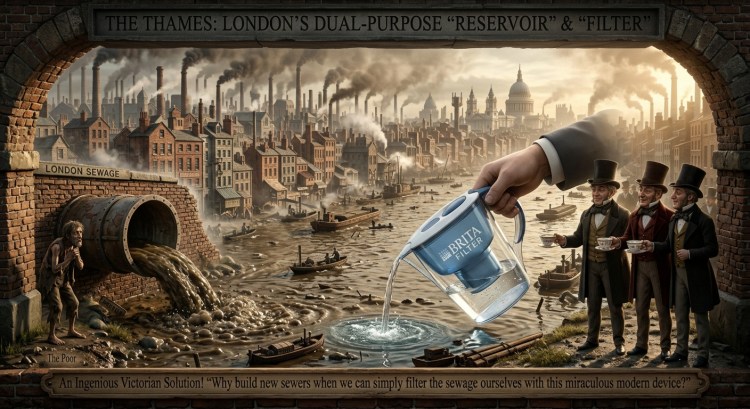
Throughout the first half of the 19th century, Londoners had a remarkably consistent—and catastrophic—approach to city planning: take millions of people, cram them into Victorian tenements, and use the River Thames as both the city’s toilet and its giant Brita filter.
Unsurprisingly, three massive waves of cholera wiped out tens of thousands of Londoners between 1831 and 1854, proving that drinking your neighbour’s sewage is generally bad for your health. Known charmingly as the “blue death” because severe dehydration turned victims a lovely shade of Smurf, cholera repeatedly humbled the capital of the British Empire.
Cholera first crashed the British party in late 1831, killing 32,000 people nationwide. London’s authorities responded with sheer panic, prayers, and, once the outbreak ended, a collective decision to change absolutely nothing.
Cholera came back bigger and meaner, claiming 14,000 Londoners. Parliament passed the Public Health Act of 1848, bravely tackling the crisis by focusing entirely on the wrong thing.
Just as London thought it was safe, an explosion of cholera in Soho killed hundreds in a matter of days. The culprit? A single, wildly popular public water pump on Broad Street that was essentially serving a vintage blend of well water and cesspit runoff.
At the time, top medical minds swore by “miasma theory”—the belief that diseases were spread by bad smells. Sanitary reformer Edwin Chadwick’s brilliant solution to clear the smelly streets was to flush all of London’s cesspits straight into the Thames. This cleared the air and efficiently poisoned everyone’s afternoon tea.
Enter Dr John Snow (no, not the one from Game of Thrones, though both dealt with bleak winters and sudden death). Snow mapped the 1854 Soho deaths, noticed they all circled the Broad Street pump, and realised people were literally drinking the disease. He convinced local officials to take the handle off the pump, effectively inventing modern epidemiology and ruining Soho’s favourite hydration station.
Naturally, the medical establishment told Snow he was crazy because nobody wanted to admit they’d been guzzling sewage for decades. It took the “Great Stink” of 1858—when a summer heatwave cooked the raw waste in the Thames so badly that Members of Parliament nearly passed out in the House of Commons—for anyone to act. Suddenly motivated by their own nostrils, politicians funded engineer Joseph Bazalgette to build a proper sewer system, finally convincing Londoners to stop drinking their own bathwater.
In the summer of 1858, Mother Nature finally snapped. After decades of watching London treat the River Thames like a bottomless frat-house toilet, the weather gods teamed up with basic thermodynamics to trap the British government inside a giant, simmering crockpot of its own citizens’ poop.
The “Great Stink” forced Parliament to pass a massive sewer-building bill in just 18 days, proving that while Victorian lawmakers could cheerfully ignore tens of thousands of peasants dying of cholera, they immediately folded the second their own nostrils were personally offended.
For years, London dumped human waste, dead dogs, slaughterhouse guts, and industrial runoff straight into the Thames. Then, someone invented the flushing toilet, which everyone loved—except it meant millions of extra gallons of fresh, liquified waste were suddenly being power-washed into the river daily.
In June 1858, a vicious heatwave hit London, baking the city at over 30°C. The Thames shrank to a sad, sluggish trickle, leaving six-foot-deep banks of raw sewage fermenting in the sun like a giant, sun-dried turd lasagna.
Even Royalty Bailed. Queen Victoria and Prince Albert hopped on a boat for a lovely, romantic summer cruise down the Thames. They lasted about three minutes before the stench punched them in the face, and they ordered the captain to smash that reverse button.
Because the shiny new Houses of Parliament had been built right on the riverbank, politicians were sitting directly in the splash zone. Worse yet, since Victorian “science” still swore that bad smells caused instant death, MPs genuinely believed the river was trying to assassinate them via fart-gas.
Desperate to keep debating laws without passing out, staff soaked Parliament’s heavy curtains in chloride of lime (industrial bleach). Spoiler: it didn’t work. It just made the room smell like a public swimming pool that someone had violently diarrhoea’d in.
Future Prime Minister Benjamin Disraeli bravely marched into a riverside committee room, took one deep inhale, and immediately sprinted out in terror—clutching his files in one hand and jamming a perfumed hankie into his nostrils with the other. He later called the river a “Stygian pool reeking with ineffable and unbearable horror,” which is fancy 19th-century politician for “Bro, I almost threw up in my top hat.”
Lawmakers were gagging so hard they seriously debated abandoning London altogether and moving the entire British government to Oxford or St Albans—essentially trying to outrun a smell.
In a fit of blind panic, authorities dumped over 200 tons of lime directly into the river to neutralise the stink. They might as well have sprayed a single squirt of Febreze at a burning dumpster.
Normally, getting a bill through the British Parliament took years of endless speeches, tea breaks, and bureaucratic napping. Yet, fueled entirely by pure, unadulterated gag reflex, Disraeli introduced a bill on July 15 to fund engineer Joseph Bazalgette’s mega-sewer system. By August 2—a blistering 18 days later—it was signed into law. Turns out, nothing inspires bipartisan cooperation quite like dry-heaving during a budget meeting.

