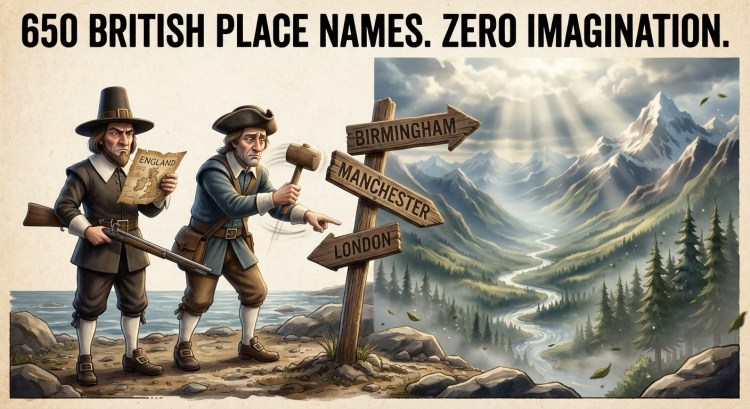
Around 650 American cities share names with places in Britain, proving that when early settlers arrived in a vast, untamed new continent full of endless possibilities, they immediately ran out of imagination.
Instead of inventing anything original, they mostly just looked around at the sweeping landscapes and thought, “You know what this reminds me of? Slough.”
The boldest move was just stealing the name outright and hoping nobody back home noticed. That’s how we ended up with a sunny, palm-tree-lined Birmingham in Alabama and a Manchester in New Hampshire, completely divorced from the drizzle and roundabouts of the originals.
When settlers felt slightly guilty about plagiarising, they slapped the word “New” in front of it and called it a day. New York, New Jersey, New London—it’s the historical equivalent of naming your second dog “New Toby.”
If they weren’t homesick, they were trying to flatter the folks paying for the trip. Cities like Charleston (King Charles II) and Baltimore (Lord Baltimore) were basically giant real-estate thank-you cards written to rich aristocrats who never actually visited.
To be fair, it works out great for confusing tourists. Nothing quite matches the existential dread of booking a flight to London and accidentally ending up in Kentucky, or expecting historic cobblestone streets in Boston and getting yelled at about parking in Massachusetts instead.
Early British settlers crossed the Atlantic in the 17th and 18th centuries for a glorious mix of greed, religious drama, and having literally no other options—basically treating North America like the ultimate emergency exit from 1600s Britain.
Early ventures like Jamestown in 1607 were funded by wealthy investors convinced the East Coast was just lying around covered in gold and silver. When they arrived and found mostly swamps and mosquitoes, they pivoted to growing tobacco—making them the world’s first successful startup pivot.
Groups like the Pilgrims and Puritans felt the Church of England was way too relaxed and wanted the freedom to practice their own brand of ultra-strict Christianity. Once they arrived in New England, they immediately celebrated this newfound freedom by banning anyone who disagreed with them.
England was overcrowded, broke, and suffering from terrible inflation. Thousands of desperate people signed up as indentured servants—essentially agreeing to work for free for seven years in exchange for a cramped boat ride and the vague promise of a patch of dirt at the end.
17th-century Britain was a non-stop soap opera featuring civil wars, a beheaded king, and constant regime changes. Whenever the political pendulum swung the wrong way, the losing side usually decided putting an entire ocean between themselves and the guillotine—or the chopping block—was a great self-care move.
Plenty of settlers didn’t actually choose to go. Britain eventually realised America was a great place to offload convicts, debtors, and political prisoners, turning a terrifying trans-Atlantic voyage into the 18th-century version of community service.
Saying America was founded as a giant global cesspit is a classic British pub roast, and to be fair, it’s not entirely wrong—it was just a much more diverse trash fire than people give it credit for.
Rather than just shipping over one specific type of problem, Britain essentially used the Atlantic Ocean as a giant sorting bin for everyone who didn’t fit into 17th-century polite society—mixed in with a few rich guys trying to monetise the chaos.
Britain really did ship over about 50,000 convicts. Before you picture a boat full of ruthless pirates, remember that 18th-century British law was unhinged—you could get deported for stealing a loaf of bread, a handkerchief, or looking at a nobleman’s sheep the wrong way.
Roughly half of the white settlers were indentured servants. They weren’t criminals; they were just regular people so violently priced out of the British housing market that signing away seven years of free labour seemed like a solid alternative to renting in London. (Some things never change.)
While Britain exported its petty thieves, it also exported its most exhausting moral purists. The Puritans didn’t leave because they were oppressed; they left because nobody back home wanted to hang out with people who thought fun was a sin.
Mixed in with the outcasts were the younger sons of British aristocrats who weren’t going to inherit the family castle. They hopped on boats to buy massive plantations, cosplaying as medieval lords in a swamp.
Once Britain got the ball rolling, the rest of Europe—plus hundreds of thousands of enslaved Africans brought against their will—ended up in the mix, creating a chaotic mashup of the desperate, the ambitious, and the outright kidnapped.
So yes, America started out as a bit of a historical clearance rack—just one where the clearance items immediately decided they were better than the store.

