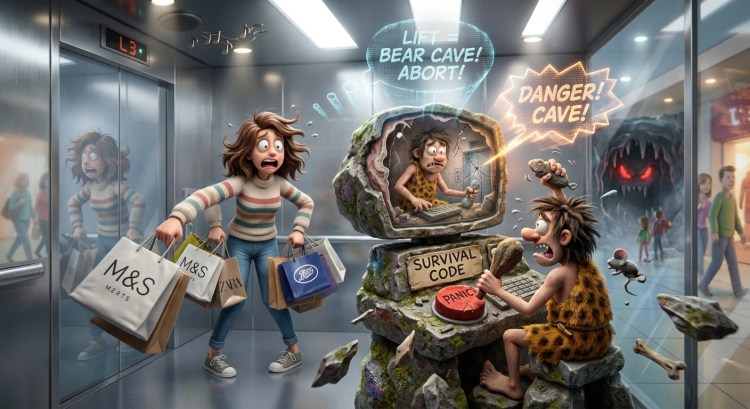
Think of a phobia as having an overdramatic, sleep-deprived security guard living inside your head who treats a harmless house spider like an armed bank robber.
The weirdest part is that the person with the phobia knows it is ridiculous. Their logical brain is sitting there saying, “Mate, that is literally a piece of fluff,” while their ancient caveman brain slams the big red panic button and floods their body with enough adrenaline to fight a bear.
Human brains are still running on prehistoric survival code. Back then, being terrified of heights, dark caves, and venomous creatures kept our ancestors alive, so our brains never got the memo that a lift in a shopping centre is not a death trap.
If you got trapped in a toilet cubicle at age seven, your brain files “small rooms” under Immediate Mortal Danger forever. It holds a grudge worse than an ex.
Kids are basically tiny sponges. If a child watches their parent scream and climb onto a dining chair over a daddy-long-legs, the child’s brain takes notes and assumes the bug has a black belt in karate.
When you cross the street to avoid a tiny dog, you feel instant relief. Your brain mistakes that relief for a heroic survival victory, cheering, “Great job, we lived! Let’s never go near a dog again!”
Half the time, people are not even scared of the plane or the clown. They are terrified of having a full-blown panic attack in front of strangers and becoming a viral video.
Because phobias make zero logical sense, people often feel too embarrassed to talk about them, so they just quietly build their entire life around dodging their triggers.
Willpower cannot fix it because you cannot politely debate a panicked lizard brain. Usually, it takes gently proving to that overzealous security guard—often with a bit of professional help—that the threat is actually a false alarm.
Despite the name, transphobia is less like screaming at a spider and more like someone having a meltdown because you rearranged the furniture in a room they never even visit.
It is one of the weirdest quirks of human psychology that people can get so fiercely invested in someone else’s personal business.
Nobody is actually diving behind the sofa in terror when a trans person walks past. The suffix just means prejudice, though some people do react as if someone else’s gender is contagious.
Many folks spent decades sorting humanity into two neat boxes labelled pink and blue. When someone ignores the sorting system, their brain freezes like an old laptop trying to run brand-new software.
Most loud critics have never knowingly met a trans person in real life. They are essentially losing sleep over fictional villains they invented after watching too much angry telly.
Some people treat another person’s transition like a direct insult to their own traditional lifestyle. It is the emotional equivalent of getting furious at your neighbour for ordering a salad while you are eating chips.
Usually, the fastest cure for all that dramatic outrage is simply meeting an actual trans person and realising they are mostly just worrying about rent and what to have for tea, like everyone else.
Think of being trans as opening a mystery parcel you never ordered and realising the label on the box is completely wrong.
If people actually got to pick their gender identity off a menu, nobody would voluntarily select the option that requires years of explaining themselves at family barbecues.
Choosing to be trans for fun would be like choosing to spend your weekends arguing with bank call centres over your legal name. People only go through the paperwork because living as the wrong gender feels way worse.
Expecting someone to just “choose” to be cisgender is like telling a cat to just decide to bark. The internal wiring was sorted out long before anyone got a vote.
Being trans is simply discovering you have been wearing your shoes on the wrong feet your whole life. Transitioning is just the sensible decision to finally swap them over so you can walk properly.
At the end of the day, science backs up what trans people already know—you do not pick your core identity; you just figure out how to live comfortably with it.

