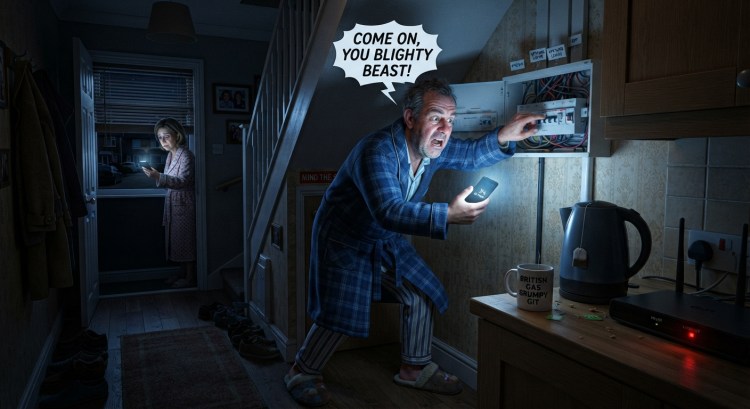
Picture it:
“Britain has a power cut. The kettle’s gone. The Wi-Fi’s gone. Half the country is standing by the fuse box pressing buttons like they’re launching a space shuttle.
Meanwhile, people who rely on powered medical equipment are looking at everyone else and saying, ‘Forget Netflix, Sharon. We’ve got bigger problems.’
‘A long power outage wouldn’t just be inconvenient. For some people, it could be genuinely dangerous.’
When the lights go out, Dave’s greatest concern is his router. The NHS patient’s concern is staying alive.
For most people, a power cut is an excuse to dig out a scented candle, play Monopoly until someone flips the board, and pretend to be Victorian peasants. For people relying on life-saving medical equipment, however, a blackout is significantly less charming—mostly because you cannot plug a ventilator into a Yankee Candle.
When the grid goes down, internal batteries on oxygen concentrators and home dialysis machines start a dramatic countdown that makes action movies look relaxing.
In the UK, anyone relying on electricity for medical gear can join their energy supplier’s Priority Services Register (PSR). Think of it as velvet-rope access for blackouts, getting you advance warnings and priority reconnection so you aren’t left sitting in the dark plotting against the grid.
If the UK electricity grid suffers a total, multi-day meltdown—officially known in government binders as a National Power Outage—things get serious fast, especially for anyone whose vital organs are outsourced to a plug socket. While the British grid is usually sturdy enough to survive a stiff breeze, emergency planners spend a lot of time worrying about a total collapse because it turns a minor inconvenience into a genuine survival scenario.
Most home ventilators and oxygen concentrators have internal batteries that tap out after 2 to 8 hours. That is plenty of time to watch The Lord of the Rings, but not nearly enough time for engineers to rebuild a broken power grid.
When the electricity vanishes for days, mobile masts die, water pumps quit, and petrol stations stop pumping. Calling 999 or driving to A&E suddenly requires carrier pigeons and a full tank of optimism.
Local emergency rooms would instantly become the hottest hangout spot in town as thousands of home-care patients run out of juice at the exact same time.
The National Energy System Operator (NESO) has secret “Black Start” plans to jump-start the grid from scratch using giant power stations that don’t need electricity to wake up. Hospitals and critical infrastructure get plugged back in first, while the rest of us wait for our kettles to come back to life.
Local councils, emergency services, and the NHS use the Priority Services Register like a treasure map to find medically vulnerable folks. If the power stays off, rescue teams and community hubs are deployed to haul high-risk patients to powered rest centres before their batteries hit zero.
For people who literally cannot afford a power cut, standard advice upgrades from “buy a torch” to “become an off-grid survivalist.” This means hoarding giant lithium power stations, hugging solar panels, keeping NHS emergency oxygen cylinders on standby, and having a solid escape plan to reach a hospital before the traffic lights die and the M25 turns into a car park.
In a worst-case, multi-day national grid collapse, even the most optimistic emergency planners quietly admit that not everyone would make it through. When the entire country loses power at once, the sheer math of the disaster means the NHS and emergency services would be stretched thinner than cheap toilet paper, leaving many vulnerable people dangerously exposed.
Once mobile phone masts and Wi-Fi routers run out of juice, calling 999 becomes a game of shouting out the window. Emergency crews can’t rescue people if nobody can actually tell them where they are.
Ambulances and fire engines only have so many wheels and so much fuel. Trying to taxi tens of thousands of medically vulnerable folks to the hospital at the exact same time would break the system faster than a Taylor Swift ticket drop.
Even massive hospitals rely on backup diesel generators when the grid dies. If petrol stations stop pumping and the roads turn into a giant game of bumper cars, keeping those generators fed becomes a serious headache.
Signing up for the Priority Services Register puts you on the official list, which is great. However, during a full-blown national meltdown, it doesn’t summon a personal helicopter or a dedicated power station to your front lawn.
Disaster planners openly admit that for the first 72 hours of a major crisis, the cavalry isn’t coming—it’s just you and the people on your street. Knowing which neighbour relies on medical gear and having a plan to haul them to a powered hub is what actually saves lives when the official safety net snaps.
No major national power outage is heading for the UK, and almost all of the doomsday panic on your feed right now is pure clickbait. According to the National Energy System Operator (NESO) Winter Outlook, Britain’s electricity supply is sitting pretty with a massive 5.9 GW spare cushion—meaning your kettle and your medical gear are both safe from a scheduled apocalypse.
Comparing modern grid reassurances to Michael Fish’s legendary 1987 broadcast—where he cheerfully told Britain not to worry about a hurricane right before 15 million trees got flattened—is actually a very fair point. There is nothing quite as British as an official in a sensible suit saying “everything is completely fine” mere hours before everything goes spectacularly sideways.
Even with plenty of spare electricity on paper, engineers know that power grids are basically giant, temperamental Jenga towers.
All it takes is one lightning bolt hitting a major power line at the exact same millisecond an undersea cable trips, and suddenly half the country is sitting in the dark. (This actually happened in August 2019, knocking out power for over a million people and trapping commuters on trains right at rush hour.)
Most of the UK’s grid was built assuming British weather meant “mild drizzle.” Modern storms, heatwaves, and ice events regularly break records the original engineers never bothered to plan for.
Between ageing equipment and digital control systems, there are plenty of complicated ways for the grid to trip over its own shoelaces.
To be fair to modern engineers, they have slightly better gear than a 1980s BBC weather map with sticky-back symbols. Today’s grid is watched second-by-second by computers designed to ruthlessly chop power to a few neighbourhoods to stop the whole country from going dark. Plus, the government’s own National Risk Register officially admits a total blackout is a real threat, so emergency planners aren’t exactly whistling past the graveyard.
You don’t have to believe every unhinged TikTok conspiracy to accept that experts occasionally get blindsided by reality. Treating a massive blackout as unlikely—while quietly keeping a backup battery charged so nobody ends up shouting at the telly like it’s October 1987—is just peak British pragmatism.

