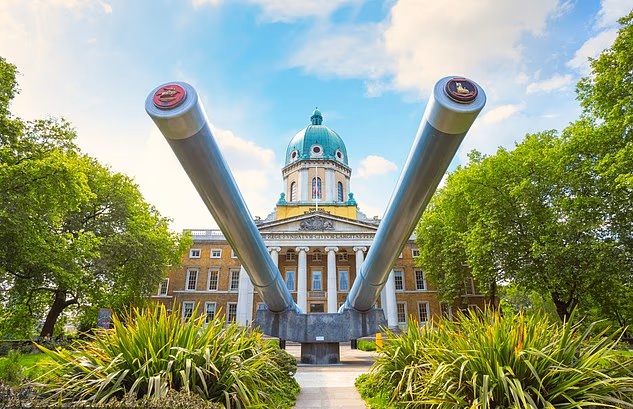
The Imperial War Museum has been accused of ‘reframing history’ to give it ‘woke appeal’ in a new tour featuring trans people in battle.
Created to celebrate the 25th anniversary since the Government lifted its prohibition on gay people serving in the Armed Forces, the new digital tour tells ‘personal stories from the LGBTQ+ community’ in times of war.
However, almost one-third of the displays focus on transgenderism, including narratives detailing the challenges faced by homosexual and lesbian military members.
Examples include a frock worn by a man for a ‘show’ in a deadly Japanese prisoner of war camp during the 1940s, as well as a Land Army girl who wanted to be called ‘John’.
Tour curators also claimed reconstructive surgeries for injured soldiers in World Wars I and II ‘laid the foundation for the future of transgender medicine’.
He criticised the institution, revered around the globe, for ‘trivialising’ often brutal moments in history to portray a woke narrative.
‘The experiences of what we now call the LGBTQ+ community are no less worthy of understanding than those of “straight” service personnel,’ he said.
‘But with this display, they trivialise true stories of bravery and courage and – what is worse – appear to be doing so in order to reframe the lessons of history to make a woke appeal to young Brits on behalf of a highly controversial special interest group.
‘I hope the IWM will think again about this. History should never be rewritten to proselytise or normalise any particular lifestyle.’
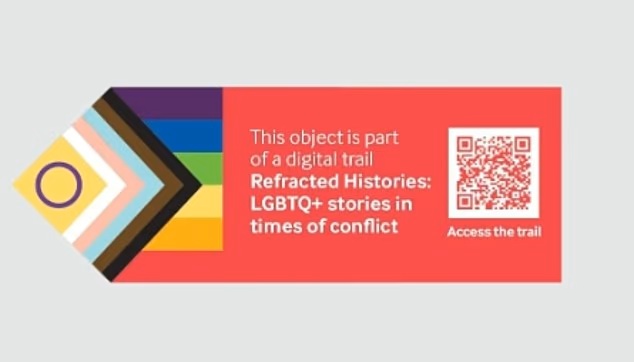
The free tour can be accessed by scanning a QR code, which lets visitors find objects in the museum and read an LGBTQ+ perspective on them.
The promotional page, which features the transgender rainbow symbol, reads: ‘The LGBTQ+ community has always been present during times of conflict, and these stories reveal how individuals navigated the cultural and social landscape of the time…
‘These histories are often sadly erased or hard to verify, but… this trail redirects traditional narratives to reveal a broader spectrum of human experiences in times of conflict.
‘IWM is committed to representing diverse experiences that reflect the world around us, and through this trail, we are looking to improve the visibility of LGBTQ+ stories across our collection.’
The exhibits, almost exclusively in the First and Second World War galleries at the museum’s London and Manchester sites, feature some trans stories alongside those about gay servicemen.
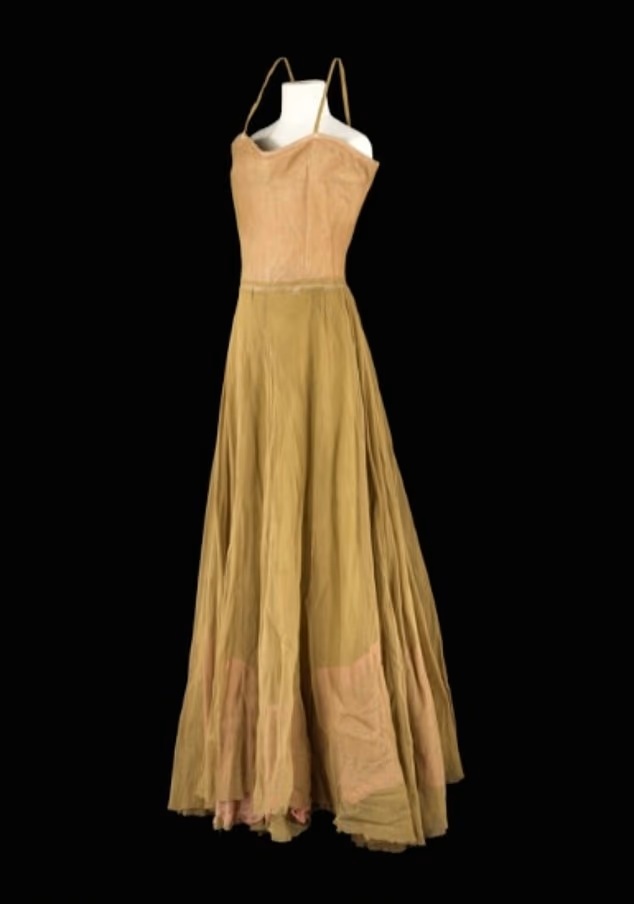
One centres around a dress made from a mosquito net that was worn, apparently, for ‘drag shows’ during the Second World War.
The wearer was Gunner Charles Woodhams, who donned it to dance with an officer during a makeshift ‘theatre revue’ in Changi Prison, Singapore – a notorious Japanese prisoner of war camp where 850 British soldiers were executed or died from maltreatment.
The guide notes: ‘Drag performances in Changi Prison in Singapore during the Second World War were vital for prisoners’ morale.’
It also features a recording from a former British POW, Dudley Cave, who later became an ‘LGBTQ+ rights advocate’, who recalled of the camps: ‘Certainly as far as the transvestites went, they were popular – they were liked.’
Running until April 2026, another shows a photo of a worker in the Land Army – made up of civilian women who took over farm duties from men who were called to the military.
The guide says that one such worker was Enid Mary Barraud, who ‘challenged gender norms’.
It notes: ‘Enid preferred to identify as male, known to friends as “John”, and she lived with her female partner “Bunty”.
‘She has become a significant LGBTQ+ figure as later generations consider her memoirs to be an important documentation of a life lived outside of conventional gender expectations.’
A third exhibit is a portrait of the Queen’s Hospital for Facial Injuries, Frognal, Sidcup, with injured servicemen being operated on in 1918.
The guide notes that one of the doctors who worked there was Dr Harold Gillies, hailed as the father of modern plastic surgery after he developed skin graft techniques on hurt soldiers.
It notes that after the wars, he used his expertise to ‘perform the first ever phalloplasty’ on transgender man Michael Dillon in 1946.
Dr Gillies ‘used surgical techniques originally developed for wounded servicemen to create a penis,’ it notes.
In 1951, this was followed by the first vaginoplasty – the construction of a vagina – on transgender woman Roberta Cowell.
‘These trailblazing procedures not only transformed Michael and Roberta’s lives, but also laid the foundation for the future of transgender medicine,’ the guide concludes.
Also included is a modern-produced comic telling the story of Flight Lieutenant Caroline Paige, who ‘made history in 1999 as the first serving RAF officer to transition gender’.
It tells of ‘living a top-gun lifestyle all while grappling with the emotional toll of hiding her true identity for much of her career’, the guide notes.
Professor Glees said of the exhibits: ‘The story of the notorious Changi jail, scene of appalling brutality towards British and Commonwealth servicemen, cannot be illustrated with reference to “drag artists”. Almost 1,000 were killed there.’
He added: ‘The idea that surgical skills developed in wartime found their fruit in gender “re-assignment surgery” as told by the IWM seems tendentious at best.’
An IWM spokesman said: ‘This year is the 25th anniversary of the UK Government decision to lift the ban on LGBT people serving in the military. To mark this anniversary, visitors to our IWM London and IWM North museums can find out more about some of these stories by scanning a QR code next to exhibits in our galleries.
‘We are proud to play our part in telling some of the lesser-known stories of lives affected by war and conflict.’
This isn’t about changing the past; rather, it’s about honouring the contributions of people who were present because back then, you could or would be jailed for being gay.
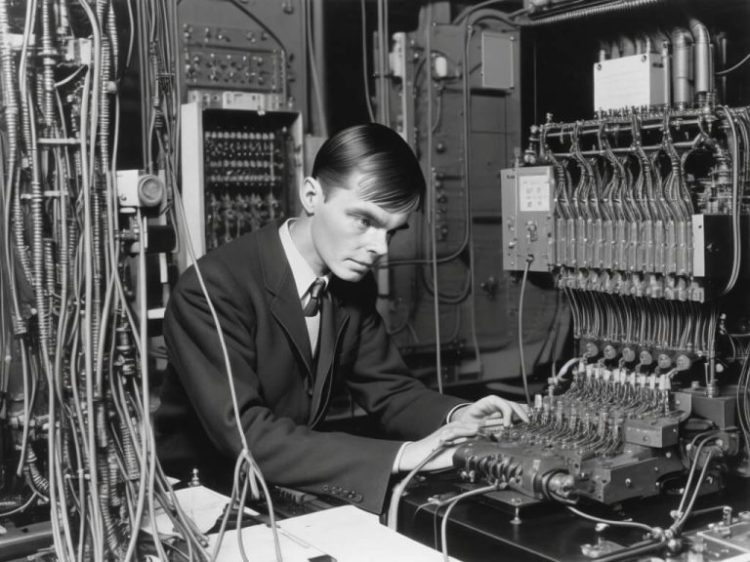
Because homosexuality was illegal in the UK at the time, Alan Turing was prosecuted for gross indecency. He was chemically castrated, which is incredibly tragic given how far society has come. We wouldn’t even bat an eyelid now.
In 1952, Turing was prosecuted for homosexual acts. He apparently accepted hormone treatment as an alternative to prison, but he died on 7 June 1954, aged 41, from cyanide poisoning. An inquest determined his death was from suicide, but there was also evidence of accidental poisoning – we will never actually know.
Following a campaign in 2009, British Prime Minister Gordon Brown made an official public apology for the appalling way Turing was treated, and Queen Elizabeth II granted a pardon in 2013.
The term ‘Alan Turing Law’ is used informally to refer to a 2017 law in the UK that retroactively pardoned men cautioned or convicted under historical legislation that outlawed homosexual acts.
In actuality, a person’s inclinations are irrelevant. I might consider more pressing issues, such as the end of the world.
As long as you’re a decent person, it doesn’t matter who you are.
People come from all walks of life. After all, Winston Churchill might have had ADHD, and it’s frequently speculated that Albert Einstein might have had dyslexia or perhaps traits of autism, and that Ludwig van Beethoven was deaf. They were different, but we wouldn’t go burning them at the stake, and if you did, you actually wouldn’t be right in the head.
Of course, rewriting history is literally the job of historians, and history is a construct – more history is a good thing, especially when teaching our children that we have gone from barbarians to peaceful citizens. Not sure when that time will come, but we can live in hope!
Just remember, there are two types of male oysters, and one of them can change gender at will, and before man crawled out of the muck, maybe he had the same option. Maybe originally we were supposed to be able to switch genders, and being born with just one sex… is a mutation.
 THE MONTHLY MOSQUITO
Guess the German pow’s had those ’troupes’ too ….. ‘ The Pink Panzers ‘ perhaps ? ‘ Lez be ‘avin yue ‘ ?
>
LikeLiked by 1 person