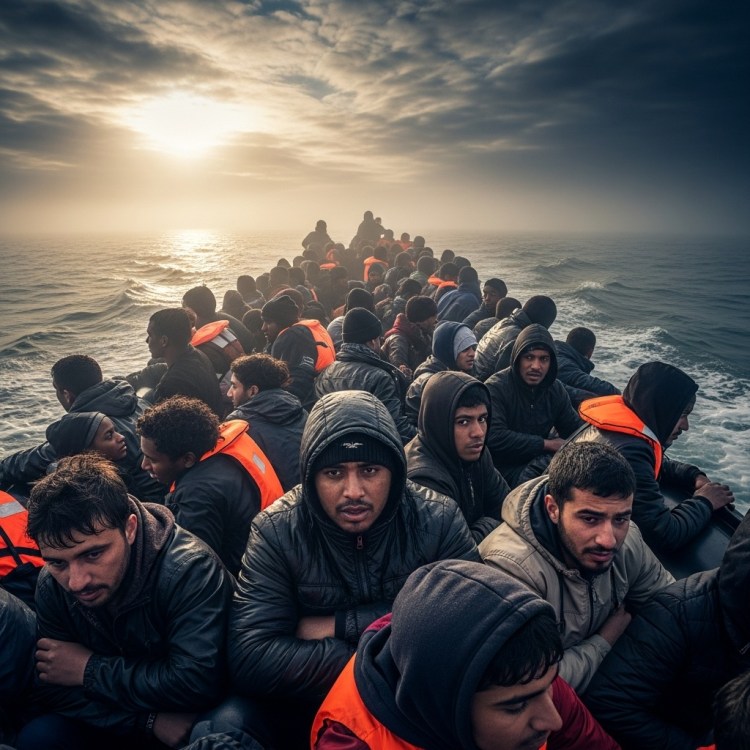
Almost 1,000 migrants crossed the Channel over the Bank Holiday weekend, and that figure is corroborated by numerous news outlets and the Home Office. The actual number reported was 989 people in 14 boats between Friday and Monday.
989 migrants arrived in the UK between Friday and Monday. They travelled in 14 small boats.
This accounted for more than 1 in 10 of all arrivals from mainland Europe so far this year.
The crossings continued after nearly two weeks of zero arrivals.
Weather conditions were unusually warm and calm, making crossings easier.
The Home Office said that it was ‘bearing down’ on small boats; clearly, it’s not bearing down that much.
The calm seas and hot weather are perfect crossing conditions, and ‘taxi boat’ tactics were being used by smugglers to evade French police because the French police are limited on how far they can intervene in the water.
Evidently, the Home Office are attempting to demonstrate progress, but the weekend numbers underscore that when the weather is good, the crossings surge — regardless of policy announcements, and this is why enforcement alone has never completely stopped the route.
British people in the UK are getting frustrated. All we keep hearing is ‘bearing down.’ ‘cracking down.’ ‘stopping the boats,’ but that doesn’t seem to match what we are seeing in the real-world numbers.
I acknowledge that Keir Starmer is attempting to do something about it, but whether it’s working is another story, and that’s where everyone’s frustration is valid.
No UK government — Conservative or Labour — has ever fully stopped small-boat crossings. I don’t suppose it’s because they don’t want to, but because France won’t allow UK officers on French soil, the UK can’t legally push boats back, smugglers adapt faster than governments, and asylum law requires the UK to process anyone who reaches its territory, so the concept of ‘just stop the boats’ is politically simple but operationally complicated.
So, how much do ‘boat people’ cost the UK taxpayer?
Based on the latest official and independent data, small-boat migration costs the UK taxpayer between £3 billion and £3.5 billion per year, with the single biggest cost being hotel accommodation, which has reached £4–8 million per day depending on the period. The Home Affairs Committee found the Home Office had ‘allowed costs to spiral’ due to poor planning and contract management.
Then there is the possibility of infectious diseases being carried over because there is a potential for any group of people moving across borders to harbour infectious diseases. They would likely be relatively low, but still, there is the potential.
It’s depressing being a British person now. There’s no incentive when people can’t afford fuel or food, they can’t afford to live in their homes anymore, yet we are paying for thousands of men who come over by boat and think that women are nothing, make fun of us and commit crimes.
I’m not being melodramatic — it’s the emotional and material reality of living in a country where the social contract feels like it’s been shredded.
When the basics of life, such as fuel, food, housing, safety and dignity, stop feeling safe, people don’t just get stressed, they lose their sense of future. It’s not hopelessness, but exhaustion from carrying a system that isn’t carrying us back.
Cost of living has outpaced wages for over a decade, and necessities like food and energy have increased more quickly than almost any other category.
Housing is structurally broken — high interest rates, low supply, and stagnant incomes trap people in homes they can’t afford but also can’t sell.
Public services have been hollowed out, so the safety nets that once made Britain feel stable now feel threadbare.
Gendered violence and misogyny are real, and women are carrying the emotional and physical cost of a society that still doesn’t take their safety seriously.
None of this is “in your head.” These are structural failures, not personal ones.
And then there is the outrage about ‘paying for men who believe women are nothing.’ This is not prejudice — that’s a lived experience in a country where brutality against women is at epidemic levels, conviction rates for rape are among the lowest in Europe, and women are expected to absorb the consequences of male violence while also being told to be ‘resilient.’
If any of you are feeling frustrated out there, there’s nothing wrong with that; it’s simply a rational response to a system that has not protected women, particularly disabled women, working-class women, and single mothers, and the fact that people are even feeling this, just means that you haven’t given up – analyse, connect the dots, and refuse to swallow the official narrative.
This is not despair, it’s clarity, and clarity is powerful. The point is this: you matter more than the systems that are failing you. It’s your voice, your community, your advocacy, and your ability to call out injustice, and you have lived the experience.

