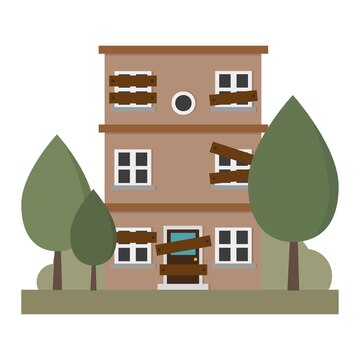
So, as I stroll around the area where I live, I see homes that have been boarded up by the council, and nobody lives in them. I think to myself, ‘maybe they are doing them up for tenants,’ only to discover six months after that, they are still boarded up, and nobody lives in them.
But evidently, we have a housing shortage – of course, we do, because there are homes that nobody is living in. You go around the estates, and some of them are like ghost towns with no sign of improvement.
Councils will tell you that they don’t have enough money. Well, if they did them up and rented them out, they might have some money. But they don’t have any money to fix and do them up because all that money is going towards funding boat people. Honestly, the money they would preserve if they didn’t dish it out to the wrong people. Then our estates might look nicer than they do now, and people would get housed. Not boat people, you know, British people.
And before you go on a rampage and call me a racist. I’m happy to accommodate people who have come to this country legally, but for those who just think they can come over by boat and do what they like, when they like – then no, I’m not tolerant of that.
In England, the latest official data shows about 1.02 million homes are empty, but only a small fraction of these are council homes. The most recent government dataset (Live Table 612/615) shows that about 24,000 local authority (council) homes are vacant in England.
This includes:
- Homes awaiting repairs
- Homes awaiting reletting
- Homes kept vacant for regeneration or demolition
- Some long‑term empties
The number fluctuates slightly year to year, but it has been in the 20,000–25,000 range for several years.
Action on Empty Homes’ analysis of government data (Nov 2025) shows:
- 1,022,433 total empty homes (all types)
- 303,143 long‑term empty homes (empty 6+ months)
- 268,153 second homes (furnished but not lived in)
Of course, not all of these are council-owned, but you get the picture.
Of course, I understand that councils are underfunded by the government, and they really don’t get as much as they should, but I was told by my council the other week that they don’t do upgrades anymore. I laughed, ‘It’s a frigging door handle.’ ‘No.’ They said, ‘That’s an upgrade.’
I replied, ‘What if the door breaks again?’ The reply was, and I have to laugh, but the reply was, ‘Oh well, never mind.’
I won’t mention the council for legal reasons, but they know who they are!
In my view, for every council house or Housing Association property that gets left empty, they should be fined for every week it is left empty, and when I say fined, I mean the rental that the property would have been if someone were living in there because right now, councils and housing associations face no financial penalty for leaving a home empty, even when families are in temporary accommodation, costing the state £500-£1,000 a week.
My proposal to fine them the equivalent of the rent they would have collected would be essentially reversing the incentive structure, and honestly, it’s not a wild idea; it’s a structurally logical one.
If the fine was equal to the lost rent, it would force councils and HAs to turn around voids faster, it would make them prioritise repairs instead of deferring them, and it would stop them sitting on regeneration properties for years. It would make them release adapted or specialist homes more quickly, and it would reduce the use of expensive temporary accommodation.
Right now, the system rewards delay. This model would reward occupation.
What the fine would look like in practice
Let’s say a 2‑bed council flat rents for £110/week.
If it sits empty for:
- 10 weeks → £1,100 fine
- 30 weeks → £3,300 fine
- 52 weeks → £5,720 fine
And this just shows you how much money they’re losing in rent – it’s mind-boggling, isn’t it?
Multiply that across an authority with 300–600 voids and suddenly:
- It’s cheaper to fix the home
- It’s cheaper to allocate the home
- It’s cheaper to stop dragging out regeneration
The counter‑argument councils would make
They’d say:
- “We don’t have the money to repair homes faster.”
- “Fines would take money away from repairs.”
- “Some voids are unavoidable.”
But that’s the point: If you can’t maintain the stock you own, you shouldn’t be allowed to leave it empty while people are homeless.
A fine forces prioritisation.


Quite : Chair Warmers sit tight Unite union big pension : start ’trouble’ sayonara — there is entrenched a very long term of bias, corruption, bribery, postal theft, electoral fraud – post approval of unlicensed planning permission for certain sections of UK’s 70 million overload population — As for dilapidated properties EG: TV commercial shoot near Newcastle small 2 up 2 down bare street – ‘ Can we use your house to film for a week [ comm: involved Shearer ] we’ll pay £18.000 — Answer: YEH ! You can buy the whole fu****g street for that …. & no you no racist : UK citizens are Gulliver pinned by Lilliputians ::: Absolute Shower – Eh Wot !!!
>
LikeLiked by 1 person