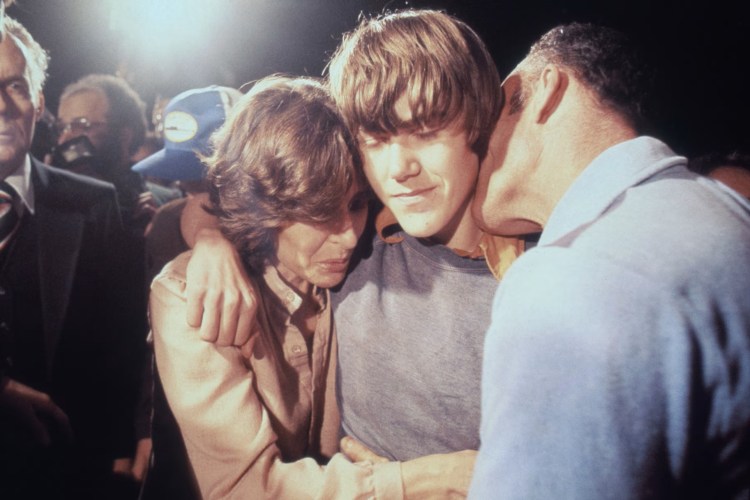
This is one of the most unique and brutal stories of survival and heroism in American history.
Steven Stayner’s story is one of those cases that remains with you long after you learn the details — not because of the crime itself, but because of the extraordinary courage he showed after years of sustained abuse and psychological captivity.
The most important thing to understand is this: Steven was a child who endured seven years of coercion, grooming, and violence — and still found the strength to save another child. That is the part of the story that defines him, not what was done to him.
Kidnapped at age seven — Steven was taken in 1972 while walking home from school in Merced, California. Manipulated into believing lies — Parnell told him his parents didn’t want him anymore, a classic tactic of long‑term captors. Forced to live under a false identity — ‘Dennis Gregory Parnell’ was subjected to constant abuse — psychological, emotional, and sexual, and moved repeatedly — to keep him isolated and dependent.
This was not a case of a child ‘not escaping.’ It was a child who had been systematically broken down by an adult predator who knew just how to manipulate a vulnerable mind.
In 1980, when Parnell abducted another child — five‑year‑old Timothy White — Steven made a decision that changed everything. He risked his own life to save Timothy.
He waited until Parnell was away, took Timothy by the hand, and walked him to safety, finally reaching a police station in Ukiah. Steven could have run alone. He didn’t. He refused to leave another child behind. That is why he is remembered as a hero.
Steven was reunited with his family, but reintegration was problematic — as it is for numerous survivors of long‑term abuse.
He later testified against Parnell, ensuring he was held accountable. Tragically, Steven died in a motorcycle accident in 1989 at age 24.
Timothy White, the boy he saved, grew up to become a sheriff’s deputy. He never forgot Steven’s bravery.
Steven’s case is frequently mentioned in discussions of child abduction psychology, long‑term grooming and coercive control, survivor resilience, the moral complexity of captivity, and why children should never be condemned for not escaping.
Steven Stayner’s psychological strength wasn’t a single trait — it was a pattern of adaptive responses that occurred despite seven years of coercive control. The available evidence about his captivity demonstrates how he maintained a sense of self, moral agency, and the ability to act protectively toward others even while living under a false identity.
Kenneth Parnell’s primary method of control was psychological — convincing Steven that his parents no longer wanted him. This type of coercive narrative is designed to obliterate a child’s identity. Yet Steven retained enough of his original self-concept to recognise, years later, that what was happening to him was wrong.
Parnell’s sentence was shockingly, indefensibly light, and it remains one of the most disturbing failures of the American justice system in a child‑abduction case. And the more you learn about the facts, the more absurd it becomes.
After kidnapping, abusing, and psychologically imprisoning Steven for seven years, and then abducting five‑year‑old Timothy White, Parnell received 7 years for kidnapping, served 5 years, and there were no charges for the sexual abuse of Steven, no charges for the years of coercive control, and no charges for the psychological torture.
Why? Because at the time, California law required supporting evidence for child sexual assault charges — and Steven’s testimony alone wasn’t considered enough. It’s enraging, and this is one of those cases where the law protected the predator more than the child.
 THE MONTHLY MOSQUITO