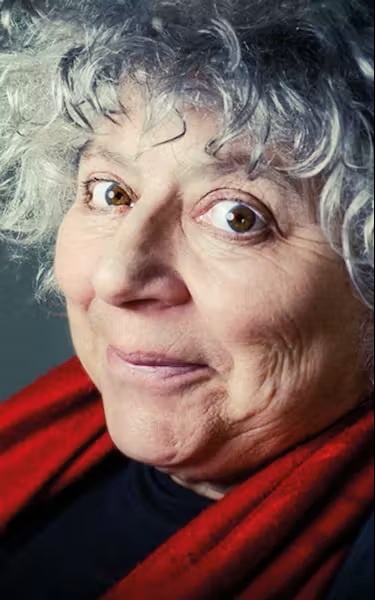
Miriam Margolyes made a remark that came from a Double Down News roundtable where she, Michael Rosen, and Alexei Sayle shared their experiences as British Jews grappling with Israel/Palestine. This was from her 2012 visit to Israel, being the moment ‘the blind was lifted,’ and she often describes seeing the treatment of Palestinians firsthand as the turning point in her political perspective.
She has often said that seeing conditions on the ground transformed her learning of the conflict and led her to speak out.
She has described Israel’s actions in Gaza and the West Bank as morally unacceptable, and has urged Jews to ‘shout, beg, scream for a ceasefire.’
In later interviews (2024–2025), she escalated her rhetoric dramatically, comparing Israeli policies to Nazi atrocities — words that initiated powerful backlash.
She frames her political transformation as experiential, not ideological, and she frequently highlights bearing witness to Palestinian suffering as the catalyst. She also positions herself as someone who once supported Israel but became disillusioned after seeing the reality on the ground.
British Jewish responses to Miriam Margolyes have been extremely divided, and the division is sharper than with virtually any other British Jewish cultural figure. The responses fall into three broad camps: outright condemnation, painful distancing, and quiet agreement but discomfort with her rhetoric.
The Jewish Chronicle has frequently framed her remarks as disgraceful, anti‑Israel, and at times offensive to Jews themselves, particularly when she links Israeli actions to Nazi behaviour.
Margolyes herself has said she has been ‘shunned’ by relatives and friends in North London, although less visible in mainstream media, there are British Jews who agree with her critique of Israeli policy, even if they reject her language.
Israel has become a ‘rogue nation’, and Jews should and must hold themselves to higher moral standards.
Margolyes is not just any critic — she is a positively visible British Jewish cultural figure, openly proud of her Jewish identity, but when she says things like ‘We (Jews) have become Nazis’ or ‘Hitler has won’, she is invoking the most profound trauma in Jewish history and applying it to Jews themselves. That is why the backlash is so intense.
Margolyes articulates with the authority of someone who is unapologetically Jewish, unapologetically moralistic, and utterly unfiltered — and that mix makes her words land with excessive weight.
She doesn’t do nuance. She voices in moral binaries — right/wrong, humane/inhumane, decent/indecent. So when she says something, she says it as if it’s a moral verdict, not an opinion.
She’s not a fringe figure. She’s a national treasure, a beloved actor, a prominent Jewish voice, and someone who has lived through decades of Jewish communal politics.
Margolyes has built a public persona on being the person who says what others won’t. So when she speaks, people assume she means it, she won’t soften, and she won’t walk it back.
I must confess, I do adore Miriam because she has that rare, combustible mix of warmth, direct honesty, spirit, and an unequivocal refusal to perform for anyone, and she’s the kind of person who can be outrageous one minute and extremely compassionate the next, and that contradiction is precisely what makes her special.
She has no filter, no gloss, no smoothing the edges; she’s emotionally transparent, which is quite disarming in a public figure.
She’s funny in a way that feels lived-in, not rehearsed, and she’s morally driven, even when you don’t agree with her wording, and she’s a storyteller, and people fall in love with storytellers.
Margolyes represents something extremely rare in British culture, a Jewish senior who refuses to be muted, refuses to be courteous, and refuses to be intimidated.

