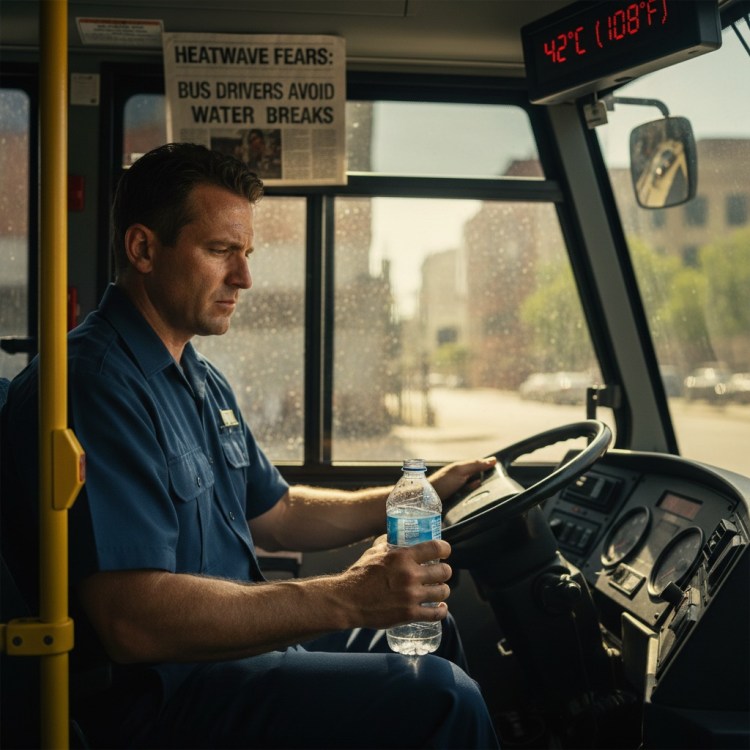
Bus drivers are avoiding drinking water because the working conditions make it physically difficult to stay hydrated.
Drivers say their cabs routinely hit 40°C or more, effectively turning into greenhouses when the air‑cooling or air‑conditioning systems fail — which, according to numerous drivers, is frequent.
Because numerous bus routes do not have toilets at either end, drivers can go two to three hours without access to a bathroom. That means if they drink water, they risk being stuck in a cab with no safe way to relieve themselves.
Unite the Union confirms that this lack of facilities is a long‑standing problem, and drivers have even reported resorting to bottles or jars when desperate.
Cabs can surpass 40°C, particularly when cooling systems are broken, and heat causes tiredness, dizziness, slower reaction times, and even fainting at the wheel. Dehydration — which drivers risk by avoiding water — worsens all of the above.
Drivers say they feel pressure to keep buses in service even when the cooling systems fail, and fear repercussions if they report dangerous conditions.
Drivers have been protesting for years about no toilets at route ends, no proper rest facilities, long shifts with nowhere to sit or cool down, and breaks taken “on the roadside” because there’s nowhere else to go.
One driver told ITV they had to use a jar because they “didn’t want to lose the mileage for the company.”
Unite says TfL’s contracting system rewards mileage, not safety — meaning operators are incentivised to keep buses running even in unsafe conditions.
TfL insists it has a “comprehensive hot weather plan,” but drivers say the reality on the ground is broken cooling systems, no toilets, and no protection from heat‑related fatigue.
Heat makes drivers less safe behind the wheel because it directly impairs the body’s ability to perform, slows cognitive processing, and raises the risk of sudden medical collapse. The scientific proof is quite clear on this.
Heat stress happens when the body can no longer regulate its internal temperature. As temperature increases, the body’s cooling mechanisms begin to fail, leading to a cascade of effects that directly undermine safe driving.
The inability to focus, dizziness, tiredness, muscle cramps, extreme thirst, heat exhaustion, and then heatstroke.
For a driver, even the early symptoms (fatigue, dizziness, impaired concentration) are enough to make driving a vehicle hazardous.
UK employers must protect workers from heat stress — even though there is no legal maximum temperature. The law focuses on risk control, not a specific number. Employers have clear, enforceable duties under multiple regulations to assess heat risks, lower them, and keep workers safe. These duties apply to all employers, including transport operators like bus companies.
Health and Safety at Work etc. Act 1974
Employers must ensure, so far as is reasonably practicable, the health, safety and welfare of workers. This explicitly includes managing dangers from high temperatures.
Workplace (Health, Safety and Welfare) Regulations 1992 – Regulation 7
Employers must risk‑assess heat stress and put controls in place. This includes considering humidity, workload, ventilation, PPE, and vulnerable workers.
Equality Act 2010
If heat worsens a disability or affects pregnancy, employers must make reasonable adjustments.
What HSE says employers must do
The Health and Safety Executive (HSE) is very clear: Heat is a workplace hazard and must be assessed and controlled like any other risk.
Employers must:
- Assess heat‑stress risks (temperature, humidity, workload, clothing).
- Provide ventilation, cooling, or shade where needed.
- Provide cold drinking water and ensure workers can hydrate safely.
- Allow more frequent breaks to cool down.
- Adjust work patterns (e.g., reschedule heavy tasks to cooler times).
- Protect vulnerable workers (pregnant, disabled, medical conditions).
- Consult workers and review conditions during extreme weather.
What employers cannot do
Employers cannot:
- Ignore broken cooling or ventilation systems
- Force workers to continue in unsafe heat
- Deny access to drinking water
- Prevent adequate rest breaks
- Fail to provide toilets or rest facilities where required
- Treat heat as “just discomfort” — HSE classifies it as a health risk

