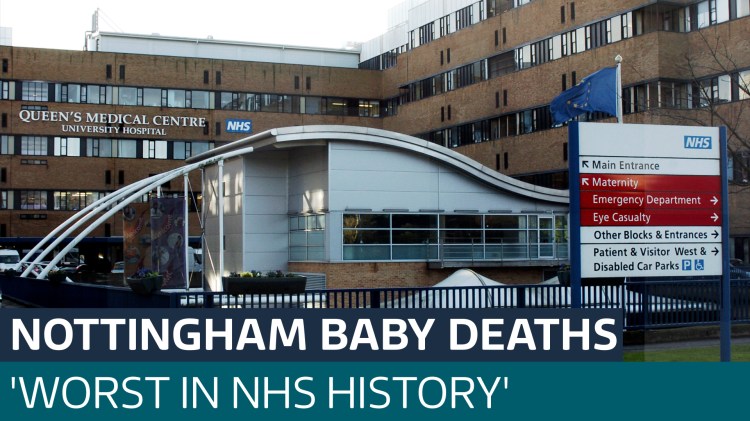
The biggest maternity inquiry in NHS history has found that hundreds of mothers and babies died or were harmed due to failures at Nottingham University Hospitals trust. Grieving families have demanded a public inquiry.
The Nottingham maternity scandal has now been laid out in full — and it is every bit as catastrophic as one would expect. The inquiry chair, Donna Ockenden, has told the government to act now, after her investigation exposed hundreds of avoidable deaths and life‑altering injuries at Nottingham University Hospitals NHS Trust.
Hundreds of mothers and babies died or were harmed due to substandard care, and in 444 maternity cases and 76 newborn cases, outcomes were considered “potentially avoidable”.
155 babies died, and 105 suffered severe injury, including brain damage.
Women were constantly ignored, neglected, or not believed, even when in pain or reporting danger signs.
Staff were chronically understaffed, inadequately trained, and working in a toxic, bullying culture, and the trust had known about many of these problems since at least 2010 and failed to act.
Ockenden’s words were blunt: “This report is about what it costs when systems fail. It costs lives. It costs futures, and it costs families everything.”
Ockenden has made it clear that this cannot be another report that collects dust. She is calling for immediate national action because the failures in Nottingham are not isolated — they reflect a wider UK maternity problem.
UK maternal mortality is now higher than the rest of Europe, and worse than it was in 1985, and harm and poor care are at risk of becoming normalised in the maternity system.
This is precisely the pattern we should be furious about: women not listened to, families ignored, and preventable deaths brushed aside.
Grieving families say the current review — despite its scale — lacked legal powers, and around half of senior executives refused to answer questions.
Families want a full statutory inquiry with the power to compel witnesses and force disclosure of documents.
Michelle Welsh MP, the government’s new maternity adviser (and herself a victim of Nottingham’s failings), is pushing the government to consider this.
The government says “nothing is off the table”, but families want accountability, not platitudes.
Women experienced cruel and dangerously poor care. Staff formed bullying cliques that shut down concerns. Lessons were not learned, even after deaths, and babies were treated with an “absence of dignity”.
This wasn’t a few bad apples — it was a systemic collapse.
Michelle Welsh has also said the General Medical Council must be investigated for what it knew — and allegedly denied knowing — about unsafe doctors working in Nottingham.
Ockenden’s message is clear: Act decisively, or more mothers and babies will die. Her report calls for mandatory listening to women and families, proper staffing and training, national oversight of maternity safety, and a cultural reset across NHS maternity services. She emphasises that the voices of families must drive the change.
A statutory maternity inquiry is the highest‑powered form of investigation the UK can launch — and it is precisely what many Nottingham families are now demanding because the existing Ockenden review could not compel witnesses or force disclosure of documents.
A statutory inquiry is established under the Inquiries Act 2005. It has full legal powers to uncover the truth, force cooperation, and hold institutions to account. It is the same mechanism used for the Mid Staffordshire scandal, the Post Office Horizon inquiry, and the Covid Inquiry.
Unlike the Nottingham review — where half of senior executives refused to answer questions — a statutory inquiry can compel individuals to attend and testify honestly, with no option to refuse; lying becomes a criminal offence, and senior clinicians, managers, board members, and regulators can all be compelled.
This is the single biggest reason families are demanding it.
A statutory inquiry can legally require internal trust emails, incident reports, board minutes, risk assessments, and communications with regulators (GMC, CQC, NHS England).
This is important because families believe failures were allowed to continue “in plain sight of the state”.
Families and campaigners argue Nottingham is not an isolated case. The Guardian reports that families want a statutory inquiry to look at maternity and neonatal care across England, because safe care “can only be consistently delivered when the full truth is known.”
A statutory inquiry could therefore investigate staffing levels, training failures, toxic cultures, racial disparities, national oversight failures, and
regulator performance (CQC, GMC, NHS England).
A statutory inquiry can name trust executives, senior clinicians, regulators, government departments, and professional bodies.
This is something non‑statutory reviews avoid because they lack legal protection for making such findings.
While statutory inquiries cannot prosecute, their findings hold major legal and political weight. They can recommend national reforms, mandatory staffing ratios, new safety standards, regulatory changes, and criminal investigations (if evidence suggests wrongdoing).
The government is then under extreme pressure to enforce these recommendations.
A statutory inquiry produces a public report, archived permanently, ensuring families get the truth, the public understands what went wrong, parliament can act, and prospective scandals can be prevented.

