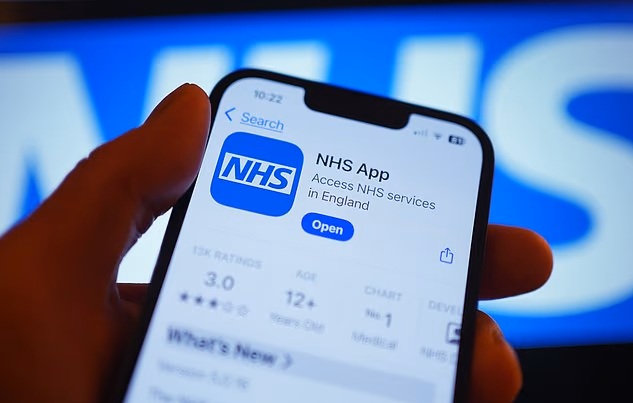
Artificial intelligence will be used on the NHS app to tell patients if they should book a GP appointment or would be better off going to A&E.
People will be asked a series of questions by the new triage tool, which will utilise their responses to guide them to the optimum service for their medical condition.
The update is anticipated to reach more than 200,000 patients in the next 12 months and will be available to all NHS app users by April 2028.
It forms part of a ‘major overhaul of tech’ in the coming years in a bid to transform NHS services.
Although the tool’s launch has been widely applauded, several health organisations have asked the NHS to give patient safety, confidentiality, and inclusiveness first priority as it becomes more dependent on AI.
A trial at a GP practice in Sussex led to a 29 per cent fall in the number of people queuing on the phone for an appointment.
Dr Ragu Rajan, from Wealden Ridge Medical Partnership in Sussex – which ran the initial trial, said: ‘Integrating AI triage directly into the NHS app means our patients can tell us what they need, when they need it, and be directed to the right care first time.
‘It hasn’t replaced our judgment – it’s given us back the time to use it.’
It comes as the health service sets out how £10 billion in funding allotted by the Government last year will be used to overhaul its technology and data systems.
Part of this includes AI that records conversations between patients and staff to generate real-time transcripts and save time on note-taking, and it will be rolled out nationally.
A trial led by Great Ormond Street Hospital for Children and carried out across nine NHS sites in London found NHS staff spent nearly 25 per cent more of their time interacting with patients when using the tool.
St George’s, Epsom and St Helier, Croydon, Kingston, and Richmond are the four NHS trusts in London where the rollout will begin with hospital appointments that don’t require an overnight stay.
Additionally, Manchester University NHS Foundation Trust and Alder Hey Children’s NHS Foundation Trust in Liverpool are growing their AI note-taking initiatives.
Sir Jim Mackey, chief executive of NHS England, said: ‘The major overhaul of tech we’re making over the next few years will transform services.
‘The new AI tool in the NHS app will help get patients to the best service for their needs first time – whether that’s a GP appointment, trip to a pharmacy or advice on caring for themselves at home – so that clinicians can make sure those most in need of a GP appointment can get one sooner.
‘We’re also seeing huge benefits from the introduction of AI note-taking tools, with clinicians finding they’re able to spend up to a quarter more of their time with patients, so we’re rolling out the tools as quickly as possible across the NHS.
‘We’re prioritising the improvements that will make the biggest difference and supporting local leaders to adopt them to drive change in their services – helping to cut waiting lists and improve care for millions of patients so that the NHS is fit for the future.’
Health Secretary James Murray said: ‘As the NHS marks 78 years of serving patients, this investment shows how we can build on that proud legacy by embracing the technologies that will shape its future.
‘As someone who believes deeply in the power of tech to transform public services, I’ve made sure we’re backing the right innovations, which will have the biggest positive impact on patients and clinicians and give us the biggest bang for our buck.
‘I’m certain the technological innovations I’ve chosen to prioritise will get patients to the right care faster, free our brilliant clinicians from mountains of paperwork, and help drive down waiting times.
‘By harnessing the power of AI – using it to direct people to the right service first time and giving clinicians back more time to spend with patients – we’re making the NHS work better for patients and staff alike and helping make it fit for the future for its next 78 years.’
Responding to the announcement, the Royal College of Nursing (RCN) said the rollout could mark ‘an important step in upgrading technology in the NHS’.
‘We should be under no illusion though about just how far the NHS needs to go,’ RCN chief nursing officer, Professor Lynn Woolsey, said.
‘With some community nursing staff in 2026 still without mobile phones, while others in the system are forced to share painfully slow computers with poor connectivity, improvements to basic IT infrastructure must come first.
‘New digital technology like AI notetaking could ease the administrative burden on nursing staff, freeing up their precious time for frontline care.
‘But there are also warnings to heed, with growing concerns about overstated, overly-optimistic assessments of the productivity benefits from AI,’ Prof Woolsey added.
‘We cannot have situations where it increases bureaucracy through the need to correct flawed or inaccurate work.
‘Patient safety must be at the heart of any AI triage system, with a guarantee that a health professional will be the one making decisions at key points in that process.’
Prof Woolsey further highlighted the importance of privacy and patient confidentiality, adding: ‘Patients must be reassured that any new systems handling their information, such as ambient voice technology, are accurate and properly protect confidentiality.
‘Privacy and safety cannot be afterthoughts, with everyone deserving to know how and by whom their sensitive data is being used.
‘AI and new digital technology must be deployed with proper guardrails, staff training and anti-bias safeguards.’
Tory shadow health secretary Stuart Andrew said: ‘Any innovation that improves patient care and helps the NHS work more effectively should be welcomed. But new technology must be introduced with a fully-funded plan that delivers value for taxpayers.
‘Labour came into government without a credible plan for the NHS, and their first year saw one million fewer appointments delivered. Modernisation cannot be a sole substitute for reform.’
Most patients haven’t seen a GP for months; it’s usually always a nurse, and they always have to go back if symptoms continue, and this is a ridiculous situation.
Naturally, these arguments are only used to support reducing the number of doctors. These ludicrous assertions that doctors now have 25 per cent extra time are only a diversion, and how will the elderly cope if they don’t have a smartphone or computer? What will they be left to die?
GPs shamefully grabbed the opportunity to disappear during COVID and then never truly returned, other than to collect their pay cheques, and it seems that since COVID everyone has lost the art of being human.
AI is neither the answer nor the best course of action. Talking to a computer is not what people want; they want to speak with actual, caring individuals.
I’m fine with technology, but this is going too far, particularly for the elderly and non-techies, and when dealing with patients, some of them can’t articulate what their problem is, which is usually no fault of their own, and some people drastically play down their symptoms because they don’t want to cause a fuss.
When seen by a doctor, they can usually get to the bottom of it with examinations and targeted questions based on all sorts of factors, so how can an AI determine what help the patient needs based purely on what the patient has told it?

