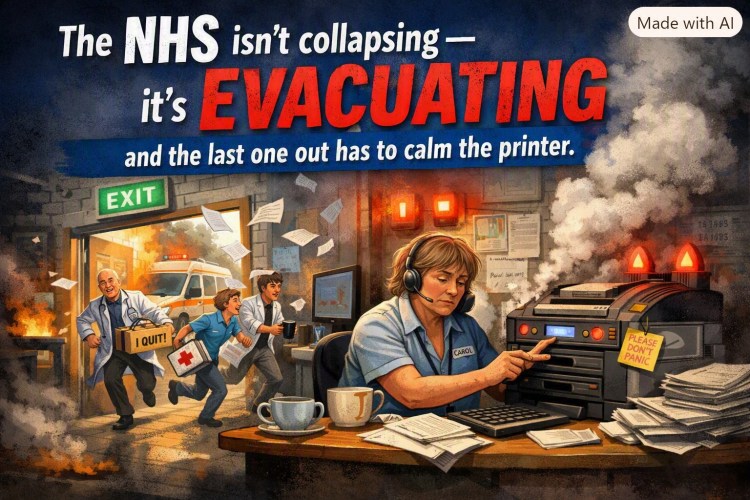
Six in ten GPs now admit they can’t give patients the care they deserve at least once a week, which is exactly what happens when doctors like Dr Tamara Keith are pulling 12‑hour shifts without lunch, holding the NHS together with sheer willpower, ibuprofen, and a receptionist called Carol who’s basically running a war zone.
She’s a GP partner in Bottisham, Cambridgeshire, and the workload is now so apocalyptic that doctors aren’t just swamped — they’re basically starring in a low‑budget disaster film where the NHS plays the collapsing building, the government provides the special effects (none), and the only functioning piece of equipment is Carol on reception, who’s now technically classed as critical infrastructure.
And a major new poll from the General Medical Council shows she’s far from alone — apparently 60% of GPs are now struggling to provide sufficient care every week, which is basically the medical equivalent of the fire brigade announcing they’re down to one hose and a bucket. Doctors call it “moral injury,” which is the polite term for “I’m trying to practise medicine with the resources of a school lost‑property cupboard and the emotional stability of someone who’s been awake since 2007.”
Much of the frustration comes from the government’s shiny new plan to end the dreaded 8 am scramble — surgeries in England must now stay open to online requests all day, which sounds great until you realise it basically means GPs are now running a 24‑hour digital complaint portal while still trying to treat actual humans with nothing but a biro, a dying laptop, and Carol on reception who’s one password reset away from staging a coup.
But practices aren’t endlessly staffed, which means doctors are now triaging an avalanche of online requests with roughly the same number of appointment slots as a village fête fortune‑teller. The Royal College of GPs says there are about 2,300 patients per full‑time GP — a 13% rise in a decade — which is basically the NHS announcing, “We’ve doubled the queue but kept the same number of chairs, good luck everyone.”
Unmanageable workloads are already driving senior GPs into early retirement — not because they fancy a quiet life, but because the NHS has essentially become an escape room with no clues and no exit. Now nearly a quarter of all doctors say they’re considering walking away permanently, which is the medical equivalent of the pilot standing up mid‑flight and saying, “Right, I’ve had enough, someone else land it.”
With senior GPs retiring early and a quarter of doctors ready to quit, the NHS isn’t just in trouble — it’s staging a full‑scale evacuation while the last poor sod left has to switch off the lights, calm the printer, and pretend Britain still works.

