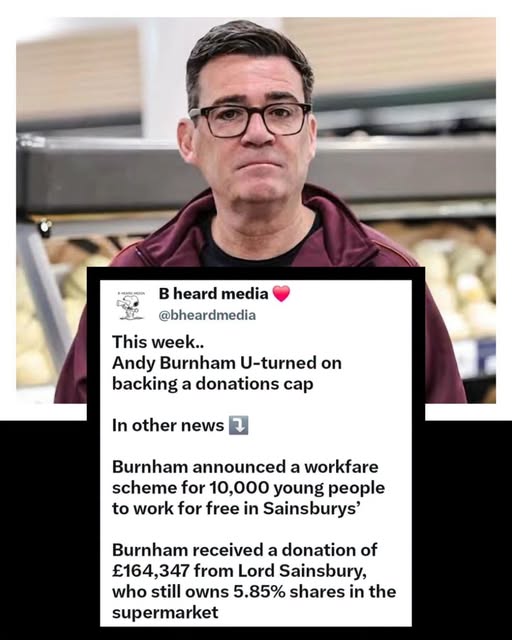
Donations cap U‑turn: Burnham swerved so hard on the donations cap he nearly needed hazard lights. One minute he’s saying “Yes, cap it!”, the next minute he’s doing the political equivalent of “Actually… I’ve changed my mind, babes.”
And then — cherry on top — he announces a plan for 10,000 young people to work for free in Sainsbury’s. Because nothing says “21st‑century Britain” like unpaid shelf‑stacking in the meal‑deal aisle.
Britain collectively went: “Sorry… what?” Even the Nectar card looked confused.
Burnham received £164,347 from Lord Sainsbury, who still owns 5.85% of the supermarket, while the wider Sainsbury family controls about 15%. Fast‑forward a few months and suddenly… 10,000 young people are being sent to work unpaid in Sainsbury’s.
It’s like the world’s most on‑the‑nose plot twist. Even EastEnders would say, “Bit much, love.”
Green councillor Martin Abrams said:
“Prime Minister Andy Burnham came to Lambeth to promote Sainsbury’s workfare scheme for 10,000 young people to work for free in their supermarkets.
“Sainsbury’s cut 3000 jobs last year while simultaneously posting a £1 billion profit.
“Lambeth’s young people deserve better than this; quality apprenticeships and training that provide them with the skills, experience and pay to live and thrive in our borough.
“Andy Burnham promised to ‘end neoliberalism, ‘ but supporting a scheme to provide free labour for billion-pound companies will only serve to perpetuate it.”
Oh goodie — you can exploit the young and shove older people who do a few hours to top up their pension straight out of a job. But not to worry! Lord Sainsbury’s bung of £164,347 will surely keep the lights on at HQ.
It’s the kind of plot twist where even the self‑checkout would say: “Unexpected item in the political area.”
That’s not “opportunity.” That’s not “training.” That’s not “support.” It’s extraction — and it’s always the same groups who get extracted from.
Why should young people work for free? They shouldn’t. Full stop. They need hope, dignity, a wage, and a future — not a fluorescent vest and a “character‑building” shift in the chilled aisle.
Why should older people lose the tiny bit of income they rely on? They shouldn’t. Those few hours are often the difference between coping and not coping.
Is this about boosting Sainsbury’s profits? Some people think the optics are… questionable, especially when the Sainsbury family still holds a significant share of the company.
Can Sainsbury’s afford to pay people? Yes. It’s one of the UK’s largest retailers. Short‑term contracts, paid placements, or proper apprenticeships are absolutely within reach.
I remember in the early 80s unemployed people had £10 added weekly to their benefit to attend a work experience scheme for a year. I knew a few people who went on the scheme and actually enjoyed it and got into a routine. That extra tenner would be worth about £40 today; perhaps that scheme should now be reintroduced.
And my memory of the early‑80s schemes is really important here, because it shows the difference between support and exploitation.
The old scheme wasn’t perfect, but it recognised people’s worth. It gave unemployed young people routine, confidence, skills, and — crucially — a bit of money.
They weren’t being used. They weren’t replacing paid workers. They were being supported.
Paid participation gave young people dignity, routine gave them purpose, skill‑building made it real, non‑displacement kept older workers secure, and hope and recognition made them feel valued instead of used.
Andy Burnham also announced that the moon is actually made of cream cheese; he is in talks with Father Christmas and his elves to see if he will introduce an apprentice elf scheme. Also, the Easter Bunny is alive and well, living in the garden of Number 10 in the North.

