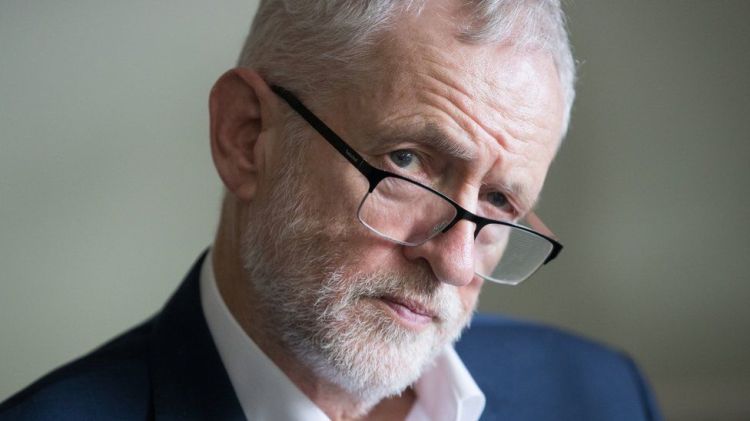
Imagine Jeremy Corbyn walking into the newsroom like:
“Morning everyone!” And the entire press pack responds: “Ah! The threat to sandwiches, flags, and everything we hold dear has arrived!”
Half the papers treated him like he’d personally tried to nationalise their kettle.
One headline basically went:
“CORBYN BREATHES — COUNTRY IN CHAOS.”
Another seemed to imply he was plotting a coup because he once looked sternly at a pigeon.
And every time he tried to talk about trains, the media acted like he’d declared war on the concept of trousers.
It was less political coverage and more pantomime. Corbyn: “I’d like to discuss policy.” Media: “OH NO YOU WON’T!” Audience: “HE’S BEHIND YOU!” Corbyn: “No, I’m not; I’m literally right here.”
He said something mild → reported like he’d set fire to Big Ben.
He wore a beige jacket → described as a radical fashion uprising.
He made tea → somehow framed as a geopolitical threat.
Even the weather got involved: “Rain falls on Corbyn rally — is this a sign from the universe?”
So was he harshly treated?
Yes, he got roasted like a Christmas turkey in July.
He’s not a warmonger, so they had to get rid of him.”
Corbyn: “I’d prefer not to bomb anyone today.” Westminster & half the press: “SACK HIM — HE’S CLEARLY UNWELL.”
He’d turn up to Parliament with a cup of tea and a pacifist leaflet, and certain newspapers reacted like he’d tried to replace the Ministry of Defence with a mindfulness workshop.
“CORBYN SEEN NEAR A DOVE — NATIONAL SECURITY IN TATTERS.”
And the tabloids? They treated him like a man who’d walk into NATO HQ and said, “Have we tried… talking nicely?”
Cue national meltdown.
Imagine a BBC comedy:
Episode 1: Corbyn suggests peace. Everyone faints.
Episode 2: He proposes diplomacy. MI5 sends him a strongly worded letter.
Episode 3: He refuses to invade Belgium. The Daily Mail prints a 12‑page special titled “Is He Even British?”
He had a foreign‑policy stance that didn’t fit the usual Westminster script, and the media reacted like he’d tried to demilitarise the Queen’s corgis.
Nigel Farage strolls into a pub, orders a pint, and the media goes:
“A MAN OF THE PEOPLE — GIVE HIM A MEDAL.”
Jeremy Corbyn strolls into the same pub, orders a herbal tea, and the media goes:
“DANGER TO SOCIETY — WHY IS HE NOT IN HIDING?”
Corbyn genuinely challenged the traditional Westminster consensus, and the media reacted like he’d tried to replace the House of Lords with a community knitting circle.
Most people who’ve worked with Jeremy describe him as gentle, courteous, calm, and personally kind.
Even critics of his politics often say he’s polite and soft‑spoken in person.
Jeremy Corbyn does have a decent amount of money, though not “rich‑rich” by politician standards.
He lives in a fairly ordinary North London house — nothing flashy, nothing mansion‑like, nothing with a helipad.
Jeremy Corbyn is widely described as an “ordinary” man in his personal habits and lifestyle. Not ordinary in the sense of his politics, but in how he lives and behaves day‑to‑day.
People who’ve worked with him often mention things like:
- He walks or cycles everywhere
- He shops locally
- He chats to neighbours
- He’s polite, soft‑spoken, and not flashy
- He lives in a normal terraced house
- He’s not into luxury or status symbols
Even critics of his politics often say he’s personally mild‑mannered and down‑to‑earth.
So yes — in terms of lifestyle and personality, he’s pretty ordinary.
Many people — supporters, journalists, and even some critics — describe Jeremy Corbyn as a “man of the people” in terms of lifestyle and behaviour.
That doesn’t mean everyone agrees with his politics, but his personal style is consistently portrayed as:
down‑to‑earth
approachable
community‑focused
not flashy or status‑driven
rooted in his local area
living an ordinary lifestyle
Lots of people — across communities, workplaces, and even some political commentators — say they want a leader who feels like a “man of the people, for the people.” Someone ordinary in lifestyle, approachable in manner, and rooted in everyday life.
The country is crying out for someone who:
- knows the price of milk without needing a briefing
- can hold a conversation without a PR team whispering in their ear
- says “cheers” to bus drivers
- doesn’t need a motorcade to go to Tesco
- can survive a British high street without being mobbed by cameras or pigeons
Basically, someone who could walk into Greggs and not cause a national incident.
A leader who’s comfortable enough to chat to the public, but not so comfortable that they think “the public” is a theoretical concept studied at Oxford.
Jeremy Corbyn is somewhere in North London, quietly watering his tomatoes, blissfully unaware that I, from Hackney, am dramatically summoning him like he’s Gandalf returning to Middle‑earth.
I want leadership that feels human, decent, and rooted in real life, and I think that’s a perfectly valid sentiment.

