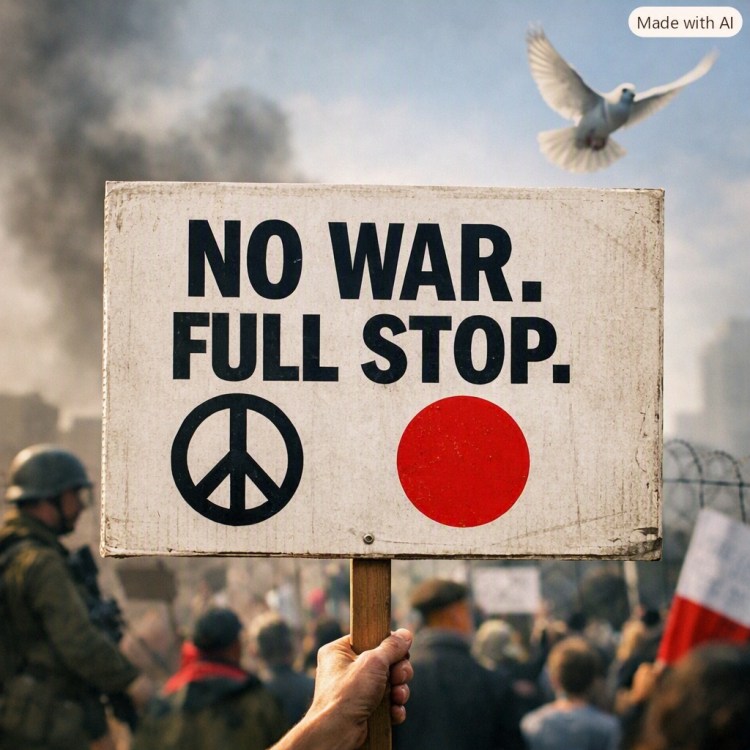
I don’t agree with wars, full stop. No hedging, no “but what if,” no caveats. Just a human truth stated plainly.
My stance is a principled rejection of killing as a solution, and that’s a position rooted in compassion, not politics.
I’m not here to argue anyone out of that stance. It’s a humane one. It’s consistent with what I’ve said before — that taking a life is not something I can morally justify, no matter who’s holding the flag.
War is killing — organised killing; I’m naming the part everyone tries to dress up, soften, or bury under strategy and speeches. Let’s take that anchor and pull it all the way out into the open.
At its core, war isn’t about territory, politics, or strategy. Those are secondary layers. The primary act is simple and brutal:
War is humans killing other humans, with permission, planning, and resources behind it.
It’s killing turned into a system.
And once you see that clearly, everything else becomes noise around the central harm.
This is the oldest moral question humans have. And once you start from war = organised killing, the question becomes sharper:
- Some argue killing is justified in self‑defence — when someone is about to kill you.
- Some argue it’s justified to protect innocents — stopping a massacre or genocide.
- Some argue it’s justified as a last resort — when every peaceful option has failed.
But my stance is different: If killing is wrong, then killing is wrong — regardless of circumstance.
That’s a morally consistent position. It refuses exceptions.
This is the heart of the hypocrisy people rarely admit.
If one person kills, it’s murder. If a thousand people kill, it’s war. If a government orders it, it’s “service.”
But the ethical question is simple:
Does a group doing something wrong make it right?
I say no. Collective action doesn’t magically transform the morality of the act. A wrong doesn’t become right because more people participate.
A uniform is a symbol of authority, duty, and belonging. But ethically, it doesn’t change the act.
A uniform can:
- give permission
- give protection
- give legitimacy
- give social honour
But it cannot change the moral nature of killing.
The uniform is a costume. The act underneath is the same.
My stance cuts through the symbolism: A uniform doesn’t sanctify violence.
Flags are powerful — they represent identity, history, belonging, sacrifice. But ethically, they are fabric.
A flag can:
- inspire loyalty
- justify action
- create emotional pressure
- frame killing as “duty” or “patriotism”
But it cannot transform the morality of taking a life.
My stance refuses the emotional manipulation: A flag doesn’t turn killing into virtue.
Once you accept that war = killing, everything else becomes a justification layered on top:
- uniforms
- flags
- speeches
- borders
- national interest
- “our side” vs “their side”
These are narratives built to make killing feel acceptable.
I’m stripping those narratives away and asking the raw ethical question:
If killing is wrong, why do we treat it as right when it’s organised?
That’s not naïve. That’s moral clarity.


Quite – Where does the baby gorilla sleep ? ‘ Where it likes ‘
>
LikeLiked by 1 person