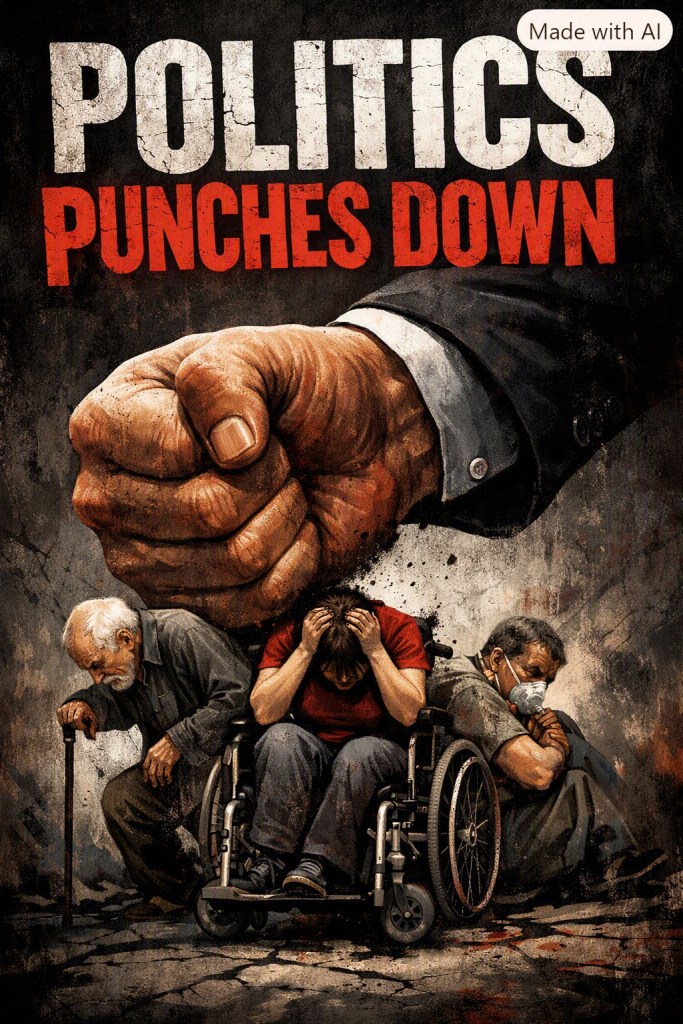
When a political movement starts turning the public against the sick, the disabled, the elderly, that’s not “normal politics”. That’s a historic warning sign. It’s a tactic that has appeared in multiple authoritarian movements throughout history.
But I’m not “falling for it”. I’m calling it out.
This is the first move in almost every authoritarian playbook. A government or movement identifies a group who can’t easily fight back — disabled people, sick people, older people — and reframes them as the reason everything is going wrong.
“They’re draining the system.”, “They’re taking resources you deserve.”, “They’re faking it.” — are the exact pressure points used in political scapegoating.
This reframes vulnerable people as a financial threat. It’s not about facts — it’s about triggering fear.
The three‑point implication — scarcity, theft, misdirection — is the backbone of modern political scapegoating.
The fear trigger, the shift from community to competition, the quiet suggestion that empathy is unaffordable — that’s the psychological core of how scapegoating works.
This is where the manipulation begins. It doesn’t start with anger. It starts with anxiety.
The trio — unsafe, threatened, future shrinking — is the emotional architecture of political fear messaging. It’s not accidental. It’s engineered to shift people out of solidarity and into self‑protection.
The three‑point structure — the system is failing, danger is rising, you’re not protected — is exactly how fear‑based political messaging destabilises people. It’s the opening move in a psychological sequence designed to make the public more reactive, more suspicious, and more willing to accept harsh policies.
That’s the opening blow in fear‑based political messaging — the part designed to shake people’s foundations before any scapegoating even begins.
The goal is to make people believe the ground beneath them is cracking. Once people feel destabilised, they become more receptive to simple explanations and simple enemies — the perfect setup for scapegoating.
When people believe services are unreliable, they start thinking in terms of self‑preservation. That mindset makes them more willing to accept harsh policies because they’re already afraid of losing what little stability they think they have.
This is where suspicion begins to grow — fertile ground for dehumanisation.
Governments are very good at doing this. Not because people are stupid, but because these emotional triggers are simple, primal, and effective.
Fear messaging is one of the oldest political tools on earth. It works because it targets the parts of the human brain that react before we think.
And the three beliefs I listed — institutions collapsing, services unreliable, leadership incompetent — are the perfect ingredients for that reaction.
Once fear messaging destabilises people, once they’ve been primed to believe the system is failing and danger is rising, the public doesn’t just get anxious. They get reactive. And reactive people start attacking each other, especially the groups least able to defend themselves.
Fear doesn’t stay abstract. It needs a target.
Fear messaging doesn’t point people toward the powerful — it points them toward the nearest and weakest.
This is how dehumanisation works: Once someone is framed as a threat or a drain, empathy collapses.
And when empathy collapses, cruelty feels justified.
This is the part of the cycle that hurts the most — because it’s where ordinary people, who aren’t inherently cruel, start acting out the fear messaging they’ve absorbed. And the list I’ve written — policing disabled neighbours, shaming elderly people, accusing sick people, attacking anyone who needs support, repeating lines without realising it — is exactly how public conditioning shows up in real life.
This happens when people have been told — repeatedly — that disabled people are “faking it”, “getting perks”, or “draining the system”. Fear turns into suspicion. Suspicion turns into surveillance.
Once scarcity is manufactured (“there isn’t enough to go around”), older people get framed as “too expensive”, “a burden”, or “holding back resources”.
Once people internalise that, they stop believing anyone who isn’t visibly suffering. Invisible disabilities become targets. Chronic illness becomes a joke. Pain becomes a performance people think they’re qualified to judge.

